Spinal Decompression Cost San Diego: What Patients Should Know Before Starting Care
Free phone consultation with our San Diego functional neurology team. No obligation.
Many people searching for spinal decompression cost San Diego want two answers. How much could treatment cost, and is it worth it for their condition? Price matters, but it should be weighed alongside the exam, diagnosis, treatment plan, and expected goals.
At San Diego Chiropractic Neurology, non-surgical spinal decompression is viewed as one possible tool within conservative care. It is not a one-size-fits-all option. For some patients with disc-related low back pain, sciatica, or nerve irritation, decompression may fit the plan. For others, a different strategy may be more appropriate.
Patients in San Diego often find vague or confusing pricing online. Some pages promote treatment without giving useful cost context. Others mix up non-surgical spinal decompression therapy with surgical decompression. These are different interventions with different risks, indications, and cost structures. Patients should consult a qualified provider before starting care. Recommendations should be based on symptoms, exam findings, health history, and imaging when appropriate.
What is non-surgical spinal decompression?
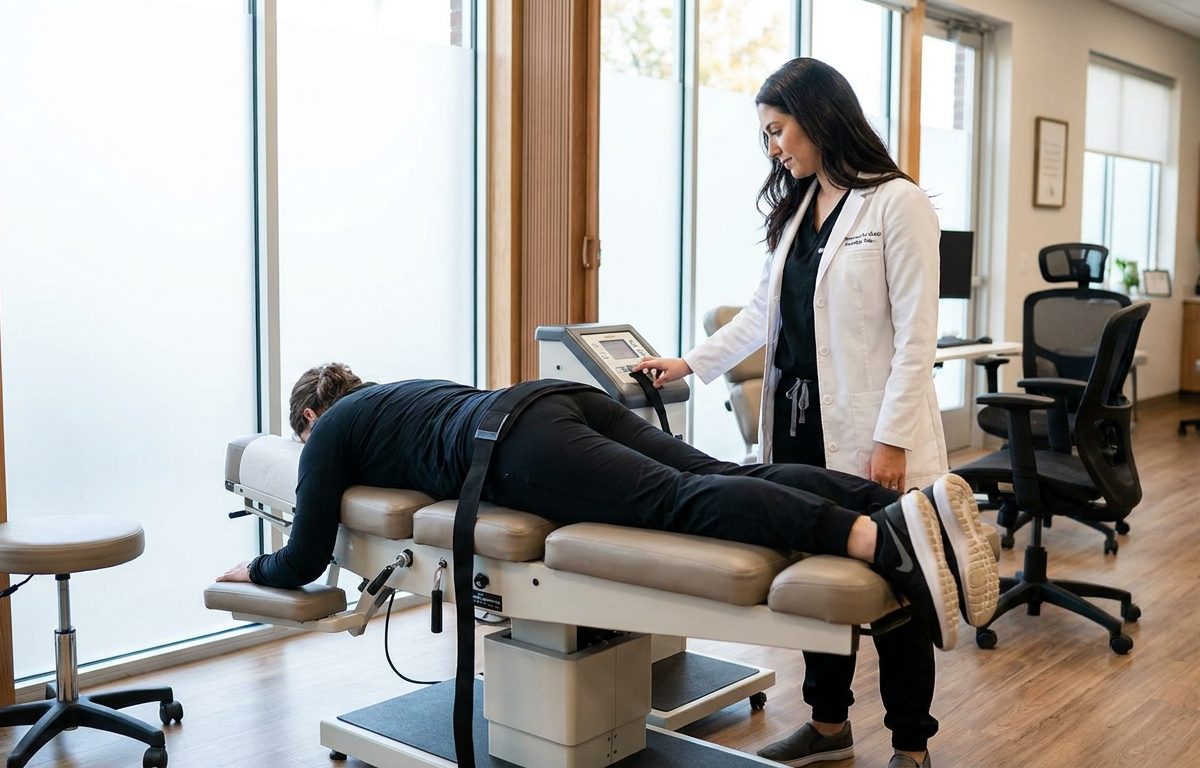
Non-surgical spinal decompression is a form of motorized traction. It is designed to reduce pressure across selected spinal segments in a controlled way. It is often discussed for lumbar disc problems, radiating leg pain, and some cases of chronic low back pain.
This is different from spinal decompression surgery. Surgical decompression is an operation used for specific structural problems, such as severe stenosis or progressive neurologic loss. Non-surgical decompression is office-based conservative care. These treatments should not be compared as if they are interchangeable .
For disc-related symptoms, decompression may be paired with rehabilitation, mobility work, and condition-specific management. That matters because current research on low back pain supports active, function-oriented care rather than relying on passive treatment alone .
How much does spinal decompression cost in San Diego?
There is no single citywide price for spinal decompression therapy. In San Diego, cost usually depends on:
- Whether there is a separate new-patient consultation and exam
- Whether prior imaging must be reviewed or new imaging is recommended
- The number of sessions suggested
- Whether treatment is priced per visit or sold as a package
- Whether rehab or supportive therapies are included
- How complex the case is
Patients often see two common pricing models:
- Per-session pricing, where each visit is billed individually
- Package pricing, where a course of care is quoted in advance
Online price comparisons can be misleading. One clinic may quote a lower session price but exclude the exam, progress checks, or rehab. Another may quote a higher total fee because the plan includes reassessments and active rehabilitation. A better question is not only, “What is the cheapest spinal decompression therapy cost?” It is also, “What is included, and why is it recommended for me?”
Patients should also be cautious with branded marketing terms such as “DRX9000 San Diego.” A table name alone does not determine outcome. Candidacy, clinical reasoning, and the full treatment plan matter more.
Why spinal decompression prices vary
1. The initial workup
A thorough workup takes time. A clinic should review symptom history, aggravating factors, imaging when available, neurologic findings, and movement patterns. The exam should also look for signs that point toward or away from decompression. That affects both price and clinical decision-making.
2. Session count and treatment frequency
Some patients are quoted a short course. Others are shown a larger package. The number of visits often depends on symptom duration, severity, irritability, and the working diagnosis.
3. Whether rehab is included
One major factor in spinal decompression cost San Diego is whether rehab is included. Some clinics offer decompression as a stand-alone passive therapy. Others use it as one part of a broader conservative program. Research on low back pain supports active, nonpharmacologic, function-oriented care .
4. The diagnosis being addressed
Disc herniation, sciatica, chronic low back pain, and lumbar stenosis are not the same problem. A patient with classic lumbar radiculopathy may fit the traction evidence better than someone with another pain pattern. In stenosis, patient selection is especially important .
5. Geographic and practice-model differences
San Diego-area pricing may differ from national cost articles. Local overhead, staffing, visit length, and treatment model can all affect the final quote.
Is spinal decompression worth the cost?
That depends on the diagnosis, the treatment plan, and the patient’s goals. For selected patients with lumbar radiculopathy, mechanical traction may help in the short term. Some studies suggest improvements in pain and disability when traction is added to physical therapy. However, evidence quality is limited, and outcomes vary .
Current peer-reviewed evidence does not support broad claims that decompression heals every disc problem. It also does not prove that decompression prevents surgery for everyone. The strongest evidence suggests possible short-term benefit in selected patients, especially those with lumbar radicular symptoms .
Before deciding whether a plan is worth the cost, patients should consult a qualified provider and ask:
- Was there a meaningful exam before recommendations were made?
- Does the diagnosis fit the type of case that may respond?
- Are progress markers being tracked?
- Is care paired with an active strategy to improve function?
- Is the patient told when decompression may not be the right option?
Value depends on fit, transparency, evidence, and measurable goals. Lower price does not always mean better value, and higher price does not automatically mean better care.
Who may be a candidate for non-surgical spinal decompression?
Non-surgical spinal decompression may be considered for patients with:
- Low back pain with suspected disc involvement
- Radiating leg pain consistent with sciatica
- Symptoms that worsen with spinal loading and improve with unloading
- Clinical findings suggesting lumbar radiculopathy
- Persistent symptoms that have not improved enough with simpler conservative care
Not every person with back or leg pain is a strong candidate. In some cases, another conservative strategy, medical evaluation, or surgical evaluation may be more appropriate. Patients should consult a qualified provider before purchasing a treatment package.
Patients dealing with related conditions can review the clinic’s resources on sciatica, herniated disc, and back pain.
What should be included before paying for a package?
Before agreeing to a plan, patients should ask for clear answers about:
- The diagnosis and why decompression is being recommended
- What signs would make decompression a poor fit
- Whether the quoted price includes the exam, imaging review, progress checks, and rehab
- How many sessions are proposed and why
- How progress will be measured
- When the plan would change if improvement is limited
This matters because current traction evidence points more toward short-term symptom improvement than certainty about long-term resolution . Patients deserve realistic counseling, not sales language.
Insurance coverage and out-of-pocket costs
Many patients ask whether insurance covers non-surgical spinal decompression San Diego clinics provide. Coverage varies by plan and service. Some plans may not cover decompression as a distinct service. Others may cover portions of the visit, depending on coding and what care is performed.
Patients should confirm benefits directly with the clinic and their insurer. They should not assume coverage based on a website or a general article. When coverage is limited, clinics may use cash pricing, package plans, or hybrid approaches.
Why a root-cause approach matters more than table branding
Many marketing pages focus on equipment names or dramatic claims. A more useful approach asks what is driving the patient’s symptoms. Is the problem mainly disc-related? Is there clear nerve-root irritation? Are movement or stability issues involved? Those questions matter more than whether a machine sounds impressive in an ad.
Patients exploring non-surgical spinal decompression should expect clear clinical reasoning before starting care.
How to compare spinal decompression providers in San Diego
If a patient is comparing providers across San Diego, these questions can help:
- Does the clinic explain the difference between non-surgical and surgical decompression?
- Are costs presented clearly, including what is and is not included?
- Is there a meaningful exam before a package is recommended?
- Are claims backed by current peer-reviewed evidence?
- Is decompression combined with a function-oriented strategy when appropriate?
Those questions usually reveal more than a headline price alone. The most useful plan is one that fits the diagnosis and sets realistic expectations.
When decompression may not be the right next step
There are times when another path may be more appropriate. Examples include progressive neurologic loss, certain structural findings, or symptoms that do not match a traction-responsive pattern. In lumbar spinal stenosis, guideline-based care may involve multimodal conservative management and careful patient selection .
Online searches can also be confusing. Some pages ranking for decompression terms are actually about surgery for stenosis or other operations. Those topics belong to a different evidence base .
FAQ: Spinal decompression cost in San Diego
How much does spinal decompression cost in San Diego?
Cost varies by clinic. It usually depends on the exam, imaging review, treatment frequency, session count, and whether rehab is included. Some clinics price care per visit, while others use package pricing.
Is spinal decompression usually priced per session or as a package?
Both are common. Some clinics charge per session, while others recommend a bundled care plan. Patients should ask for a detailed breakdown of what is included before starting.
Does insurance cover non-surgical spinal decompression therapy?
Insurance coverage is variable. Some plans may not cover decompression as a distinct service. Others may cover parts of a visit, depending on coding and services performed. Patients should verify benefits directly.
Who is a good candidate for spinal decompression for sciatica or disc pain?
Patients with disc-related low back pain, lumbar radiculopathy, or sciatica may be considered. A proper examination is important because not every back-pain patient is a strong candidate.
What is the difference between non-surgical spinal decompression and spinal decompression surgery?
Non-surgical decompression is conservative office-based traction treatment. Surgical decompression is an operation used for specific structural indications. They are not the same treatment and have different risks, goals, and price structures.
Take the next step with a clearer framework
If someone is researching spinal decompression cost San Diego, the goal should be a clear clinical answer. Does the treatment match the diagnosis? What does the plan include? What benefits are realistic? What would change the recommendation?
For selected patients, decompression may be a useful part of conservative care. It should be recommended carefully and explained honestly. To learn more about related conditions, patients can review the clinic’s resources on spinal stenosis and degenerative disc issues and the FAQs page.
To discuss whether non-surgical spinal decompression may be appropriate, call (619) 344-0111 or book a consultation with San Diego Chiropractic Neurology.
References
- Vanti C, et al. Effectiveness of Mechanical Traction for Lumbar Radiculopathy: A Systematic Review and Meta-Analysis. Phys Ther. 2021. PMID: 33382419.
- Vanti C, et al. The effects of the addition of mechanical traction to physical therapy on low back pain? A systematic review with meta-analysis. Acta Orthop Traumatol Turc. 2023. PMID: 36939359.
- George SZ, et al. Interventions for the Management of Acute and Chronic Low Back Pain: Revision 2021. J Orthop Sports Phys Ther. 2021. PMID: 34719942.
- Bussières A, et al. Non-Surgical Interventions for Lumbar Spinal Stenosis Leading To Neurogenic Claudication: A Clinical Practice Guideline. J Pain. 2021. PMID: 33857615.
- Vanti C, et al. Vertical traction for lumbar radiculopathy: a systematic review. Arch Physiother. 2021. PMID: 33715638.
- Gadjradj PS, et al. Decompression alone versus decompression with fusion in patients with lumbar spinal stenosis with degenerative spondylolisthesis: a systematic review and meta-analysis. Eur Spine J. 2023. PMID: 36609887.
Medical disclaimer: This article is for educational purposes only. It is not medical advice. Diagnosis and treatment should be based on a professional evaluation. Patients should consult a qualified provider for recommendations based on their history, symptoms, imaging when appropriate, and clinical findings.
Not sure what is driving your symptoms?
Talk with our Functional Neurology Trained team on a free phone consultation. We will tell you honestly whether we can help.