Understanding Your Vestibular System
Your vestibular system is your body's internal GPS. Located deep within the inner ear, it consists of three semicircular canals filled with fluid and two otolith organs (the utricle and saccule). Together, these structures detect every head movement—rotation, tilting, and linear acceleration—and send that information to your brain in real time.
Your brain integrates these signals with input from your eyes (visual system) and your muscles and joints (proprioceptive system) to maintain balance, stabilize your vision during movement, and keep you oriented in space. When any part of this triad is disrupted—whether by injury, infection, displaced inner ear crystals that cause BPPV, or neurological dysfunction—the result is dizziness, vertigo, imbalance, and a cascade of secondary symptoms like nausea, anxiety, and brain fog.
Vestibular therapy works by systematically retraining each component of this balance triad, helping your brain compensate for vestibular damage and rebuild stable, confident movement.
Signs You May Need Vestibular Therapy
If you're experiencing any of the following symptoms, your vestibular system may not be functioning properly.
- Dizziness or lightheadedness that comes and goes
- Room-spinning vertigo triggered by head movements
- Feeling unsteady or off-balance when walking
- Nausea or motion sickness during normal activities
- Difficulty focusing your eyes during head movement
- Feeling disoriented in busy visual environments (stores, crowds)
- Frequent stumbling or near-falls
- Brain fog or difficulty concentrating after head movement
Vestibular Conditions We Treat
Our vestibular rehabilitation program addresses a wide range of inner ear and balance disorders.
Benign Paroxysmal Positional Vertigo (BPPV)
The most common cause of vertigo, BPPV occurs when tiny calcium crystals (otoconia) become dislodged in the inner ear. Vestibular therapy includes repositioning maneuvers like the Epley and Semont techniques that guide these crystals back to their proper location, often resolving symptoms in just 1 to 3 sessions.
Post-Concussion Vestibular Dysfunction
Concussions frequently disrupt the vestibular system, causing persistent dizziness and balance problems. Our vestibular rehabilitation program uses graded exposure exercises to progressively retrain the brain's ability to process balance signals, helping concussion patients recover stability they thought was permanently lost.
Vestibular Neuritis & Labyrinthitis
Inflammation of the vestibular nerve or inner ear structures causes sudden, severe vertigo. Vestibular therapy promotes compensation—the brain's ability to adapt and rely on alternative balance inputs—accelerating recovery and reducing the duration of debilitating symptoms.
Ménière's Disease
This chronic condition causes episodes of vertigo, hearing loss, and tinnitus. While vestibular therapy cannot cure Ménière's, it significantly improves balance confidence between episodes, reduces fall risk, and helps the brain adapt to fluctuating vestibular function.
Persistent Postural-Perceptual Dizziness (PPPD)
A functional vestibular disorder causing chronic non-spinning dizziness and unsteadiness. Vestibular therapy combined with cognitive-behavioral strategies helps desensitize the brain's overactive threat response and gradually restore normal balance processing.
Our 5-Step Vestibular Rehabilitation Program
A personalized approach that systematically retrains your balance system for lasting stability.
Comprehensive Vestibular Assessment
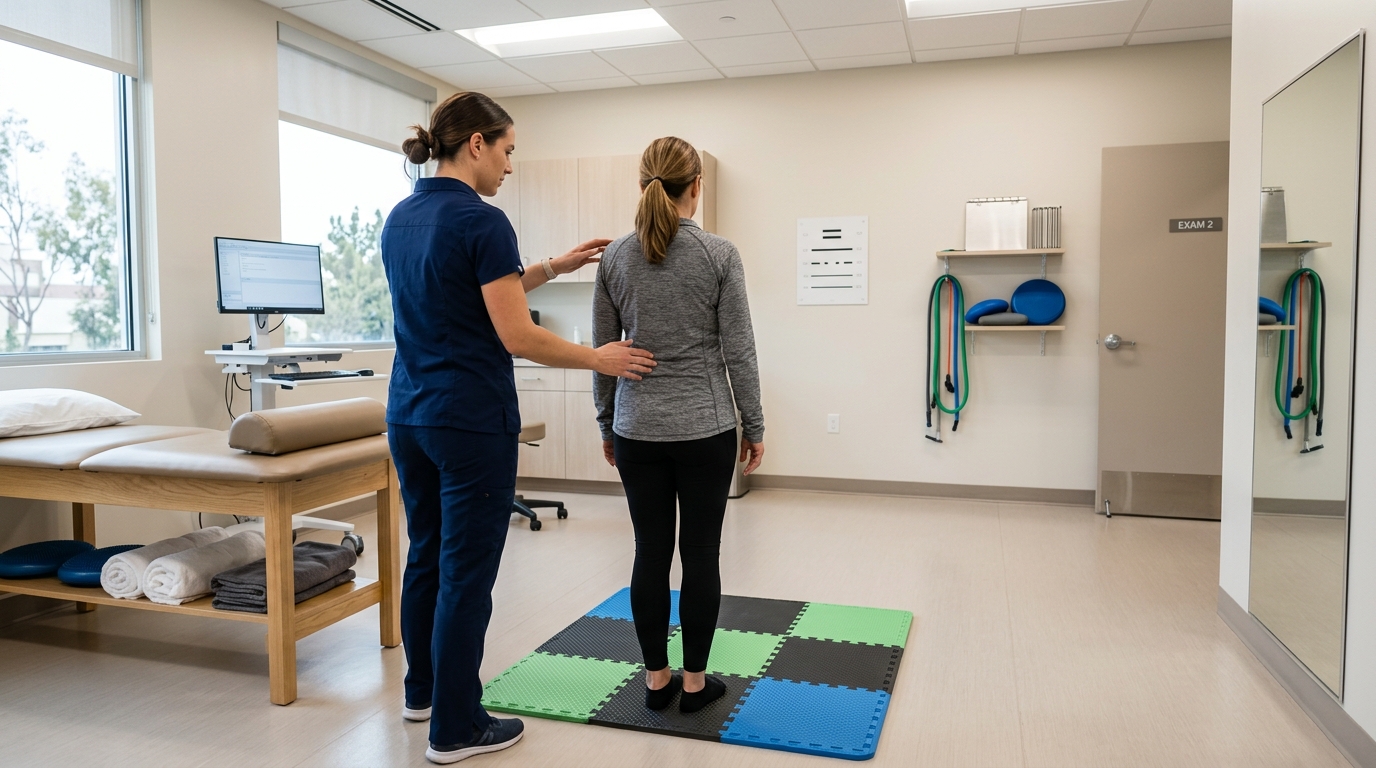
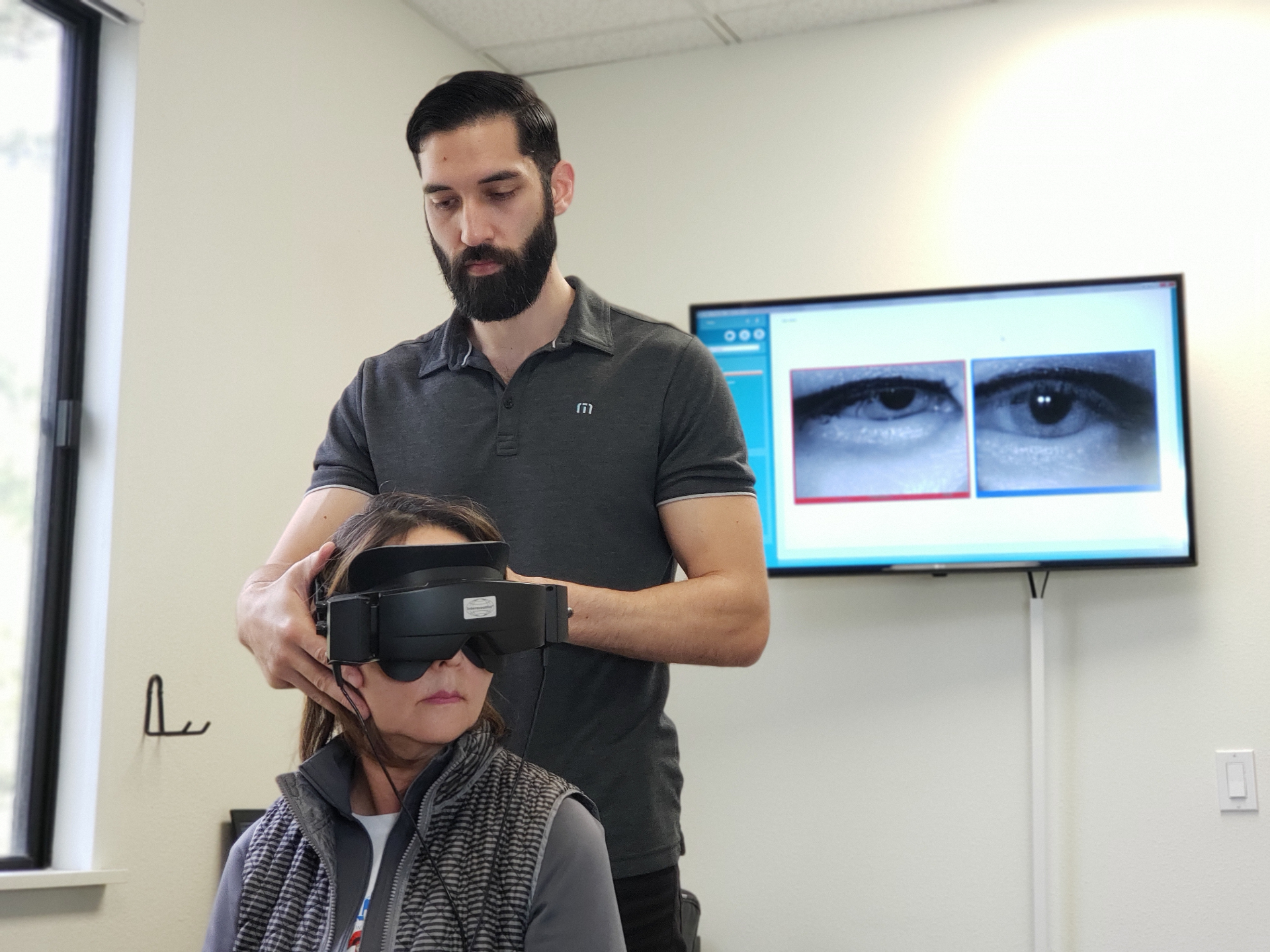
Detailed testing of eye movements (VOR, saccades, smooth pursuit), balance (Romberg, tandem stance), positional testing (Dix-Hallpike), and functional mobility to identify exactly which parts of your vestibular system are affected.
Canalith Repositioning (if BPPV)
If displaced crystals are identified, we perform the appropriate repositioning maneuver (Epley, Semont, or BBQ roll) to guide the crystals out of the affected semicircular canal immediately.
Gaze Stabilization Exercises
Targeted exercises that train your eyes to stay focused during head movement, rebuilding the vestibulo-ocular reflex (VOR) that keeps your visual world stable as you move through daily life.
Balance & Habituation Training
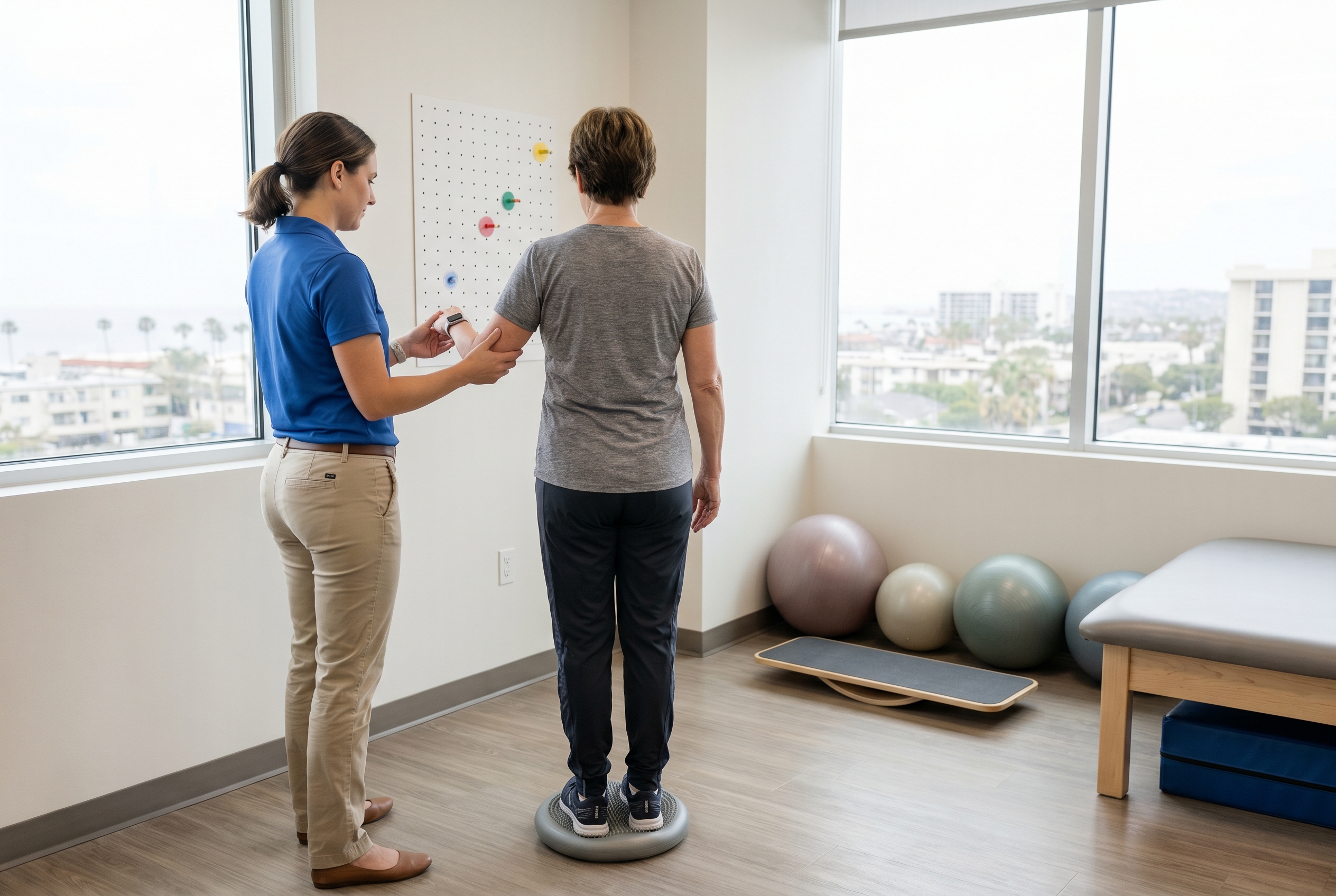
Progressive balance challenges on various surfaces combined with repeated exposure to movements that trigger symptoms—gradually desensitizing your vestibular system and rebuilding confidence in your stability.
Functional Integration & Home Program
Real-world movement training that applies your improved vestibular function to daily activities, plus a customized home exercise program to maintain gains and continue progress between sessions.
Home Exercises to Support Your Recovery
Consistency between sessions is crucial for vestibular recovery. Your brain needs regular, repeated exposure to the exercises we prescribe in order to build new neural pathways for balance. Here are general principles that support your rehabilitation:
Gaze stabilization practice. Hold a target (like a business card with a letter on it) at arm's length and move your head side to side while keeping the letter in focus. Start with slow movements and gradually increase speed as your control improves. Perform for 1 to 2 minutes, 3 times daily.
Standing balance progression. Practice standing with feet together, then tandem (heel-to-toe), then single-leg stance—first with eyes open, then eyes closed. Always practice near a wall or counter for safety. Hold each position for 30 seconds, building to 60 seconds.
Habituation movements. If specific head movements trigger mild dizziness, practice those movements gently and repeatedly. Over time, your brain learns to process these movements without triggering symptoms. Stop if symptoms become severe, but mild provocation is expected and therapeutic.
How Your Vestibular Therapy Plan Is Built
No two vestibular plans look the same, because the exercises are selected from the examination findings rather than from a standard handout. A patient whose testing shows a gaze stability deficit needs a different progression than a patient whose testing points to sensory reweighting, visual dependence, or a cervical contribution.
Your first appointment is an assessment rather than a treatment session. We take the symptom history, run oculomotor and positional testing, look at balance and gait under different sensory conditions, and screen the upper cervical spine. From those findings we explain what we believe is driving the dizziness, what the plan involves, and roughly how often you would need to be seen.
Sessions typically pair in-office retraining with a short home program, because repetition between visits is what drives the adaptation. We reassess at defined checkpoints and change the plan when the retest data says the current approach is not producing measurable change. Where the visual or cognitive systems are also involved, care can be coordinated with neuro-visual rehabilitation.
How This Differs From General Physical Therapy
General physical therapy for balance tends to focus on strength, mobility, and fall prevention, and for many patients that is genuinely appropriate. Vestibular rehabilitation targets a different system: the reflex pathways that keep vision stable during head movement and the brain circuits that weigh inner ear, visual, and joint position signals against each other.
The practical difference shows up in the testing. Oculomotor examination, positional testing, and sensory-conflict balance testing are what reveal whether the problem sits in the inner ear, in central processing, or in the neck. Without those findings, dizziness exercises are generic by necessity.
Our clinicians are trained in functional neurology, so the vestibular, visual, cervical, and autonomic contributors are examined together rather than referred out one at a time. If your dizziness is driven mainly by the neck, that is treated as cervicogenic dizziness; if it is driven by an inner ear or central vestibular pattern, it is treated as vertigo.
When Medical or ENT Care Should Come First
Vestibular therapy is not the right starting point for every dizzy patient. Seek emergency care right away if dizziness appears with sudden severe headache, double vision, slurred speech, facial droop, one-sided weakness or numbness, or an inability to walk.
See a physician or ENT first when dizziness comes with new hearing loss, ear pain or drainage, fever, or fainting, and when a recent medication change may be responsible. Those presentations need a medical workup before rehabilitation is appropriate.
We screen for these patterns at the consultation and refer out when the findings call for it. Working alongside your ENT, neurologist, or primary care physician is a routine part of how vestibular care is delivered here.
Vestibular Therapy Across San Diego County
Our clinic is located at 5230 Carroll Canyon Rd, Suite 218 in the Sorrento Valley and Carroll Canyon area, with freeway access from the I-5, I-805, and SR-56. Patients travel to us from La Jolla, University City, Mira Mesa, Poway, Rancho Bernardo, Del Mar, Encinitas, Kearny Mesa, Mission Valley, La Mesa, El Cajon, and Chula Vista.
No referral is needed to be evaluated, and our office verifies insurance benefits before care begins. The next step is a free consultation: call (619) 344-0111 or book online, describe what you are experiencing, and we will tell you whether a full vestibular assessment is the right next step for your situation.
Why Choose San Diego Chiropractic Neurology for Vestibular Therapy?
Neurological Expertise
Functional Neurology Trained clinicians
Comprehensive Testing
Full vestibular assessment on day one
Drug-Free Approach
Rehabilitation over medication
Fast Results
Many patients improve in 1-3 sessions
Whole-Brain Care
Vestibular + visual + cognitive integration
Vestibular Therapy FAQs
Common questions about vestibular rehabilitation therapy in San Diego.
Related Conditions
Vertigo
Vestibular therapy is the gold-standard treatment for vertigo, addressing the root cause of spinning sensations.
Learn about VertigoCervicogenic Dizziness
Vestibular retraining is combined with upper cervical care when the neck is driving the dizziness.
Learn about Cervicogenic DizzinessVertigo & Balance Disorders
Ongoing imbalance and fall risk after the spinning stops, when the brain has not fully compensated.
Learn about Vertigo & Balance DisordersConcussion
Post-concussion dizziness and balance problems respond exceptionally well to vestibular rehabilitation.
Learn about ConcussionPOTS
Orthostatic dizziness and balance issues in POTS patients benefit from tailored vestibular and autonomic therapy.
Learn about POTSTreatments That May Help
Neuro-Visual Rehabilitation
The vestibular and visual systems are deeply linked—combining both therapies produces the best outcomes.
View serviceCognitive Therapy
Brain fog and concentration difficulties often accompany vestibular dysfunction and improve with cognitive rehab.
View serviceVagus Nerve Therapy
Vagus nerve stimulation helps regulate the autonomic component of vestibular-related nausea and anxiety.
View service