Sciatica vs Piriformis Syndrome
Free phone consultation with our San Diego functional neurology team. No obligation.
Many people use the word sciatica for any pain that runs from the buttock down the leg. That is common, but it is not precise. Sciatica is a symptom pattern. It is not one single diagnosis. Piriformis syndrome is one possible cause of that pattern, but it is not the only one.
This distinction matters because the next step depends on where the irritation is coming from. In some people, the source is the low back. A lumbar disc or irritated nerve root may be involved. In others, the problem may sit deeper in the buttock around the piriformis and nearby tissues. Some patients have features of both.
For the functional neurology team at San Diego Chiropractic Neurology, the goal is not to force every case into one label. The goal is to find the main driver of symptoms, look for red flags, and decide whether the pattern fits a lumbar source, a deep gluteal source, or a mixed picture.
That can be important for people in San Diego who flare up after long drives, desk work, hiking, cycling, gym training, or pickleball. Pain that starts in the back may behave differently from pain that starts deep in the buttock. The location of the pain is only one clue. The full history and exam matter more.
Sciatica Is a Symptom Pattern. Piriformis Syndrome Is One Possible Cause.
When comparing sciatica vs piriformis syndrome, it helps to define the terms first.
Sciatica usually means radiating pain that follows the sciatic nerve pathway. It often relates to irritation of a lumbar or sacral nerve root. Lumbar disc herniation is one common cause, but spinal stenosis and other spine problems can also play a role.
Piriformis syndrome usually means irritation of the sciatic nerve in the deep gluteal area, near the piriformis muscle. Current research often places it under the broader term deep gluteal syndrome. That term refers to non-disc-related sciatic nerve entrapment outside the spine.
So piriformis syndrome vs sciatica is not really two separate symptom groups. Sciatica describes what the pain does. Piriformis syndrome describes one place the irritation may be happening. That is why symptom checklists alone can be misleading.
Why This Is Hard to Self-Diagnose
Patients with leg pain do not all fit the same pattern. Two people may both say, "I have pain down my leg," while the real cause is very different. One may have a lumbar nerve root problem. Another may have a deep gluteal entrapment. Another may have referred pain from the hip or other nearby tissues.
This is what clinicians mean when they say these cases are heterogeneous. In plain terms, the same symptom can come from different sources. That is why the answer is often not as simple as sciatica or piriformis syndrome.
Radiculopathy can also add confusion. Patients usually hear this word and assume it means any leg pain from the back. More precisely, lumbar radiculopathy suggests the nerve root is irritated enough to cause symptoms such as numbness, tingling, weakness, reflex changes, or pain along a nerve pattern. Some people with leg pain have these findings. Others do not.
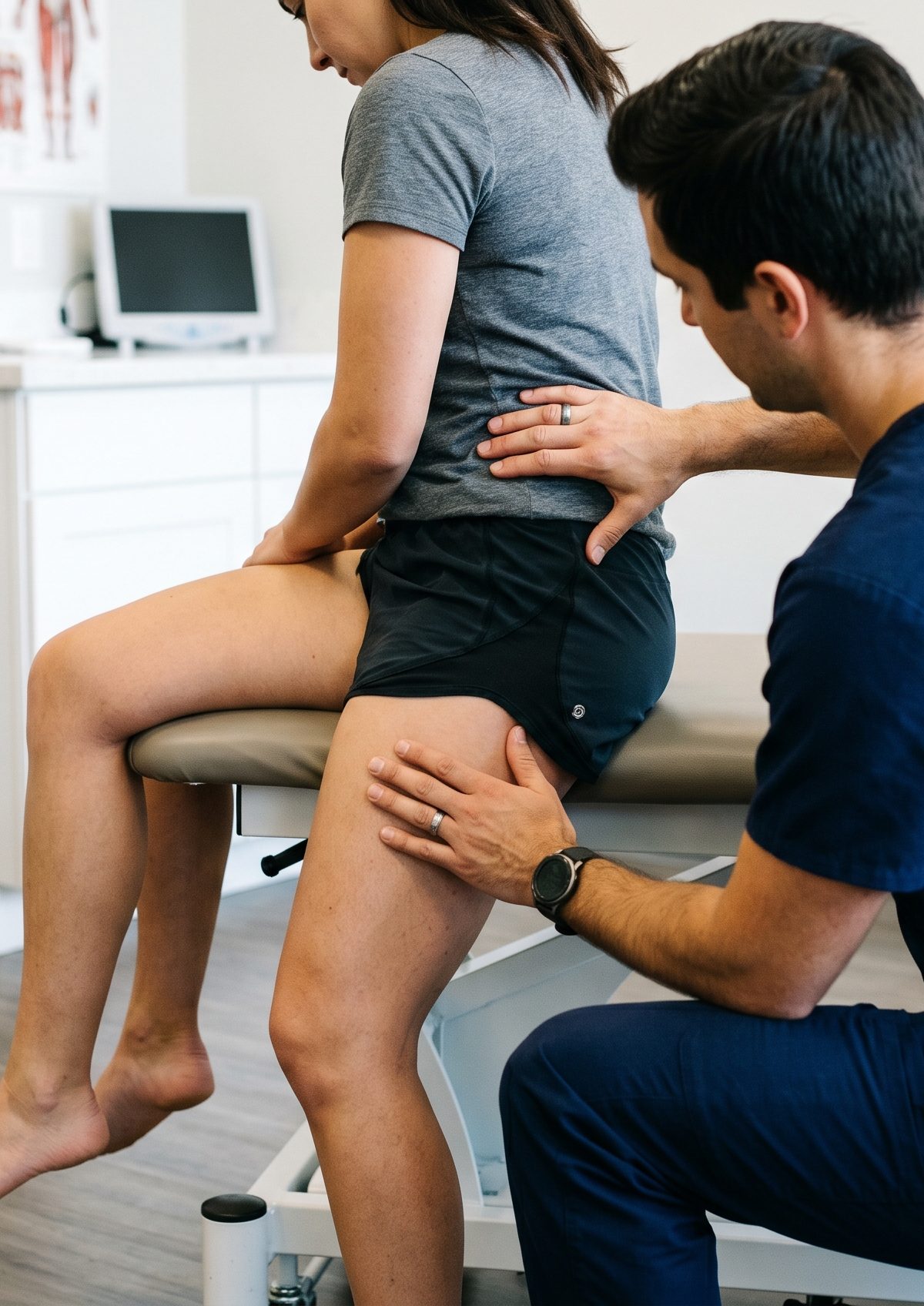
A good exam helps sort that out. The clinic looks at symptom behavior, neurologic findings, lumbar loading, hip motion, gluteal tenderness, and movement patterns together. No single test gives the full answer.
Symptoms That Often Point More Toward Lumbar Sciatica
Some features make a lumbar source more likely.
Common clues include:
Low back pain with leg pain. The episode often starts in the low back, then moves into the buttock, thigh, calf, or foot.
Pain with bending or spinal loading. Lifting, bending, coughing, or sneezing may increase symptoms.
Numbness or tingling in a nerve pattern. Symptoms may follow a more defined path into part of the leg or foot.
Weakness or reflex changes. These findings raise concern for nerve-root involvement and can change how quickly imaging or referral is considered.
Positive neural tension signs. The straight leg raise test may support suspicion of lumbar radicular pain, but it is not perfect on its own.
When this pattern is present, the question becomes whether the pain behaves like disc-related sciatica, stenosis-related nerve irritation, or another lumbar problem. Patients who want more background can review the clinic’s pages on sciatica and herniated disc.
Symptoms That Often Point More Toward Piriformis Syndrome
If the main question is how to tell if leg pain is sciatica or piriformis syndrome, the pain pattern can offer useful clues.
Common clues include:
Buttock-dominant pain. The pain often feels deepest in the gluteal region, then may travel down the back of the leg.
Pain with sitting. Long drives, desk work, flights, or sitting on a hard chair may make symptoms worse.
Tenderness in the deep gluteal area. Pressure near the sciatic notch or nearby buttock tissues may reproduce symptoms.
Pain with hip movement or piriformis loading. Certain hip positions, stretching, or muscle contraction may trigger familiar pain.
Less obvious low back pain. Some patients have strong buttock and leg symptoms without much lumbar pain.
Even with those clues, piriformis syndrome is not a simple yes-or-no diagnosis. There is no single test that confirms it in every patient. In many cases, it is an exclusionary diagnosis. That means the clinician also has to ask what else could explain the pain, including lumbar disc problems, hip disorders, or other extraspinal causes.
Deep Gluteal Syndrome vs Sciatica: What Patients Should Know
The phrase deep gluteal syndrome vs sciatica can be confusing. Deep gluteal syndrome is not the opposite of sciatica. It is one possible reason someone has sciatica-like symptoms. The nerve can be irritated outside the spine by structures in the deep buttock, not just by a disc or nerve root in the low back.
This matters because people often assume that if the pain goes down the leg, the low back must be the only cause. That is not always true. At the same time, buttock pain does not automatically mean piriformis syndrome either. The exam still has to separate spinal from extra-spinal sources.
Can You Have Both at the Same Time?
Yes. Some patients have a mixed-mechanism pattern. In plain terms, more than one problem may be adding to the pain.
For example, a person may start with a lumbar flare, then change how they sit, walk, bend, or train. That compensation can increase tension and sensitivity in the deep gluteal area. Another person may already have buttock irritation, then develop a lumbar issue on top of it. The result can feel like one large problem even though more than one pain generator is involved.
This is one reason online symptom sorting often fails. If someone asks whether the pain is from a herniated disc or piriformis syndrome, the honest answer can be that both regions need attention. The exam should identify the main driver, not just the loudest symptom.
What a Good Evaluation Should Include
A useful workup does more than confirm that the pain goes down the leg. It should help answer where the irritation is most likely coming from and whether urgent referral is needed.
A thorough evaluation may include:
A detailed history. Onset, lifting injury, sitting tolerance, sports, driving time, prior episodes, and symptom spread all matter.
Neurologic screening. Strength, reflexes, sensation, gait, and balance help show whether a nerve root may be involved.
Lumbar testing. The exam checks whether bending, extension, or other spinal loading changes symptoms.
Hip and gluteal testing. Hip rotation, gluteal palpation, seated tolerance, and local provocation may point toward a deep gluteal source.
Neural tension testing. Straight leg raise findings can help, but they should be interpreted within the bigger picture.
Movement analysis. Walking, sit-to-stand, bending, and single-leg loading may show patterns that table tests miss.
This kind of whole-patient approach fits the clinic’s root-cause model. Instead of focusing only on the pain location, the team looks at how the spine, nerves, movement system, and daily activities interact.
When Imaging Is Helpful
Many patients ask when to get imaging for sciatica vs piriformis syndrome. The short answer is that not every case needs early MRI.
Guideline-based care usually reserves imaging for cases with red flags, severe or progressive neurologic findings, or symptoms that are not improving as expected when imaging would change management. That means the decision should be based on the full clinical picture, not fear or curiosity alone.
If a lumbar cause is strongly suspected and the findings are significant, imaging may help clarify the next step. If piriformis syndrome is suspected, imaging often serves a different purpose. It may help rule out other causes rather than prove piriformis syndrome itself. That is because piriformis syndrome is usually a clinical diagnosis supported by the pattern of symptoms and the exclusion of better explanations.
Patients dealing with ongoing back-related leg pain may also want context from the clinic’s pages on spinal stenosis and degenerative disc changes and back pain.
Red Flags That Need Urgent Medical Attention
Most radiating leg pain is not an emergency, but some patterns should not wait.
Urgent medical evaluation is important if symptoms include:
Progressive weakness. Trouble lifting the foot or pushing off the toes can signal a more serious neurologic problem.
Loss of bowel or bladder control. This needs immediate medical attention.
Saddle numbness. Numbness in the inner thigh or groin region is a major red flag.
Major trauma, fever, unexplained weight loss, or cancer history. These features raise concern for causes that need a different workup.
Rapidly worsening pain with neurologic change. Waiting it out is not appropriate in that setting.
Why Special Tests and Internet Checklists Fall Short
Patients often want a quick way to label the problem at home. That is understandable. But special tests and symptom charts have limits.
A straight leg raise can be helpful, but it is not perfectly reliable for suspected lumbar radicular pain. Piriformis provocation tests can also add clues, but they do not settle the diagnosis by themselves. The same patient may have overlapping findings from the back, hip, and deep gluteal region.
That is why the clinic does not treat one positive test as a final answer. The safer approach is to ask which pattern fits best, which red flags are present, and whether the symptoms match the exam findings.
How the Team Frames Conservative Care
When the presentation fits conservative management, the functional neurology team at San Diego Chiropractic Neurology focuses on the likely pain generator, symptom triggers, and movement patterns that may be keeping the problem active. The goal is to build a plan that fits the exam findings rather than using the same protocol for everyone.
Depending on the case, that may include activity modification, targeted rehabilitation, spinal or movement-based care, and referral when imaging or specialist input is more appropriate. Patients may also discuss whether services such as chiropractic care or non-surgical spinal decompression fit the overall picture. These options are not right for every patient, and treatment decisions should follow the evaluation.
When to Schedule an Evaluation
If leg pain is new, keeps coming back, limits activity, or does not improve the way you expected, a more complete assessment may help. That is especially true when sitting has become difficult, buttock pain is severe, or the symptoms no longer look like a simple strain.
For people in San Diego, La Jolla, Torrey Pines, Carmel Valley, and the 92121 area, the clinic can assess whether the pattern fits lumbar sciatica, piriformis-related irritation, or another mimic. To discuss whether an evaluation is appropriate, call (619) 344-0111 or book a consultation with San Diego Chiropractic Neurology.
Frequently Asked Questions
Is piriformis syndrome the same as sciatica?
No. Sciatica is a symptom pattern of radiating leg pain. Piriformis syndrome is one possible deep gluteal cause of sciatica-like symptoms.
What symptoms suggest piriformis syndrome more than a herniated disc?
Buttock-dominant pain, pain with prolonged sitting, local tenderness in the deep gluteal area, and pain with piriformis loading may raise suspicion. A full exam is still needed.
Can both lumbar sciatica and piriformis-related irritation happen together?
Yes. Some patients have mixed presentations, with both lumbar and deep gluteal factors contributing to symptoms.
When should leg pain that feels like sciatica get an MRI?
MRI is more likely to help when red flags are present, neurologic deficits are progressive, symptoms are not improving, or the results would change management.
References
- Liu C, Ferreira GE, Abdel Shaheed C, et al. Surgical versus non-surgical treatment for sciatica: systematic review and meta-analysis of randomised controlled trials. BMJ. 2023;381:e070730. https://pubmed.ncbi.nlm.nih.gov/37076169/
- Lo JK, Finnoff JT, Smith J. Piriformis syndrome. Handb Clin Neurol. 2024;201:203-226. https://pubmed.ncbi.nlm.nih.gov/38697742/
- Kizaki K, Uchida S, Shanmugaraj A, et al. Deep gluteal syndrome is defined as a non-discogenic sciatic nerve disorder with entrapment in the deep gluteal space: a systematic review. Knee Surg Sports Traumatol Arthrosc. 2020;28(10):3354-3364. https://pubmed.ncbi.nlm.nih.gov/32246173/
- Hopayian K, Danielyan A. Four symptoms define the piriformis syndrome: an updated systematic review of its clinical features. Eur J Orthop Surg Traumatol. 2018;28(2):155-164. https://pubmed.ncbi.nlm.nih.gov/28836092/
- Hopayian K, Mirzaei M, Shamsi M, Arab-Zozani M. A systematic review of conservative and surgical treatments for deep gluteal syndrome. J Bodyw Mov Ther. 2023;36:244-250. https://pubmed.ncbi.nlm.nih.gov/37949567/
- Nee RJ, Ellis RF, Dilley A, et al. Reliability of the straight leg raise test for suspected lumbar radicular pain: A systematic review with meta-analysis. Musculoskelet Sci Pract. 2022;59:102529. https://pubmed.ncbi.nlm.nih.gov/35245880/
- Stynes S, Konstantinou K, Dunn KM. Classification of patients with low back-related leg pain: a systematic review. BMC Musculoskelet Disord. 2016;17:226. https://pubmed.ncbi.nlm.nih.gov/27215590/
- Aldera M, Alturkistany A, Al Rayes H, et al. Saudi Clinical Practice Guideline for the Assessment and Management of Low Back Pain and Sciatica in Adults. J Clin Med. 2026;15(2):528. https://pubmed.ncbi.nlm.nih.gov/41598467/
- Vaishya S, Pojskic M, Bedi MS, et al. Cauda equina, conus medullaris and syndromes mimicking sciatic pain: WFNS spine committee recommendations. World Neurosurg X. 2024;22:100274. https://pubmed.ncbi.nlm.nih.gov/38496349/
Medical disclaimer: This article is for educational purposes only and does not provide a medical diagnosis or personal treatment advice. Symptoms such as progressive weakness, bowel or bladder changes, saddle numbness, severe trauma, fever, or other concerning neurologic changes require prompt medical evaluation. Any rehabilitation or conservative care plan should be based on an in-person assessment and the clinical judgment of the treating provider.
Not sure what is driving your symptoms?
Talk with our Functional Neurology Trained team on a free phone consultation. We will tell you honestly whether we can help.