Sciatica Stretches Not Working? What That Usually Means
Free phone consultation with our San Diego functional neurology team. No obligation.
TL;DR: If sciatica stretches give you a few minutes of relief and then the leg pain returns, the issue is almost never flexibility. It usually means a nerve root is being loaded by something structural, and some common stretches actively aggravate that situation.
San Diego Chiropractic Neurology offers a free consultation to review what you have already tried and whether a detailed exam makes sense.
Call (619) 344-0111 or request a free consult.
Stretching is the first thing almost everyone tries for sciatica. It makes intuitive sense. The leg feels tight, the hip feels locked up, so lengthening the tissue should help. For a subset of people it does. For a large number of others, the relief lasts minutes and the pain comes right back, sometimes worse than before.
That outcome is information, not failure. Sciatica stretches not working tells you something specific about what is driving your symptoms.
Why stretching helps some people and not others
Sciatica is a symptom pattern, not a diagnosis. Several different problems produce pain along the sciatic nerve pathway, and they respond to stretching very differently.
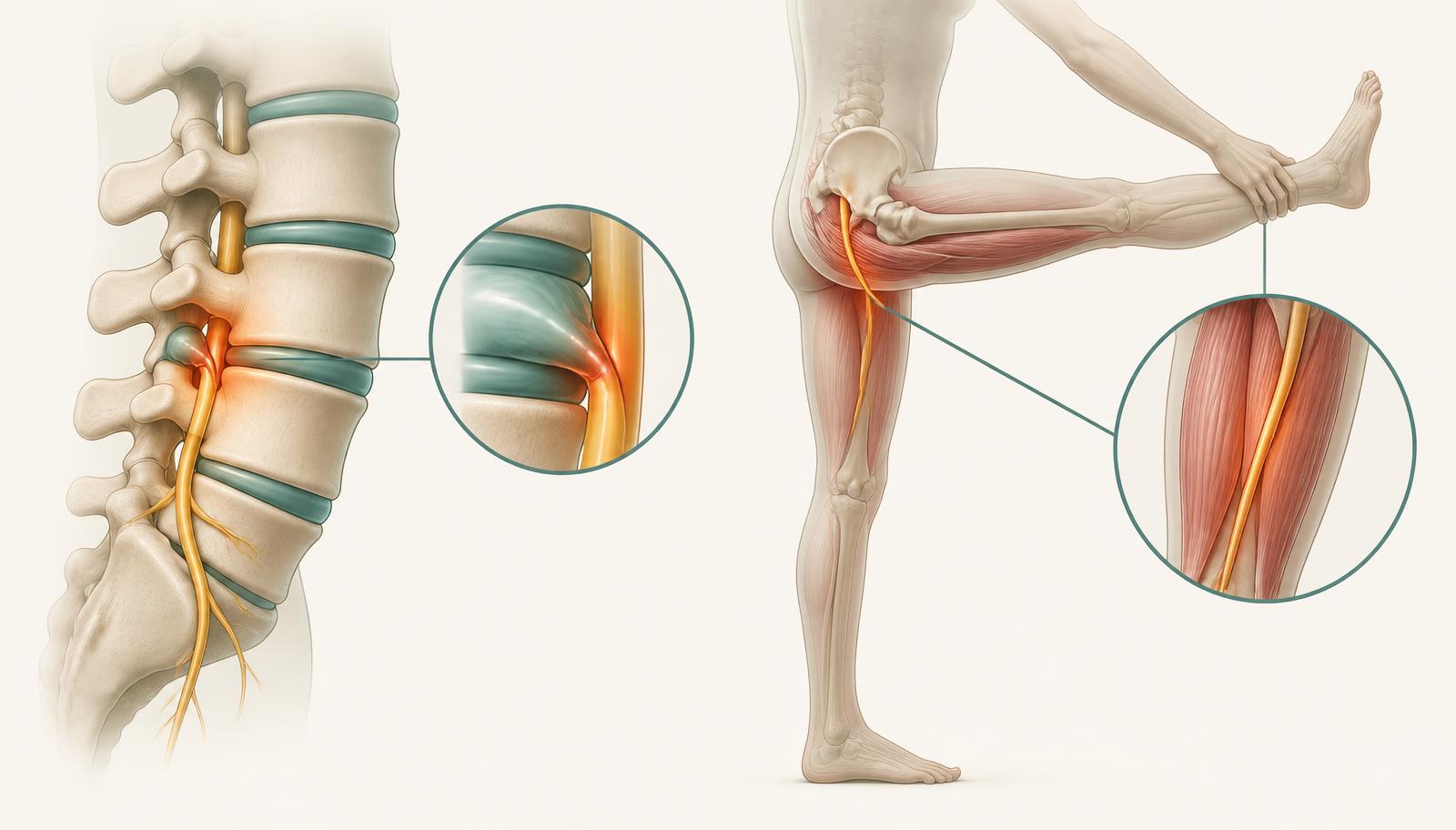
When symptoms come from muscular tension or a genuinely restricted hip, gentle lengthening can reduce the irritation and the improvement holds. When symptoms come from a lumbar disc pressing on or chemically irritating a nerve root, the picture changes. The nerve is already under tension and mechanically sensitive. Pulling on it does not release anything. It briefly changes the sensation, then the underlying load returns the moment you stand back up.
This is why the same routine that helped a friend can leave you no better. You may not have the same problem.
Stretches that commonly make disc-driven sciatica worse
Without prescribing anything, it is worth understanding the categories that tend to aggravate a nerve root case, because these are exactly the movements most commonly recommended online.
Deep forward bending. Toe touches, seated hamstring stretches, and forward folds place the lumbar spine in flexion. For a disc-sensitive back, sustained flexion increases pressure toward the posterior disc and can push symptoms further down the leg. If your pain is worse after sitting, worse getting out of the car, and worse when you cough, forward bending is usually the wrong direction.
Aggressive nerve tensioning. Movements that deliberately pull the sciatic nerve to end range can sensitize an already irritated nerve rather than desensitize it. Amount and dosage matter enormously here, and the line between helpful and provocative is narrow.
Forceful hip stretching held to the point of reproduction. Stretching into the exact symptom is often interpreted as productive. With nerve involvement it frequently is not.
There is a practical rule worth knowing: if a movement makes symptoms travel further down the leg, that is a signal to stop, even if it feels like a good stretch in the moment. Symptoms retreating toward the spine is the direction you want.
The gap: a generic routine for an unidentified problem
Most people arrive at their stretching routine the same way. A search result, a video, or a handout from a previous provider. None of those know which structure is irritating your nerve, which positions provoke it, or whether your case is disc related, stenosis related, or something else entirely.
General physical therapy often runs into the same issue when the program is built around strengthening and mobility without first establishing the pain driver. The exercises are not wrong in themselves. They are being applied to a problem nobody has actually characterized. That is why so many patients describe months of consistent effort with a symptom pattern that has not really changed.
Stretching that is not working is a diagnostic clue that gets thrown away. It usually means the problem sits above the muscle you are stretching.
What to look at instead
A useful evaluation answers a few concrete questions. Which specific positions and loads reproduce your leg symptoms, and which relieve them. Whether symptoms centralize toward the spine or peripheralize down the limb in response to particular movements. Whether reflexes, strength, and sensation show involvement along a specific nerve root distribution. Whether the presentation actually fits a disc pattern, a stenosis pattern, a piriformis pattern, or a joint driven pattern that mimics sciatica.
Those answers determine what should be loaded, what should be unloaded, and in which direction. In disc related cases with nerve involvement, care often centers on reducing the load on the affected nerve root rather than adding tension to it, which is close to the opposite of what a stretching routine does. San Diego Chiropractic Neurology approaches these cases through non-surgical sciatica treatment, and where a herniated or bulging disc is the driver, through non-surgical spinal decompression built around the specific structure producing symptoms.
If you are also wondering whether this will simply pass with time, the companion question is covered here: how long sciatica actually lasts and what changes the timeline.
When stretching is worth abandoning
Consider a proper evaluation if any of the following describe your case:
- Relief from stretching lasts only minutes.
- Symptoms have been present longer than six to eight weeks.
- Pain travels below the knee into the calf or foot.
- You notice numbness, tingling, or weakness rather than pain alone.
- The same flare keeps returning several times a year.
Progressive weakness, saddle numbness, or changes in bowel or bladder control need prompt medical attention rather than any conservative approach.
The point is not that stretching is bad. It is that a stretch cannot fix a mechanical problem it is not addressing, and continuing it for months delays the exam that would actually clarify the case.
Frequently asked questions about stretching and sciatica
Why do sciatica stretches only help for a few minutes?
Short lived relief usually means the symptom source is a nerve root being loaded by a structure in the lumbar spine rather than a tight muscle. Stretching temporarily changes sensation and blood flow, but the moment you return to standing or sitting, the original load on the nerve returns and so does the pain.
Can stretching make sciatica worse?
Yes. Deep forward bending, aggressive nerve tensioning movements, and hip stretches held into the exact symptom can aggravate a disc driven case. If a movement makes symptoms travel further down the leg, that is a signal to stop even when the stretch feels productive.
Which stretches should I avoid with a herniated disc?
Rather than a fixed list, the useful rule is directional. Movements that place the lumbar spine in sustained flexion, such as toe touches and seated hamstring stretches, commonly provoke disc related nerve pain. The right and wrong directions differ by case, which is why an exam that identifies your provoking positions matters more than any generic routine.
How do I know if my sciatica is from a disc or a muscle?
Disc related cases often worsen with sitting, coughing, sneezing, and forward bending, and may involve numbness, tingling, or weakness below the knee. Muscular cases tend to respond durably to gentle lengthening. A clinical exam that tests movement response, reflexes, strength, and sensation separates the two reliably.
What works better than stretching for nerve root sciatica?
Care that reduces load on the affected nerve root, rather than adding tension to it, tends to work better in disc related cases. That may include non-surgical spinal decompression and a plan built around the specific positions that provoke and relieve your symptoms.
San Diego Chiropractic Neurology offers a free consultation to review what you have already tried and determine whether a detailed exam makes sense. Call (619) 344-0111 to set up a time.
Not sure what is driving your symptoms?
Talk with our Functional Neurology Trained team on a free phone consultation. We will tell you honestly whether we can help.