How Long Does Sciatica Last? What the Timeline Depends On
Free phone consultation with our San Diego functional neurology team. No obligation.
TL;DR: Many cases of sciatica settle down over several weeks, but the honest answer is that the timeline depends on what is irritating the nerve. Pain that keeps returning, travels below the knee, or lasts past a couple of months usually points to a structural driver that needs a proper exam rather than more waiting.
San Diego Chiropractic Neurology offers a free consultation to review your leg pain history and decide whether a detailed exam is warranted.
Call (619) 344-0111 or request a free consult.
People search how long does sciatica last for a simple reason. The pain is disruptive, the advice online is contradictory, and nobody wants to keep rearranging their life around a symptom that may or may not resolve on its own. The useful answer is not a single number.
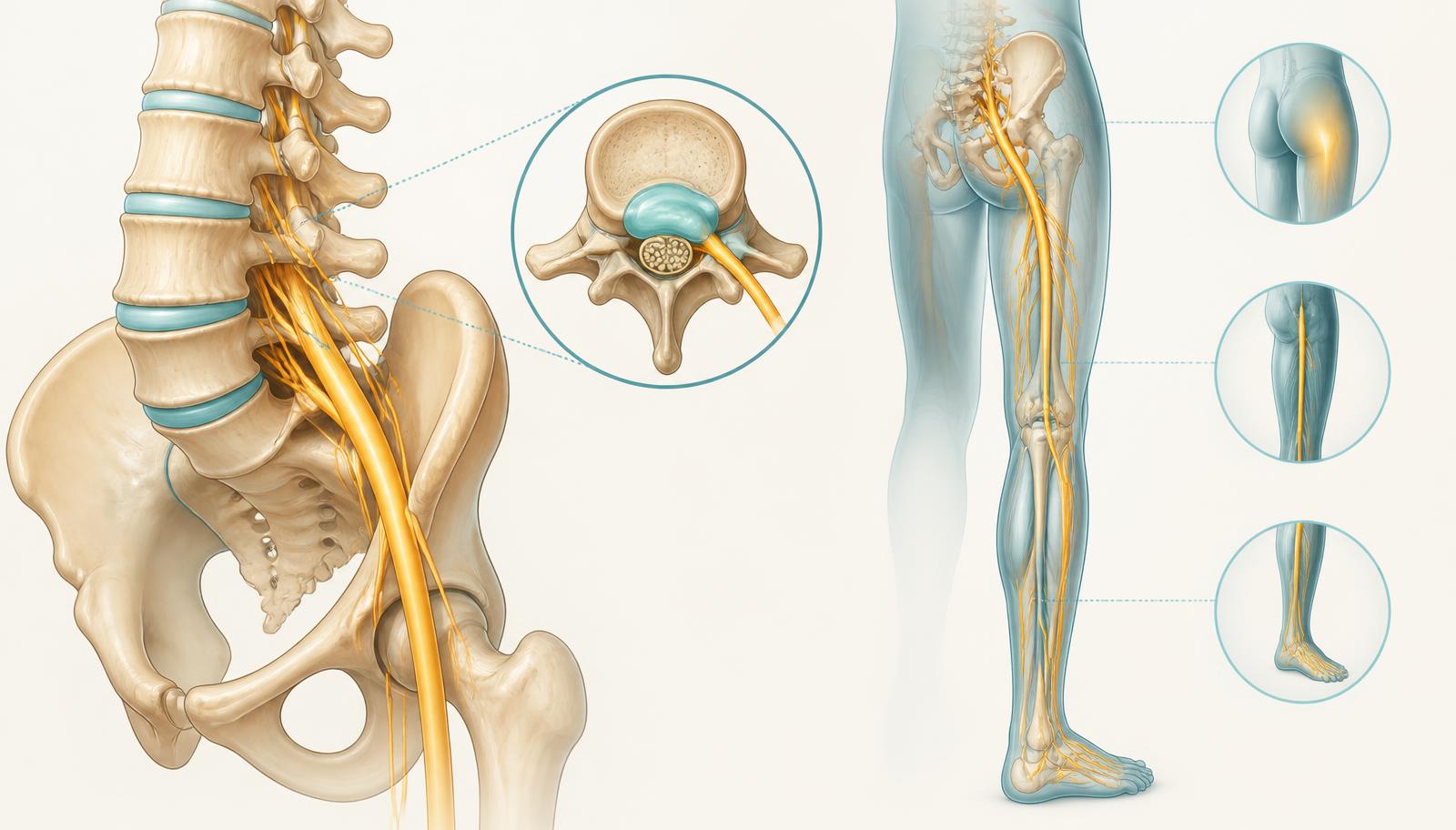
Sciatica is not a diagnosis. It is a description of pain, tingling, burning, numbness, or weakness traveling along the path of the sciatic nerve. Because several different problems can produce that pattern, sciatica recovery time follows the cause, not the label.
Typical recovery timelines for sciatica
Broadly, cases fall into three groups.
Short episodes. Some people have a flare after an awkward lift, a long drive, or a stretch of poor sleep and heavy sitting. The nerve is irritated but not meaningfully compressed. These episodes often calm within a few weeks as inflammation settles and normal movement returns.
Slower cases. When a disc is genuinely contributing, symptoms tend to improve in a stepwise way rather than a straight line. Good days appear, then a setback, then a slightly better baseline. Many patients notice changes over a span of weeks to a few months, and the trajectory matters more than any single bad day.
Stalled cases. This is the group that matters most. If leg symptoms have persisted past roughly six to eight weeks without a clear downward trend, or if they keep cycling back every time activity increases, the problem is rarely going to resolve through patience alone. Something structural is repeatedly loading the nerve.
What actually determines your timeline
Several factors change the picture considerably.
Where the symptoms travel. Pain that stays in the low back and buttock generally behaves better than pain that runs below the knee into the calf or foot. The further the symptoms travel, the more likely a nerve root is involved.
Whether symptoms centralize. If leg pain gradually pulls back toward the spine over time, that is a favorable sign. If pain that used to sit in the buttock now reaches the foot, the case is moving the wrong direction regardless of how long it has been.
Presence of numbness or weakness. Sensory changes and strength loss are different from pain. They suggest the nerve is not just irritated but compromised, and they change how urgently the case should be examined.
What you do all day. Prolonged sitting, repeated bending, and driving load the lumbar discs in ways that keep a healing nerve agitated. Two people with identical imaging can have very different recovery curves based on daily demands alone.
How many episodes you have had. A first episode behaves differently than a fourth. Recurrent sciatica usually means the underlying mechanical problem was never actually addressed, only waited out.
The gap: waiting is treated as a plan
Most people with sciatica are told some version of rest, over the counter anti-inflammatories, and give it time. That advice is reasonable for a first short episode. The problem is what happens when it does not work.
Patients often cycle through a course of general physical therapy, then a cortisone injection, then more waiting, without anyone establishing which specific structure is irritating the nerve and under what conditions. Imaging gets ordered and shows disc changes, which are extremely common and do not by themselves explain why a particular person hurts. So the case drifts. Months pass, the pain becomes background noise, and the person quietly stops doing things they used to do.
Time is not a treatment. It is only useful when the tissue is genuinely settling. When symptoms plateau or recur, the question stops being how long sciatica lasts and becomes what is driving it.
Signs your sciatica is not going to resolve on its own
Consider a thorough evaluation when any of the following apply:
- Symptoms have lasted longer than six to eight weeks without meaningful improvement.
- Leg pain is worsening or spreading further down the limb.
- There is numbness, tingling, or weakness rather than pain alone.
- The same episode keeps returning several times a year.
- Sitting, coughing, or sneezing sharply reproduces the leg pain.
- Previous care gave temporary relief but nothing held.
Certain findings warrant prompt medical attention rather than a conservative plan, including progressive weakness, loss of bowel or bladder control, or numbness in the saddle region. Those are not wait and see situations.
What a proper evaluation adds
The goal of an exam is to identify the specific pain driver and the positions and loads that provoke it. That means testing how symptoms respond to different movements, checking reflexes, strength, and sensation along specific nerve distributions, and separating a disc related presentation from stenosis, piriformis involvement, or a joint driven pattern that only mimics sciatica.
Once the driver is clear, the plan follows logically. For disc related cases with nerve involvement, care may include non-surgical sciatica treatment or non-surgical spinal decompression aimed at reducing load on the affected nerve root and restoring tolerance to the positions that currently provoke symptoms. If a herniated or bulging disc is the source, that changes the plan again. For other presentations, the emphasis changes entirely.
The reason this matters for your timeline is simple. A generic plan applied to an unidentified problem produces exactly the pattern most people describe: partial relief, repeated flares, and a question that never gets answered.
If stretching has been the main strategy so far, it is worth reading why sciatica stretches stop working in nerve root cases, because that pattern is itself a diagnostic clue.
Frequently asked questions about sciatica recovery
How long does sciatica last on average?
Many first episodes of sciatica calm down over several weeks as inflammation settles. Cases involving a lumbar disc and true nerve root involvement often take longer and improve in a stepwise pattern over weeks to a few months. Symptoms lasting beyond six to eight weeks without a clear trend usually indicate an ongoing structural driver rather than a slow healing process.
Why is my sciatica not going away?
Persistent sciatica usually means the structure loading the nerve has not been identified or unloaded. Common reasons include a disc that keeps compressing the nerve root in certain positions, daily activities that repeatedly reload the spine, or a generic treatment plan applied without establishing which movements provoke and relieve the symptoms.
Can sciatica heal on its own without treatment?
Yes, a short first episode with pain limited to the back and buttock often settles on its own. Recurrent episodes, pain below the knee, or any numbness or weakness are less likely to resolve without addressing the underlying mechanical cause.
When should I see a specialist for sciatica?
See a specialist if symptoms have lasted more than six to eight weeks, are spreading further down the leg, include numbness or weakness, or keep returning after previous care. Progressive weakness, saddle numbness, or bowel or bladder changes require prompt medical attention.
Does sitting make sciatica last longer?
Prolonged sitting and driving increase load on the lumbar discs and commonly keep an irritated nerve root agitated. Two people with identical imaging can have very different recovery curves based on daily positional demands alone.
Getting a clear answer
If your sciatica is on week three of a first episode and steadily improving, continuing sensible activity is reasonable. If you are past two months, on your third flare this year, or noticing symptoms creeping further down the leg, the useful next step is an evaluation that identifies the source rather than another round of waiting.
San Diego Chiropractic Neurology offers a free consultation to review your history and symptom pattern and determine whether a detailed exam is warranted. Call (619) 344-0111 to schedule a time to talk through what has already been tried and what has not.
Not sure what is driving your symptoms?
Talk with our Functional Neurology Trained team on a free phone consultation. We will tell you honestly whether we can help.