Post Concussion Syndrome Treatment San Diego
Free phone consultation with our San Diego functional neurology team. No obligation.
When symptoms continue for weeks after a head injury, many people start searching for post concussion syndrome treatment San Diego because rest alone has not solved the problem. Headaches, dizziness, brain fog, light sensitivity, balance trouble, visual strain, and fatigue can interfere with work, school, exercise, and normal daily life. A more useful next step is often a structured evaluation that looks at why those symptoms are still happening instead of assuming every concussion recovery should look the same.
At San Diego Chiropractic Neurology, the functional neurology team evaluates persistent concussion symptoms by looking for specific problem areas. Those can include vestibular dysfunction, oculomotor strain, neck-related pain patterns, exercise intolerance, migraine features, and activity pacing problems. Current peer-reviewed reviews support this symptom-generator approach because persistent symptoms often come from overlapping systems that need targeted rehabilitation rather than indefinite rest alone.
What post-concussion syndrome usually means
Post-concussion syndrome is a common term used when symptoms continue beyond the expected early recovery period after a concussion or mild traumatic brain injury. The label itself does not explain the cause. It only tells you that symptoms such as headache, dizziness, nausea, poor concentration, sleep changes, irritability, visual discomfort, or motion sensitivity are still present.
That matters because two people can both have ongoing symptoms after concussion but need different treatment plans. One person may mainly have dizziness and balance problems linked to the vestibular system. Another may have neck pain, cervicogenic headache, and exercise intolerance. A third may have visual tracking strain that gets worse with screens, reading, or driving. This is why the clinic starts with a detailed history and exam rather than a one-size-fits-all protocol.
Why symptoms can last longer than expected
Persistent concussion symptoms are often driven by more than one issue at the same time. A person in San Diego might return to work too quickly, struggle with screen exposure, keep exercising at the wrong intensity, and also have unresolved neck dysfunction or vestibular deficits. Each of those can keep symptoms going.
Reviews in neurology and rehabilitation literature describe concussion care as a process of identifying underlying symptom generators. Evidence-based options can include sub-symptom aerobic exercise, cervical physical therapy, vestibular therapy, vision-related treatment, cognitive rehabilitation, and behavioral strategies depending on the findings. That is a practical reason many people benefit from an exam that looks beyond the word concussion and maps symptoms to specific systems.
How the clinic evaluates persistent concussion symptoms
The functional neurology team at San Diego Chiropractic Neurology focuses on patterns that commonly show up after concussion:
1. Dizziness and balance testing
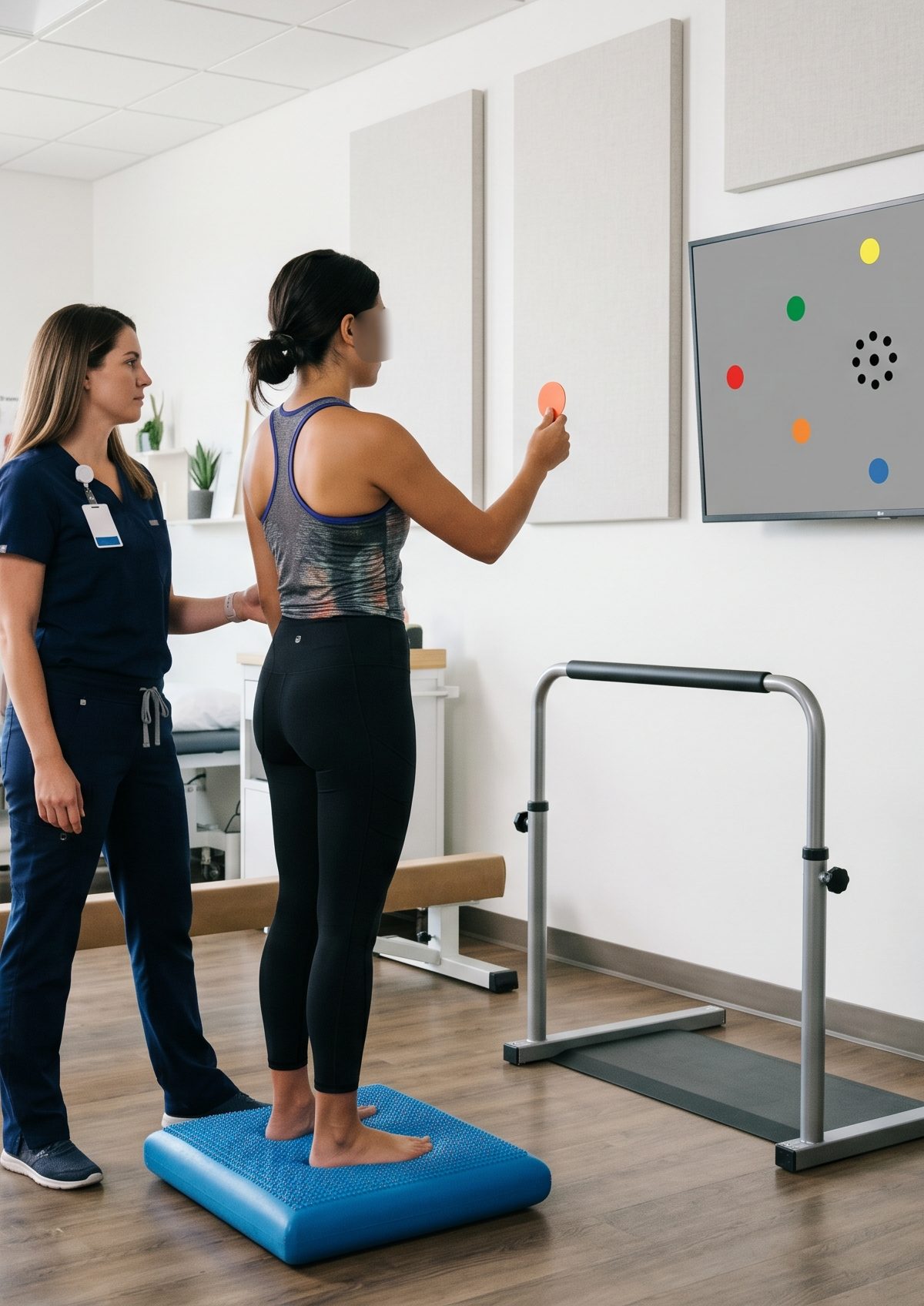
If a patient feels off balance, motion sensitive, or worse in busy environments, the clinic may look for vestibular involvement. That can include positional dizziness, poor gaze stability, visual motion sensitivity, and balance deficits. These findings can overlap with the same symptom clusters seen in patients with concussion or vertigo, but after concussion the driver may be part of a broader post-traumatic presentation.
2. Eye movement and visual strain screening
Some patients describe pressure behind the eyes, difficulty reading, losing their place on a page, nausea with scrolling, or screen intolerance. Those complaints can relate to oculomotor control and visual processing stress. Identifying that pattern helps determine whether visual rehabilitation should be part of the plan.
3. Neck and headache assessment
Neck dysfunction after a concussion can contribute to headaches, dizziness, and a feeling of disorientation. Patients with migraine features may also need symptom tracking that distinguishes concussion-related headache from post-traumatic migraine patterns. That is one reason the clinic also considers overlap with migraine presentations during the evaluation.
4. Exercise tolerance and autonomic response
Some people feel worse with minor exertion. Others crash after trying to push through symptoms. Graded exertional testing can help determine whether a person may respond to monitored, sub-symptom exercise instead of complete inactivity. In many cases, the goal is to build tolerance gradually without provoking a major setback.
5. Activity demands and recovery barriers
Recovery is affected by work demands, school load, commuting, sleep, prior concussion history, screen time, and stress. A patient living in Carmel Valley or commuting through 92121 may be spending long hours on screens, meetings, and freeway driving. Those details matter because treatment planning should match real life, not just an ideal schedule.
What treatment can include
The best plan depends on the findings, but active rehabilitation is often more useful than passive waiting once symptoms persist. A 2021 systematic review and guideline recommendation in JAMA Network Open supported several nonpharmacological options for adults with persistent post-concussion symptoms, including graded physical exercise, vestibular rehabilitation, manual treatment for neck and back symptoms, oculomotor vision treatment, and psychological treatment when indicated.
Graded aerobic exercise
There has been a shift away from telling every patient to rest until they are entirely symptom-free. A systematic review found growing evidence that subsymptom threshold aerobic exercise can help patients with post-concussion syndrome recover more effectively than prolonged inactivity. Another review of randomized controlled trials reported that aerobic exercise programs showed measurable symptom benefit compared with usual care in pooled analysis.
In practice, that means the clinic may recommend carefully dosed walking, bike work, or other aerobic activity below the level that triggers a large symptom spike. The purpose is not to train hard. The purpose is to rebuild tolerance safely.
Vestibular rehabilitation
When dizziness, imbalance, motion sensitivity, or nausea are major issues, vestibular therapy can be a central part of care. A 2022 mini-systematic review found that vestibular rehabilitation is a reasonable treatment option for adults with concussion or mild traumatic brain injury, especially when symptoms and testing point in that direction. At San Diego Chiropractic Neurology, this can overlap with the clinic's broader vestibular therapy approach for patients with dizziness and balance complaints.
Visual rehabilitation
Patients with reading fatigue, screen intolerance, blurred focus, or eye tracking problems may need visual exercises as part of their rehabilitation. These therapies are chosen based on examination findings rather than guesswork. Depending on the case, this may connect with the clinic's neuro-visual rehabilitation services.
Cervical and headache-focused care
If the neck is contributing to symptoms, treatment may include manual care, mobility work, posture guidance, and specific exercises. For people whose headaches are part of the main problem, the clinic may also adjust activity pacing, light exposure, and exertion progression while monitoring migraine-like triggers.
Return-to-work and return-to-activity planning
One of the most frustrating parts of persistent concussion symptoms is that patients are often told only to rest more or wait longer. That approach can leave people stuck. A clearer plan breaks recovery into tolerable steps, such as screen limits, graded walking, work modifications, reading intervals, and staged return to exercise. The target is steady progress, not a perfect day followed by a large crash.
Why early evaluation still matters, even when symptoms have already lingered
Patients sometimes wait because they assume persistent symptoms are normal and there is nothing to do. Evidence suggests that earlier clinical assessment after concussion is associated with faster recovery, which supports timely evaluation when symptoms are not improving as expected. Even if several weeks or months have already passed, identifying the main drivers can still help build a more rational plan.
That is particularly relevant for adults trying to keep up with work in La Jolla, students balancing reading and screens, or active people in San Diego who want to exercise again without setbacks. A targeted exam helps define what should be pushed, what should be limited, and what should be rehabilitated directly.
When to seek urgent care instead of outpatient concussion treatment
Outpatient rehabilitation is not the right setting for every symptom pattern. Emergency care is appropriate for red flags such as worsening severe headache, repeated vomiting, increasing confusion, seizures, progressive weakness, slurred speech, loss of consciousness, or other signs of a more serious brain injury. Patients should also contact their physician or seek urgent evaluation if symptoms change sharply instead of following a stable recovery pattern.
For non-emergency cases where symptoms are lingering, outpatient concussion rehabilitation may be appropriate. The important point is to match the level of care to the presentation instead of delaying action.
What patients in San Diego can expect from a first visit
A first visit for post-concussion care usually focuses on history, symptom pattern, activity limits, and focused neurologic and functional testing. The goal is to determine whether the main drivers appear vestibular, visual, cervical, exertional, headache-related, or mixed. That framework helps the team build a plan that is specific enough to guide rehab but flexible enough to adjust as symptoms change.
Patients are often looking for three things: a clear explanation, a plan that fits daily life, and a path back to work, exercise, and normal activity. The clinic's role is to provide that structure through targeted rehabilitation and careful pacing rather than generic advice alone.
Post concussion syndrome treatment is not just about waiting
Many people improve with time, but persistent symptoms should not be reduced to a passive waiting game. Modern concussion care increasingly supports active, symptom-targeted rehabilitation when the exam points to specific systems that can be treated. That may include exercise progression, vestibular therapy, vision-related work, neck-focused treatment, and guidance on pacing and return to activity.
For patients looking for post concussion syndrome treatment San Diego, the key question is not only how long symptoms have lasted. The more useful question is what is driving them now. A careful evaluation can help answer that and guide the next step.
Frequently asked questions
How long should post-concussion symptoms last before someone seeks treatment?
If symptoms are not steadily improving, or if they interfere with work, school, driving, reading, exercise, or daily function, it is reasonable to seek evaluation. Earlier assessment has been associated with better recovery trends, so waiting indefinitely is not ideal.
What therapies are commonly used for post concussion syndrome?
Common options include graded aerobic exercise, vestibular rehabilitation, visual rehabilitation, cervical treatment, headache management strategies, and activity pacing. The right combination depends on the exam findings.
Can dizziness and visual problems after concussion be treated without medication?
Yes. Many concussion-related dizziness and visual complaints are addressed with targeted rehabilitation rather than medication alone. Vestibular and oculomotor therapies are often used when testing supports them.
What is the difference between rest and active concussion rehabilitation?
Rest limits overload during the early phase, but persistent symptoms often need a more active plan. Active rehabilitation uses carefully chosen exercises and pacing strategies to improve tolerance without causing major symptom flare-ups.
When should someone go to the ER instead of scheduling outpatient care?
Go to the ER for red-flag symptoms such as worsening severe headache, repeated vomiting, seizures, major confusion, new weakness, or sudden neurologic decline. For stable but lingering symptoms, outpatient evaluation may be more appropriate.
Schedule an evaluation
If concussion symptoms are still limiting normal life, the next step may be a structured exam that identifies the main drivers and matches them to treatment. Call (619) 344-0111 or book a free consultation to discuss whether care at San Diego Chiropractic Neurology is appropriate.
References
- Leddy JJ, Haider MN, Ellis M, Willer BS. Management of Concussion and Persistent Post-Concussive Symptoms for Neurologists. Curr Neurol Neurosci Rep. 2021. Available at: https://pubmed.ncbi.nlm.nih.gov/34817719/
- Rytter HM, Graff HJ, Henriksen HK, et al. Nonpharmacological Treatment of Persistent Postconcussion Symptoms in Adults: A Systematic Review and Meta-analysis and Guideline Recommendation. JAMA Netw Open. 2021. Available at: https://pubmed.ncbi.nlm.nih.gov/34751759/
- McIntyre M, Kempenaar A, Amiri M, Alavinia SM, Kumbhare D. The Role of Subsymptom Threshold Aerobic Exercise for Persistent Concussion Symptoms in Patients With Postconcussion Syndrome: A Systematic Review. Am J Phys Med Rehabil. 2020. Available at: https://pubmed.ncbi.nlm.nih.gov/32079897/
- Vuu S, Barr CJ, Killington M, Jill G, van den Berg MEL. Physical exercise for people with mild traumatic brain injury: A systematic review of randomized controlled trials. NeuroRehabilitation. 2022. Available at: https://pubmed.ncbi.nlm.nih.gov/35527580/
- Schlemmer E, Nicholson N. Vestibular Rehabilitation Effectiveness for Adults With Mild Traumatic Brain Injury/Concussion: A Mini-Systematic Review. Am J Audiol. 2022. Available at: https://pubmed.ncbi.nlm.nih.gov/35077655/
Medical disclaimer: This article is for educational purposes only and does not provide medical advice, diagnosis, or treatment. Concussion and persistent post-concussion symptoms should be evaluated individually. Patients should consult a licensed healthcare provider for personal medical guidance and seek urgent care for emergency symptoms.
Not sure what is driving your symptoms?
Talk with our Functional Neurology Trained team on a free phone consultation. We will tell you honestly whether we can help.