Motion Sensitivity Treatment San Diego: Why Busy Environments Can Trigger Dizziness
Free phone consultation with our San Diego functional neurology team. No obligation.
Motion sensitivity can make everyday places feel surprisingly hard to manage. Grocery store aisles, crowded restaurants, freeway traffic, scrolling on a phone, or walking through a busy shopping center can all provoke dizziness, disorientation, nausea, or a sense of internal motion. For many people, the problem is not just “vertigo” in the simple sense. It is often a more complex interaction between the visual system, the inner ear, posture, and the brain’s ability to organize sensory information.
At San Diego Chiropractic Neurology, the clinical goal is to understand why motion-rich environments feel so difficult. That starts with a structured evaluation of balance, eye movements, positional triggers, neck involvement, visual dependence, and recent history such as concussion, migraine, vestibular illness, or prolonged dizziness. In San Diego, this matters because people are often trying to stay active, commute, work on screens, and move through visually dense environments every day.
What motion sensitivity usually feels like
People describe motion sensitivity in different ways. Some say they feel pulled, floaty, or off balance in large stores. Others say scrolling on a phone or watching fast-moving scenes makes them nauseated. Some notice symptoms when turning quickly, walking through crowds, or driving past repeating patterns such as lane markings, fences, or bright sunlight through trees.
Common symptoms can include:
- dizziness in visually busy places
- a rocking or swaying sensation
- nausea or motion intolerance
- brain fog or trouble concentrating
- increased anxiety because certain places feel unpredictable
- unsteadiness when turning the head or body
Not everyone with motion sensitivity has spinning vertigo. In many cases, the problem is better described as visual dependence or persistent dizziness worsened by motion and complex surroundings.
Why busy environments can trigger dizziness
Balance depends on several systems working together: the inner ear, the eyes, joint and muscle feedback, and brain processing that integrates those signals. When one part is underperforming—or when the brain starts relying too heavily on visual information—busy environments can overwhelm the system.
That is one reason grocery stores are such a classic trigger. The lighting is bright, shelves are repetitive, there is movement in the peripheral field, and the body is often turning while the eyes scan rows of products. For someone with visual motion sensitivity, that combination can create a mismatch between what the eyes see and what the rest of the balance system is reporting.
Several patterns may contribute:
- Visual dependence: the brain leans too heavily on visual input for balance, so complex motion becomes harder to process.
- Vestibular weakness or asymmetry: after an inner ear event, the visual system may overcompensate.
- Persistent postural-perceptual dizziness (PPPD): a chronic dizziness pattern often worsened by upright posture, movement, and visually complex spaces.
- Post-concussion sensory overload: eye movement and visual motion can remain uncomfortable long after the initial injury.
- Migraine-related dizziness: some people have a migraine-sensitive nervous system that becomes reactive to motion, light, and visual clutter.
- Cervical contribution: neck injury or neck tension can make spatial orientation feel less stable.
Is motion sensitivity the same as vertigo?
Not always. Vertigo classically describes a false sense of spinning or movement. Motion sensitivity can include vertigo, but it often shows up as disequilibrium, internal motion, visual overwhelm, or nausea without room-spinning. That distinction matters because different dizziness patterns respond to different rehabilitation strategies.
For example, a person with benign positional vertigo may need positional testing and canalith repositioning, while someone with persistent visual motion sensitivity may need a broader plan that addresses gaze stability, postural control, visual-vestibular interaction, and graded exposure to triggers. That is also why a careful vertigo evaluation matters before assuming all dizziness comes from the same cause.
Common situations where motion sensitivity develops
Motion sensitivity can develop gradually or after a clear trigger. Common histories include:
- after a vestibular infection or severe dizziness episode
- after a concussion or whiplash event
- alongside migraine or vestibular migraine patterns
- after prolonged avoidance of movement because dizziness became frightening
- after a period of high stress that amplified existing balance symptoms
Some people improve from the original event but remain stuck with motion intolerance afterward. In those cases, the initial problem may have changed, but the nervous system is still responding as though motion and complex surroundings are threatening or unstable.
What a structured evaluation may include
Effective motion sensitivity treatment starts with figuring out what pattern is actually present. A focused evaluation may include:
- symptom history and trigger mapping
- timing of symptoms: immediate, delayed, constant, or episodic
- positional testing when appropriate
- eye movement testing, including smooth pursuit and saccades
- gaze stability and head movement tolerance
- balance and gait assessment
- cervical screening when neck symptoms are relevant
- screening for migraine, concussion, and visually complex triggers
This helps separate conditions that can look similar on the surface. For example, dizziness while walking through Costco is not automatically the same as dizziness while rolling in bed, and dizziness after a concussion is not always the same as primary inner-ear vertigo. The clinic may also connect findings to related concerns such as concussion-related symptoms or migraine-related dizziness when the history points that way.
How rehabilitation for motion sensitivity may be approached
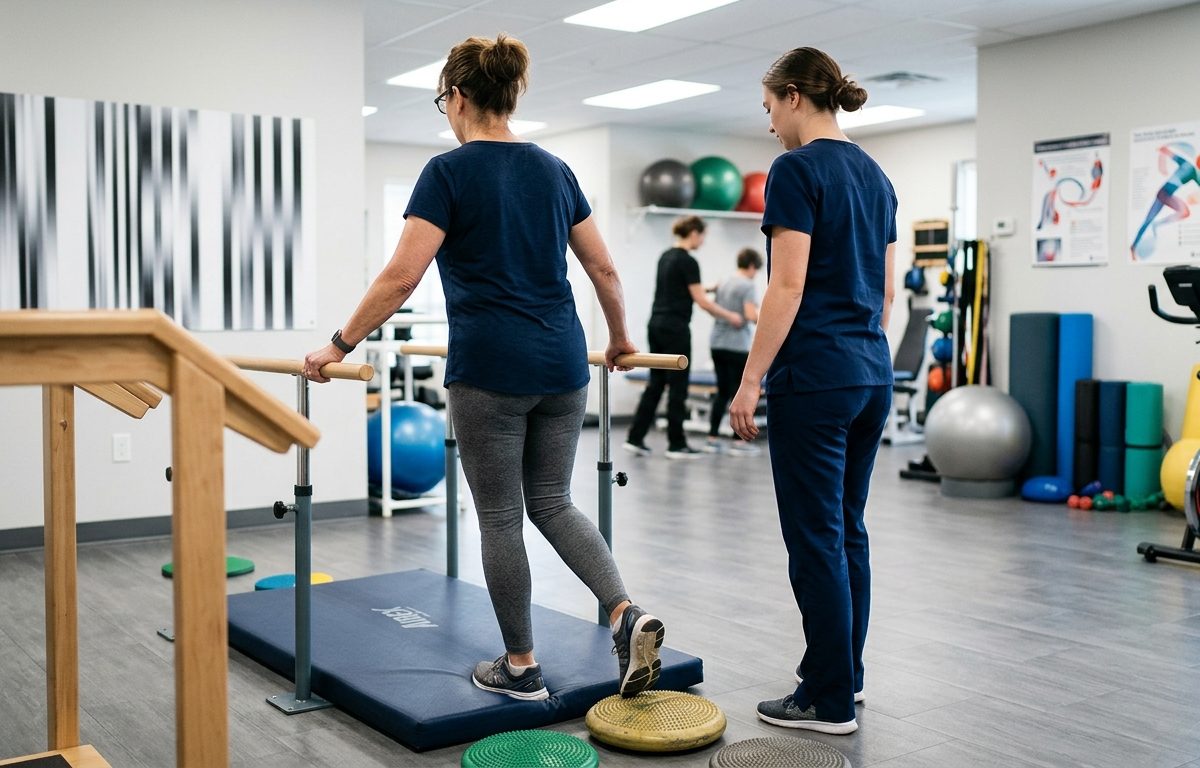
Research supports graded exposure and vestibular rehabilitation strategies for visual vertigo and related motion sensitivity patterns. The goal is usually not to push through symptoms blindly. Instead, the idea is to identify tolerable inputs, build tolerance gradually, and improve how the brain integrates visual and vestibular information.
Depending on the findings, a plan may include:
- gaze stabilization work
- graded visual motion exposure
- balance retraining under progressively more complex conditions
- head and eye movement exercises
- walking tasks with controlled visual challenge
- screen-use pacing and visual trigger modification
- education on symptom thresholds and recovery pacing
A structured vestibular therapy approach can be helpful when symptoms are tied to motion intolerance, gaze instability, or visual dependence. In some cases, the biggest gains come from a better match between the exercise dose and the person’s actual trigger pattern rather than from simply doing more.
Why people often get stuck
Motion sensitivity can become self-reinforcing. When certain places make someone dizzy, they naturally start avoiding them. That makes sense in the short term. But over time, too much avoidance can reduce exposure and keep the brain from recalibrating. People may also start moving stiffly, relying on visual cues even more, or feeling anxious before they enter a triggering environment.
That does not mean the symptoms are “just anxiety.” It means persistent dizziness often has both sensory and behavioral layers that need to be understood together. PPPD literature describes this clearly: symptoms are real, functional, and commonly intensified by motion and visual complexity.
Another reason people get stuck is mislabeling. If every dizzy symptom is assumed to be BPPV, for example, someone may repeat maneuvers that do not fit the actual problem. If the real issue is visual motion sensitivity, concussion-related ocular-vestibular dysfunction, or migraine-related dizziness, treatment has to match that pattern instead.
When to seek evaluation
It is reasonable to seek a more complete evaluation when motion sensitivity is:
- interfering with driving, shopping, exercise, or work
- lingering after a concussion or vestibular event
- causing avoidance of public places or screens
- paired with headaches, nausea, neck symptoms, or imbalance
- not improving with a generic home approach
In San Diego, many adults try to simply manage around the problem for months. But a pattern-based assessment can often clarify whether the main issue looks more vestibular, visual, cervical, post-concussion, migraine-related, or persistent functional dizziness.
What recovery often looks like
Recovery is usually gradual, not instant. Most people do better when the process is organized around measurable triggers and tolerable progression. That means finding the current threshold, working just below or around it, and increasing challenge as the system adapts. Research on visual vertigo supports this kind of graded exposure rather than complete avoidance.
Improvement may show up as:
- less dizziness in stores or crowds
- better tolerance for scrolling and screen movement
- more stable walking in visually complex settings
- less nausea with head turns or environmental motion
- less anticipatory fear about everyday environments
Some people need mainly vestibular and visual integration work. Others need a broader plan that also considers neck input, concussion recovery, or migraine susceptibility. That is why individualized evaluation matters more than a one-size-fits-all diagnosis label.
Bottom line
Motion sensitivity is a real and common reason people feel dizzy in busy environments. It can happen after vestibular illness, concussion, migraine, or prolonged dizziness, and it often reflects a mismatch between visual input, balance processing, and movement tolerance. The right next step is not guessing. It is identifying the actual pattern and building a targeted rehabilitation plan around it.
If grocery stores, scrolling, crowds, or patterned spaces are making daily life harder, a structured evaluation can help clarify the cause and the most appropriate next steps. Call (619) 344-0111 or book a free consultation.
Frequently asked questions
Why do grocery stores make me dizzy?
Grocery stores combine bright lighting, patterned shelves, peripheral movement, and repeated head turns. For people with visual dependence or vestibular sensitivity, that environment can overload the balance system.
Is motion sensitivity the same as vertigo?
No. Some people feel spinning, but many feel swaying, disorientation, nausea, or visual overwhelm instead. The distinction matters because treatment depends on the actual dizziness pattern.
Can motion sensitivity happen after a concussion?
Yes. Concussion can affect eye movements, sensory integration, and motion tolerance, making busy environments and screens harder to handle.
What kind of treatment may help motion sensitivity?
Treatment often focuses on structured evaluation, vestibular rehabilitation, graded visual motion exposure, balance retraining, and exercises matched to the person’s trigger profile.
References
- Bronstein AM. Visual vertigo syndrome: clinical and posturography findings. J Neurol Neurosurg Psychiatry. 1995.
- Pavlou M, et al. The role of repeated visual motion exposure in the treatment of visual vertigo. J Neurol. 2004.
- Popkirov S, Staab JP, Stone J. Persistent postural-perceptual dizziness (PPPD): a common, characteristic and treatable cause of chronic dizziness. Pract Neurol. 2018.
- Whitney SL, et al. Vestibular rehabilitation for persons with vestibular disorders. Neurol Clin. 2005.
Medical disclaimer: This article is for educational purposes only and is not medical advice, diagnosis, or a substitute for individualized care. Seek appropriate licensed medical evaluation for new, severe, or worsening symptoms.
Not sure what is driving your symptoms?
Talk with our Functional Neurology Trained team on a free phone consultation. We will tell you honestly whether we can help.