Does Spinal Decompression Work for Herniated Disc?
Free phone consultation with our San Diego functional neurology team. No obligation.
If you are asking whether spinal decompression works for a herniated disc, the short answer is that it may help some patients, but it is not a universal answer. The more useful question is whether spinal decompression fits your exam findings, symptom pattern, and stage of recovery. At San Diego Chiropractic Neurology, the functional neurology team evaluates whether a disc-related pain pattern appears mechanical, inflammatory, neurologic, or mixed before recommending any treatment plan.
A herniated disc can irritate or compress a nerve root and create back pain, leg pain, numbness, tingling, or weakness. Many cases improve with conservative care over time, which is one reason it is important to avoid exaggerated treatment claims. The goal is not to promise that one machine or one visit will solve the problem. The goal is to determine whether decompression may reduce symptom load enough to help the patient move better, tolerate rehabilitation, and avoid unnecessary escalation of care.
For patients in San Diego, La Jolla, Carmel Valley, and nearby communities, that usually starts with a history, neurologic exam, movement testing, and a review of any prior imaging. If the presentation does not match a straightforward disc pattern, the treatment plan may need to focus elsewhere. If the symptoms and exam do line up with lumbar disc irritation, decompression may be considered as one part of a broader non-invasive program.
What spinal decompression is meant to do
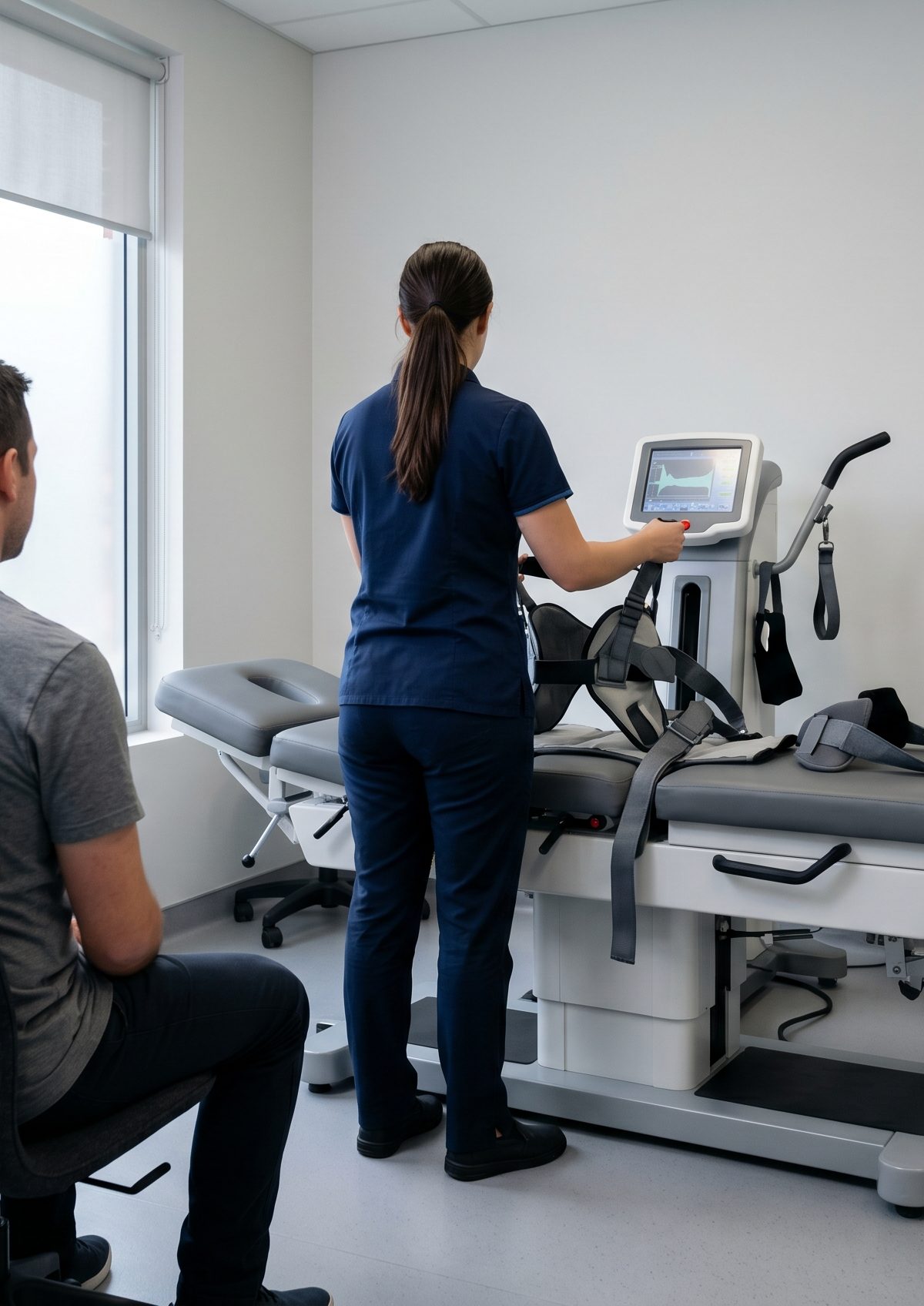
Non-surgical spinal decompression is a traction-based treatment designed to create a controlled pulling force through the spine. In practice, the intent is usually to reduce mechanical stress, improve tolerance to movement, and lower irritation around the involved segment. Patients often hear broader claims online about discs being pulled back into place or restored to normal. That language goes beyond what the evidence supports and can create the wrong expectations.
A more accurate explanation is that decompression may help selected people by changing load and position at the symptomatic level. When that reduces symptom intensity, the patient may tolerate walking, exercises, posture changes, and daily tasks more comfortably. That matters because a herniated disc usually improves best within a larger conservative program rather than from passive treatment alone.
This is why a decompression plan should be individualized. The settings, body position, symptom irritability, and response over the first several visits all matter. If pain centralizes, movement improves, and neurologic findings remain stable, treatment may be moving in a useful direction. If symptoms spread, weakness progresses, or the patient cannot tolerate the setup, the plan needs to change.
What the evidence actually supports
Most lumbar disc herniations improve with conservative care, especially when serious red flags are absent. Clinical reviews consistently note that many patients improve over the first several weeks with activity modification, pain control, and structured rehabilitation rather than immediate surgery. That matters because spinal decompression should be judged against the natural course of recovery, not against unrealistic marketing promises.
Research on traction and decompression for lumbar disc herniation is mixed. A recent systematic review and meta-analysis of exercise, manipulation, and traction physiotherapy for lumbar disc herniation reported that traction-based care may offer symptom benefit for selected patients, but the quality and consistency of the evidence remain variable across studies. In plain language, that means some patients improve, but the literature does not support claiming that decompression works for everyone or that it should replace a full evaluation.
That same nuance is often missing from online content. The better takeaway is this: spinal decompression may be reasonable when the clinical picture suggests a mechanical disc-related pain pattern and the patient can tolerate graded traction. It is less convincing when symptoms are dominated by severe inflammatory flare-ups, progressive weakness, or pain generators outside the disc itself.
Another important point is that imaging alone does not answer the treatment question. Disc bulges and herniations are common on imaging, including in some people without symptoms. A careful exam helps determine whether the disc finding actually matches the pain pattern, neurologic signs, and movement limits the patient is experiencing. Without that correlation, decompression may target the wrong problem.
Who may be a reasonable candidate
Spinal decompression may be considered when a patient has a history and exam that suggest lumbar disc irritation or disc-related sciatica, especially if symptoms are aggravated by loading and improved by unloading. Common examples include pain radiating below the knee, a positive straight-leg-raise pattern, or symptoms that change with position in a way that points toward a disc-sensitive presentation.
It may also be reasonable for someone who wants to continue conservative care before considering injections or surgical consultation, provided there are no urgent neurologic concerns. In this setting, decompression can be used as an adjunct to rehabilitation, not as a replacement for it. Many patients still need exercise progression, gait and posture coaching, work modifications, and follow-up reassessment.
Patients who tend to do best usually have clear symptom monitoring. They can describe whether the pain is centralizing or spreading, whether numbness is improving, and whether walking or sitting tolerance is changing. These details help a provider decide whether the intervention is helping enough to continue.
Who may not be a good fit
Spinal decompression is not a good default choice for every herniated disc. Some people cannot tolerate traction because it increases leg symptoms or provokes guarding. Others have a clinical picture that suggests the main problem is not a disc herniation at all. Hip pathology, peripheral nerve irritation, spinal stenosis, instability, inflammatory flare patterns, and non-spinal causes of leg pain can all complicate the picture.
It is also not appropriate to rely on decompression when symptoms suggest urgent medical evaluation is needed. Progressive weakness, saddle numbness, bowel or bladder changes, major gait decline, or rapidly worsening neurologic symptoms require immediate attention rather than a routine conservative treatment plan.
Even in non-urgent cases, if a patient has had a thorough conservative trial with no meaningful change, the next step may be imaging review, co-management, injection discussion, or surgical referral depending on the findings. Good care is not defined by staying with the same treatment no matter what. It is defined by re-evaluating the plan when the response is weak or inconsistent.
Why the exam matters more than the marketing
Many decompression advertisements make it sound as if the machine itself is the treatment decision. That is backwards. The decision comes first, and it should come from the exam. The functional neurology team looks at sensation, reflexes, motor control, pain behavior, positional tolerance, and how the nervous system responds to loading and unloading. That broader view helps determine whether decompression belongs in the plan or whether another path is more sensible.
This is especially important when patients search online after hearing terms like bulging disc, slipped disc, pinched nerve, or sciatica. Those labels get used loosely, and they do not always describe the same clinical problem. A patient with disc-related leg pain may need a different strategy than a patient whose back pain is primarily mechanical without nerve irritation. A patient with ongoing weakness may need a different timeline entirely.
The exam also helps set appropriate goals. For some patients, the goal is to reduce pain enough to sleep or sit. For others, it is to improve walking tolerance, resume work duties, or tolerate rehabilitation exercises. The best decompression plan is the one that clearly supports those functional goals and is stopped if it does not.
How decompression fits into a broader treatment plan
When decompression is used well, it usually sits inside a larger program rather than standing alone. That program may include spinal mobility work, core endurance training, nerve mobility where appropriate, ergonomic changes, and progression back to regular activity. The clinic may also review sleep position, sitting tolerance, lifting strategy, and the specific movements that trigger leg symptoms.
For disc-related pain, this broader approach matters because symptom improvement is only part of the job. The other part is helping the patient move with more confidence and less irritation. A person who feels slightly better after traction but still cannot bend, walk, or transition positions well has not completed the recovery process.
Internal education also helps patients make sense of what they are dealing with. Patients often benefit from reviewing related condition and service pages such as herniated disc care, sciatica evaluation, and non-surgical spinal decompression. These resources help frame decompression as part of a larger non-invasive pathway rather than as a one-step fix.
Can spinal decompression replace surgery?
Sometimes patients ask this question because they want to avoid surgery if possible. That is understandable, but the answer depends on why surgery is being considered in the first place. If a patient has persistent symptoms but a stable neurologic exam, a conservative trial that includes decompression may be reasonable. If the patient has progressive motor loss, severe neurologic compromise, or red-flag findings, decompression is not a substitute for prompt medical or surgical evaluation.
It is also important to understand that surgery and conservative care are not always permanent opposites. Some patients use conservative care to improve symptoms and function enough to avoid surgery. Others use it to manage symptoms while monitoring whether surgery becomes necessary. The decision should be based on clinical progression, not fear or sales pressure.
Evidence suggests surgery can improve symptoms faster in selected patients, while long-term outcomes may become more similar between operative and nonoperative care in many cases. That is another reason careful patient selection matters. The right next step depends on time course, neurologic status, disability level, and response to treatment so far.
Questions San Diego patients should ask before starting decompression
Patients often benefit from asking direct questions before beginning a decompression plan. What exam findings suggest the disc is truly the pain source? What changes would show the treatment is helping? What signs would mean the plan should stop or be modified? How will progress be measured beyond pain alone?
Those questions help separate a structured clinical plan from a generic package of visits. In a good program, there should be a clear reason for choosing decompression, a clear way to reassess progress, and a clear alternative plan if the response is poor. That is particularly relevant for active adults in San Diego who want to keep working, training, or caring for family while recovering.
Location also matters less than evaluation quality. The best clinic for this problem is not simply the one with a decompression table. It is the one that can tell when decompression may help, when it may not, and when a patient needs a different level of care.
Bottom line
So, does spinal decompression work for herniated disc? It may help some people, especially when the presentation fits lumbar disc-related pain and the treatment is part of a broader conservative strategy. It does not work for every patient, it should not be oversold, and it should never delay care when neurologic red flags are present.
The more reliable approach is a careful exam, a clear diagnosis, and a treatment plan that is adjusted based on response. For some patients, decompression may reduce symptom load enough to support progress. For others, another route will make more sense. That distinction is where good clinical judgment matters most.
If you are dealing with suspected disc-related back or leg pain, call (619) 344-0111 or book a free consultation to determine whether a non-invasive evaluation is appropriate for your situation.
Medical disclaimer: This article is for educational purposes only and is not medical advice. Individual diagnosis and treatment decisions should be made with a qualified licensed healthcare provider based on a full history, examination, and appropriate testing.
Frequently asked questions
Does spinal decompression work for every herniated disc?
No. It may help some patients with a disc-related mechanical pain pattern, but it is not appropriate for every case and should follow a careful exam.
How long should conservative care be tried before considering other options?
Many patients improve during the first several weeks of conservative care when red flags are absent. If symptoms persist, worsen, or neurologic findings change, the plan should be reassessed.
Can spinal decompression replace surgery?
Sometimes it may be part of a conservative attempt to avoid surgery, but it is not a substitute for timely evaluation when there is progressive weakness, bowel or bladder change, or other urgent neurologic concern.
What symptoms mean a herniated disc needs urgent medical attention?
Saddle numbness, bowel or bladder changes, rapidly worsening weakness, severe gait decline, or escalating neurologic symptoms warrant urgent medical attention.
Is spinal decompression the same as regular physical therapy traction?
They are related concepts because both use traction principles, but the exact setup, dosing, and clinical goals can differ by device and provider. The more important issue is whether the treatment fits the patient’s exam findings.
References
- Disk Herniation. StatPearls. National Center for Biotechnology Information. https://www.ncbi.nlm.nih.gov/books/NBK441822/
- Gregory DS, Seto CK, Wortley GC, Shugart CM. Acute Lumbar Disk Pain: Navigating Evaluation and Treatment Choices. American Family Physician. 2008. https://www.aafp.org/pubs/afp/issues/2008/1001/p835.html
- Thavarajasingam SG, et al. Exercise, manipulation and traction physiotherapy in the conservative management of lumbar disc herniation: A systematic review and meta-analysis. Brain and Spine. 2025. PubMed listing: https://pubmed.ncbi.nlm.nih.gov/?term=Exercise%2C+manipulation+and+traction+physiotherapy+in+the+conservative+management+of+lumbar+disc+herniation
Not sure what is driving your symptoms?
Talk with our Functional Neurology Trained team on a free phone consultation. We will tell you honestly whether we can help.