Disc Degeneration and Non-Surgical Spinal Decompression Therapy in San Diego: How Decompression Treats Herniated and Degenerative Discs
Free phone consultation with our San Diego functional neurology team. No obligation.
If you've been told you have a herniated disc, bulging disc, or degenerative disc disease, you're not alone — and surgery isn't your only option. At San Diego Chiropractic Neurology, we specialize in non-surgical spinal decompression therapy in San Diego that targets the root cause of disc degeneration and delivers measurable, research-backed results. This guide explains how discs degenerate, what the clinical research says about decompression therapy, and why our chiropractic neurology approach in San Diego goes beyond what conventional treatment offers.
What Is Degenerative Disc Disease and How Does Disc Degeneration Happen?
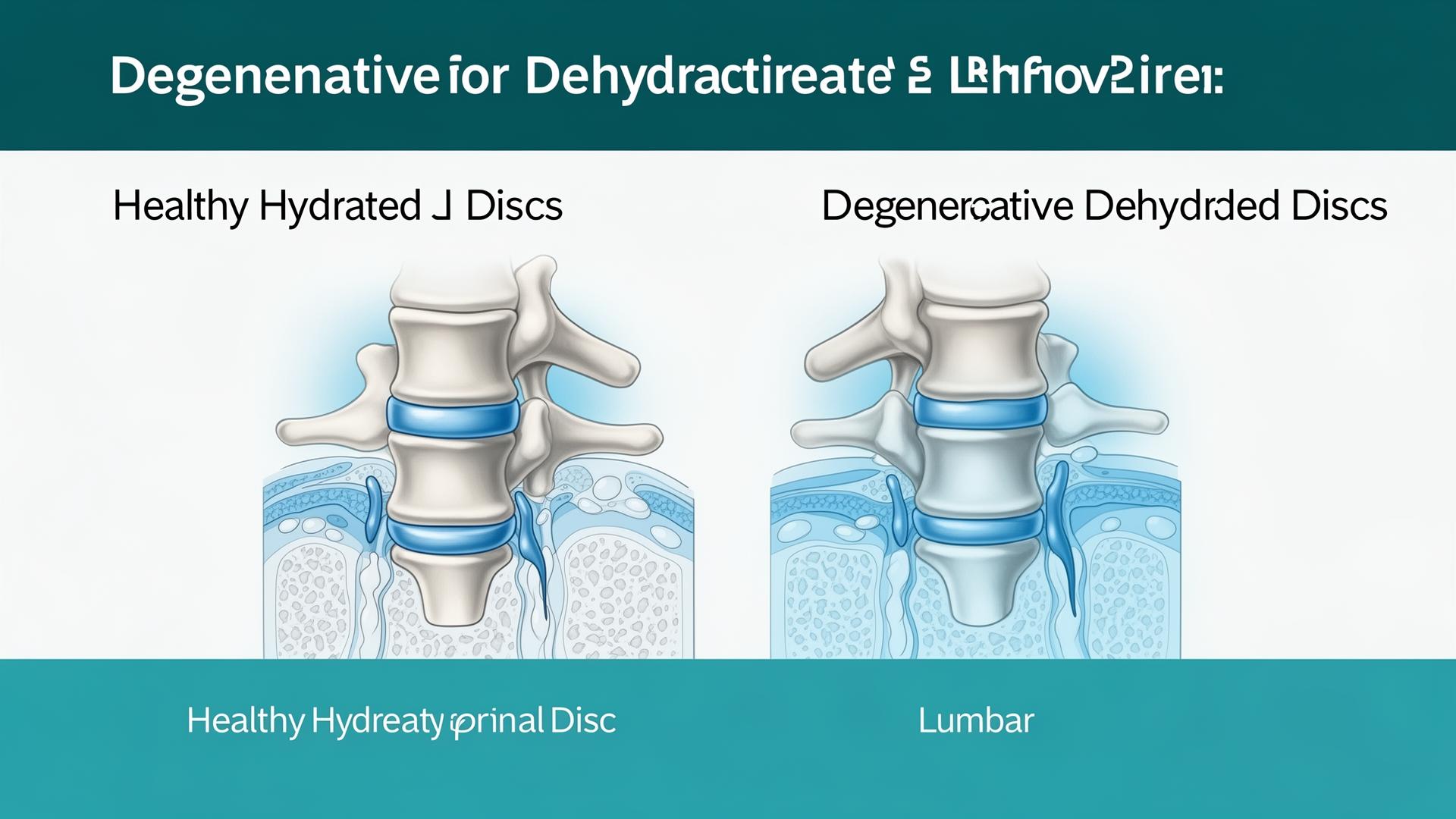
Degenerative disc disease is the progressive breakdown of the intervertebral discs that cushion your vertebrae. Each disc has a tough outer ring called the annulus fibrosus surrounding a gel-like center called the nucleus pulposus. In a healthy young adult, the nucleus is roughly 70–80% water, held in place by proteoglycans that attract and bind moisture through osmotic pressure.
Starting as early as your twenties, these discs gradually lose hydration and elasticity. A landmark systematic review by Brinjikji et al. in the American Journal of Neuroradiology (PMC4464797) found that 37% of 20-year-olds already show disc degeneration on MRI — even without any back pain. By age 50, that number climbs to 80%, and by age 80, it reaches 96%.
As the disc loses proteoglycan content, it can no longer retain water. This triggers a cascade described in research as a "vicious circle": reduced osmotic pressure leads to abnormal mechanical loading, which triggers inflammatory responses that further destroy the disc matrix (Vergroesen et al., Osteoarthritis and Cartilage, 2015). The nucleus transitions from elastic type II collagen to rigid type I collagen, becoming progressively stiffer and less capable of shock absorption (Inoue & Espinoza Orías, 2011).
The Four Stages of Disc Herniation
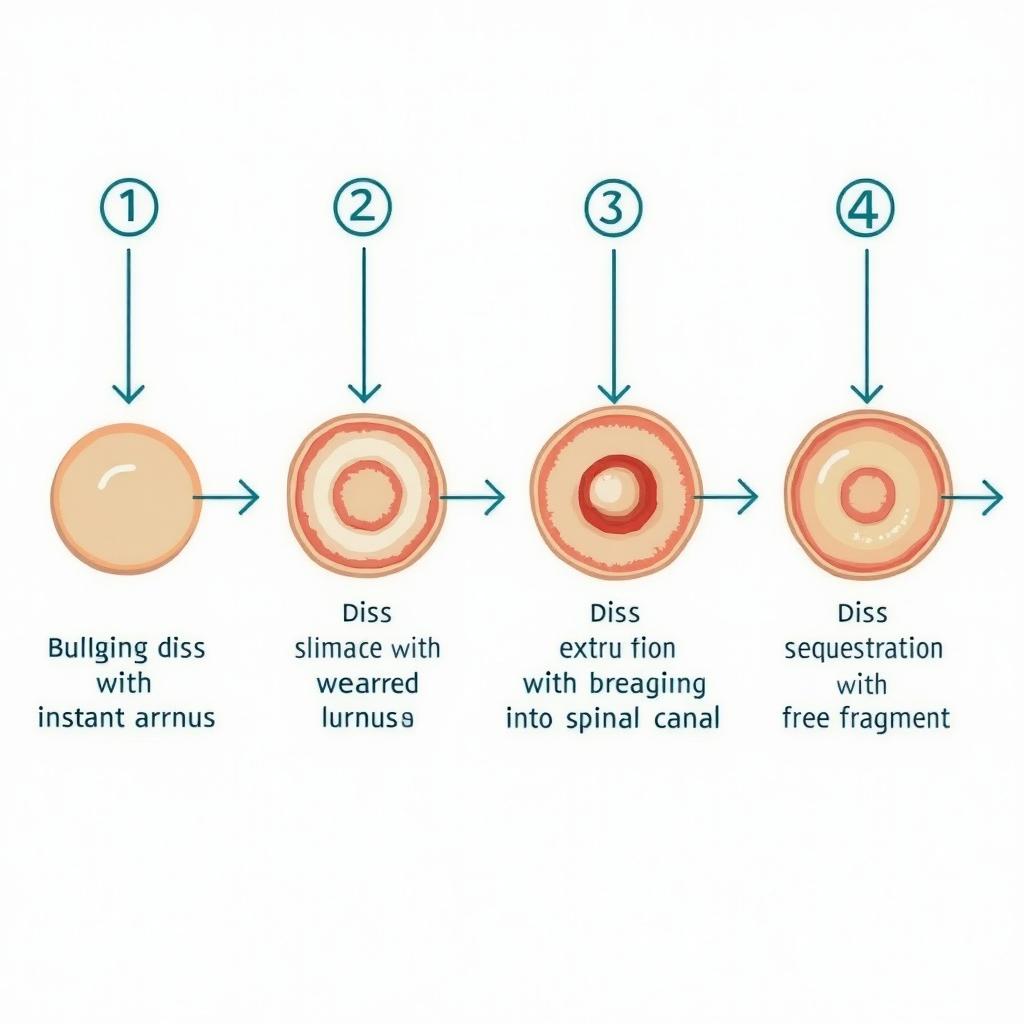
According to the Lumbar Disc Nomenclature: Version 2.0 established by the North American Spine Society (Fardon et al., The Spine Journal, 2014), disc herniation progresses through four stages:
- Bulging disc — Disc tissue extends beyond the vertebral ring but the annulus remains intact. This generalized extension typically involves more than 25% of the disc circumference.
- Disc protrusion — Focal displacement where the base of the displaced material is wider than the dome. The annulus fibrosus is weakened but typically intact.
- Disc extrusion — The displaced material breaks through a complete annular defect and protrudes into the spinal canal, often compressing nerve roots and causing radiating leg pain or sciatica.
- Disc sequestration — A fragment of disc material completely separates and becomes a free fragment in the spinal canal.
Where a disc sits on that spectrum is what shapes the plan, which is why our evaluation for bulging and herniated discs begins with imaging review and a neurological exam rather than a fixed protocol.
A critical factor in disc degeneration is that the intervertebral disc is the largest avascular tissue in the human body. Disc cells can sit 8 mm from the nearest blood supply, depending entirely on nutrient diffusion through the endplates. As these endplates calcify with age, the nutrient pathway narrows — starving disc cells and accelerating the degenerative process. This is precisely why spinal decompression therapy is so effective: it restores nutrient flow to the damaged disc.
How Non-Surgical Spinal Decompression Therapy Works for Disc Degeneration
Non-surgical spinal decompression therapy uses a computer-controlled motorized table to apply precise, variable distraction and relaxation forces to the spine. What distinguishes decompression therapy from simple traction is the computerized feedback mechanism that monitors force in real time, preventing the paravertebral muscle guarding reflex from activating. This keeps muscles relaxed while the spine is gently lengthened, allowing targeted treatment of specific herniated disc levels.
The Science: Negative Intradiscal Pressure and Disc Rehydration
The foundational research comes from Ramos and Martin, published in the Journal of Neurosurgery (1994). They directly measured intradiscal pressure during decompression therapy and found that normal resting disc pressure of approximately +75 mmHg was driven to below −100 mmHg during treatment. Conventional traction only reduced pressure to +40 mmHg — it never achieved negative pressure at all.
This negative intradiscal pressure creates a vacuum effect that draws herniated disc material back toward the center of the disc, pulls water, oxygen, and nutrients into the disc to counter the nutrient deprivation driving degeneration, and reduces mechanical compression on spinal nerve roots. The cyclic distraction-relaxation pattern creates a pumping effect that promotes disc rehydration — directly addressing the dehydration at the heart of degenerative disc disease.
Clinical Research Supporting Decompression Therapy for Herniated and Degenerative Discs
MRI-Confirmed Herniation Reduction
A 2022 sham-controlled randomized trial by Choi et al. in the International Journal of Clinical Practice (PMC9553669) studied 60 patients with lumbar disc herniation. MRI revealed a 27.6% reduction in herniation in the decompression therapy group versus only 7.1% in the sham group. Among decompression patients, 26.9% achieved greater than 50% herniation reduction compared to 0% in the sham group.
Pain Relief and Functional Improvement
Amjad et al. (BMC Musculoskeletal Disorders, 2022 — PMC8924735) randomized 60 patients with lumbar radiculopathy and found that adding non-surgical decompression therapy to physical therapy produced significantly greater improvements in pain, disability, range of motion, and quality of life, with effect sizes ranging from medium to large.
Disc Height Restoration
Apfel et al. (BMC Musculoskeletal Disorders, 2010 — PMC2912793) documented disc height increase from 7.5 mm to 8.8 mm after a 6-week decompression therapy course, with pain reduction from 6.2 to 1.6. Pain reduction and disc height increase were significantly correlated.
Large-Scale Outcomes
Gose, Naguszewski & Naguszewski (Neurological Research, 1998 — PubMed 9583577) reported on 778 patients across 22 medical centers, finding a 71% success rate for spinal decompression therapy — even in chronic patients who had averaged 40 months of symptoms.
Decompression Therapy vs. Surgery for Disc Herniation: How They Compare
The SPORT trial (Weinstein et al., JAMA), the largest study comparing surgical and non-surgical treatment for disc herniation, found that both groups improved substantially over 8 years. Surgery achieved 79–84% good results, but recurrence rates range from 5–27% depending on follow-up duration (PMC10763813).
Non-surgical spinal decompression costs approximately $1,000–$7,500 for a full treatment course compared to $15,000–$50,000 for microdiscectomy and $50,000–$150,000 for spinal fusion. Recovery is immediate versus weeks to months. Surgical risks including infection, nerve damage, and adjacent segment degeneration do not apply to decompression therapy.
Why San Diego Chiropractic Neurology Takes a Different Approach to Disc Degeneration Therapy in San Diego
At San Diego Chiropractic Neurology, our Functional Neurology Trained doctors — Dr. Steven Albinder, DC and the team at San Diego Chiropractic Neurology — treat disc degeneration as both a structural and neurological problem. Functional neurology training requires a Doctor of Chiropractic degree plus extensive post-doctoral training in functional neurology (ACNB).
Research shows that chronic disc conditions don't just compress nerves mechanically — they reshape the brain's pain-processing architecture through central sensitization (Bogduk, 2006). Functional MRI studies have demonstrated cortical reorganization of the motor network following spinal decompression (Kowalczyk et al., 2018), and a 2024 study in Brain Sciences showed that chiropractic care produces measurable changes in brain activity including increased theta, alpha, and beta EEG power (MDPI, 2024).
This is why our disc degeneration therapy in San Diego combines non-surgical spinal decompression with a full suite of neurological rehabilitation therapies including vestibular therapy, neuro-visual rehabilitation, vagus nerve stimulation, Erchonia low-level laser therapy, and autonomic rehabilitation. We address the mechanical disc problem and the neurological reprogramming simultaneously — something conventional decompression therapy in San Diego clinics simply don't offer.
Schedule a Decompression Therapy Consultation in San Diego
If you're suffering from degenerative disc disease, a herniated disc, bulging disc, sciatica, or chronic low back pain, our team at San Diego Chiropractic Neurology can help. We've treated hundreds of patients with disc degeneration therapy in San Diego using our integrated spinal decompression and chiropractic neurology approach. Click here to schedule a consultation with one of our specialists, or call us at (619) 344-0111.
References
- Brinjikji W et al. "Systematic Literature Review of Imaging Features of Spinal Degeneration in Asymptomatic Populations." AJNR, 2015. PMC4464797
- Inoue N & Espinoza Orías AA. "Biomechanics of Intervertebral Disc Degeneration." Orthopedic Clinics of North America, 2011. PMC3183968
- Fardon DF et al. "Lumbar Disc Nomenclature: Version 2.0." The Spine Journal, 2014. Full Text
- Ramos G & Martin W. "Effects of Vertebral Axial Decompression on Intradiscal Pressure." Journal of Neurosurgery, 1994. PubMed 8057141
- Choi E et al. "Effect of Nonsurgical Spinal Decompression on Intensity of Pain and Herniated Disc Volume." Int J Clin Practice, 2022. PMC9553669
- Amjad F et al. "Effects of Non-Surgical Decompression Therapy in Addition to Routine Physical Therapy." BMC Musculoskeletal Disorders, 2022. PMC8924735
- Apfel CC et al. "Restoration of Disk Height Through Non-Surgical Spinal Decompression." BMC Musculoskeletal Disorders, 2010. PMC2912793
- Gose EE et al. "Vertebral Axial Decompression Therapy for Pain Associated With Herniated or Degenerated Discs." Neurological Research, 1998. PubMed 9583577
- Weinstein JN et al. "Surgical vs Non-Operative Treatment for Lumbar Disc Herniation: SPORT Trial." JAMA. PMC3921966
Not sure what is driving your symptoms?
Talk with our Functional Neurology Trained team on a free phone consultation. We will tell you honestly whether we can help.