Why Do I Get Dizzy When I Turn My Head in San Diego?
Free phone consultation with our San Diego functional neurology team. No obligation.
If you feel unsteady, light, or spinning when you turn your head, the symptom can be unsettling fast. Many people notice it when checking a blind spot while driving in San Diego traffic, rolling over in bed, looking up, or turning quickly during exercise. The important thing to know is that dizziness when turning head position is not one single diagnosis. It is a symptom pattern that can come from several different systems.
In many cases, the problem starts in the inner ear. In other cases, the trigger is more connected to neck input, visual motion sensitivity, migraine patterns, or lingering changes after a concussion. Because these causes can overlap, the most useful next step is usually not guessing. It is getting a structured evaluation that looks at timing, trigger pattern, balance, eye movement control, neck contribution, and neurologic function together.
At San Diego Chiropractic Neurology, the clinical focus is on understanding why head movement provokes symptoms and whether vestibular, cervical, visual, or neurologic rehabilitation may help improve tolerance and function. That is different from emergency or specialty medical care, which may be needed first when warning signs are present.
What does it mean if turning your head makes you dizzy?
When head motion triggers dizziness, the body may be having trouble matching information from three major systems:
- The inner ear vestibular system, which tracks motion and position
- The visual system, which helps orient the body in space
- The neck and body position system, which sends feedback about where the head and body are located
If those signals do not match well, dizziness, disequilibrium, nausea, motion sensitivity, or a sense of "lag" can show up. In some patients the sensation is true spinning vertigo. In others it feels more like swaying, floating, tilting, or lightheadedness.
That is why the question "why do I get dizzy when I turn my head san diego" deserves a careful answer rather than a one-size-fits-all explanation.
Common causes of dizziness with head turning
1. Benign paroxysmal positional vertigo (BPPV)
BPPV is one of the most common reasons people get brief spinning when they roll in bed, look up, bend over, or turn the head in certain positions. It happens when small calcium particles in the inner ear move into the wrong canal and create a false motion signal. The dizziness is often brief but intense, and it may come with nausea or a jumpy eye movement called nystagmus. Clinical guidelines continue to identify BPPV as a common and highly specific positional vertigo pattern.
People often describe BPPV like this:
- The room spins for seconds after turning over in bed
- Looking up into a cabinet or down to tie shoes triggers a wave of vertigo
- The symptom is strongest in one direction
- There may be a "hangover" effect afterward even if the spinning is short
If this sounds familiar, a positional vertigo evaluation may help, including testing that distinguishes BPPV from other causes. Related background is available on the clinic's vertigo page.
2. Cervicogenic dizziness
Some people get dizzy when turning the head because the neck itself is contributing to poor sensory input. This pattern is often discussed as cervicogenic dizziness. It is usually more likely when dizziness shows up with neck pain, stiffness, whiplash history, or reduced neck motion. Researchers describe it as a diagnosis of exclusion, which means clinicians should rule out other causes before assuming the neck is the only driver.
Clues that may point toward a cervical contribution include:
- Dizziness that increases with neck rotation more than body rotation
- Associated neck tightness, pain, or headache
- Symptoms after a car accident or whiplash event
- A sense of imbalance rather than strong spinning
Because neck and vestibular problems can coexist, this category is easy to oversimplify. A careful exam matters.
3. Vestibular migraine
Head movement can also aggravate dizziness in people with vestibular migraine. In this group, symptoms may include vertigo, visual motion sensitivity, head pressure, light sensitivity, nausea, or imbalance. Not every episode comes with a strong headache, which is one reason vestibular migraine gets missed. Updated diagnostic work continues to support that head motion, positional change, and sensory sensitivity can all play a role in this pattern.
Common clues include:
- Episodes tied to stress, poor sleep, hormonal shifts, or certain foods
- Motion sensitivity in stores, traffic, or busy visual environments
- History of migraine, even if headaches are not always present
- Dizziness with turning the head that lasts longer than classic BPPV episodes
If migraine-related dizziness is part of the picture, rehabilitation planning often needs to consider sensory load, autonomic tolerance, and visual-vestibular triggers together.
4. Post-concussion or post-whiplash dizziness
After a concussion or whiplash injury, head turning may trigger dizziness because vestibular reflexes, eye tracking, neck input, or motion tolerance are no longer working smoothly. This pattern can linger well after the original injury, especially if visual motion, neck strain, and balance systems all remain irritated. Systematic review evidence supports vestibular rehabilitation for concussion-related dizziness in properly selected patients.
Watch for related symptoms such as:
- Brain fog
- Light sensitivity
- Difficulty in busy environments
- Fatigue with driving or screen use
- Neck pain or headache with head turns
For patients with this history, the clinic's concussion page and vestibular therapy service page give more context on common evaluation themes.
5. General vestibular hypofunction or motion sensitivity
Some people do not have classic BPPV or migraine but still feel dizzy when the head moves quickly. They may have reduced vestibular function, poor gaze stabilization, or visual dependence. In these cases, the symptom is often not a brief spin. It is more of a delayed, swaying, or unsettled feeling when turning the head while walking, shopping, or driving.
That type of motion-triggered dizziness is often easier to identify with specific testing than with a symptom description alone.
How do you know whether it is vertigo, a neck issue, or something else?
The answer usually comes from the pattern, not from one symptom word alone. "Dizzy" can mean spinning, tilting, rocking, floating, or feeling off balance. A good evaluation asks:
- Is the symptom brief or prolonged?
- Is it triggered by position change, quick head turns, or only one direction?
- Is there neck pain, migraine history, concussion history, or hearing change?
- Does the problem happen in bed, while walking, in stores, or while driving?
- Are there red-flag neurologic symptoms?
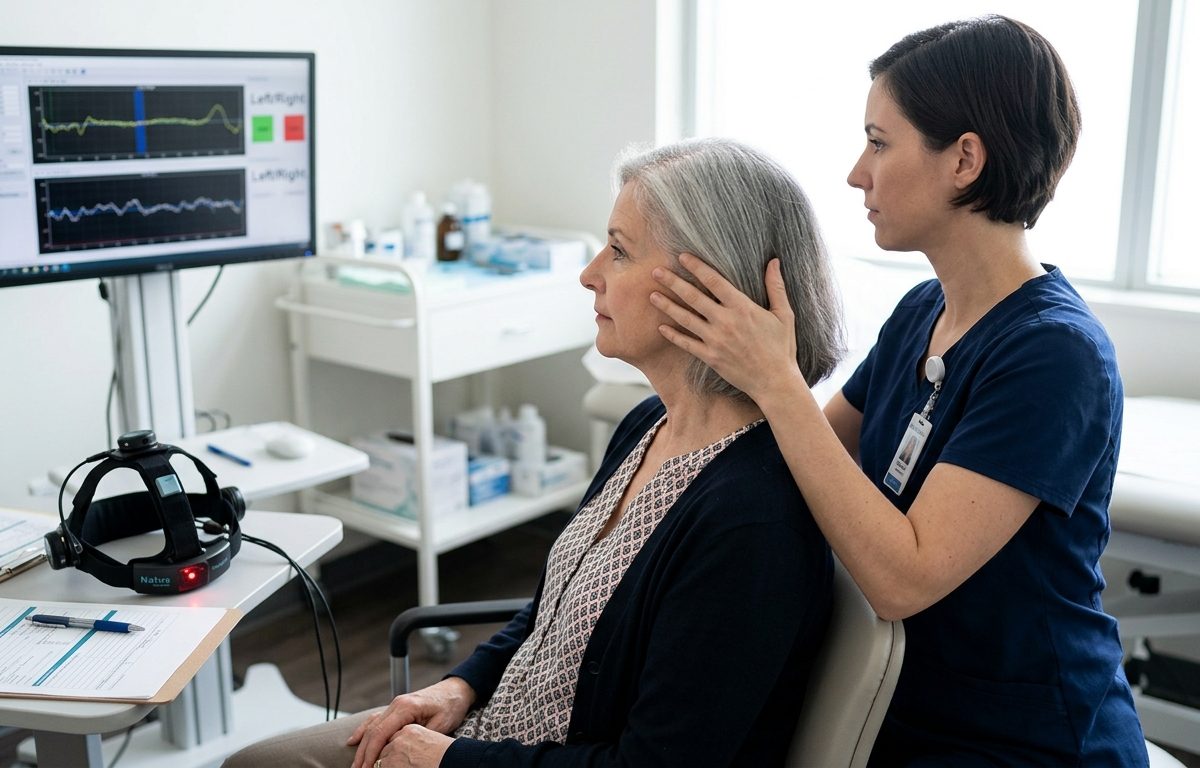
That history is then paired with exam findings such as positional testing, eye movement testing, balance tasks, cervical assessment, and visual-vestibular interaction checks.
When is dizziness with head turning an emergency?
Most cases of movement-triggered dizziness are not emergencies, but some are. Urgent medical assessment is appropriate if dizziness comes with:
- New weakness or numbness
- Double vision
- Slurred speech
- Severe new headache
- Fainting
- Chest pain
- New trouble walking that is severe or sudden
- Sudden hearing loss
If those symptoms are present, emergency or conventional medical evaluation comes first. Rehabilitation-focused care is not a substitute for ruling out urgent neurologic or vascular causes.
What does an evaluation for dizziness with head movement usually include?
At a clinic level, a useful workup often includes:
Detailed symptom pattern review
The clinician looks at when the dizziness started, what movements trigger it, how long it lasts, what other symptoms travel with it, and whether there was an injury, infection, migraine history, or major stressor before it began.
Positional and vestibular testing
Testing may help determine whether the problem behaves like BPPV, motion sensitivity, vestibular hypofunction, or a visual-vestibular mismatch. That matters because each of those patterns tends to need a different plan.
Cervical and movement assessment
If symptoms change with neck movement, posture, or muscle tension, the neck may be part of the story. The question is not simply "is it the neck?" but rather how much the neck is contributing compared with vestibular or migraine factors.
Neurologic and oculomotor screening
Eye tracking, gaze stabilization, balance integration, and motion tolerance can reveal why simple head turns feel harder than they should. This is especially useful for people with ongoing symptoms after concussion, whiplash, or persistent motion intolerance.
What treatment depends on the cause?
Yes. The plan should match the mechanism rather than the symptom label alone.
- If BPPV is present, positional maneuvers may be appropriate.
- If the neck is a contributor, care may focus on cervical mobility, sensorimotor control, and reducing provocation from neck-driven input.
- If vestibular migraine is likely, the plan may include trigger management, coordinated conventional medical follow-up, and gradual visual-vestibular rehabilitation.
- If post-concussion dizziness is the issue, rehabilitation may target gaze stability, balance, graded movement tolerance, and cervical-vestibular integration.
The clinic's role is typically to support neurologic and vestibular function through evaluation and rehabilitation planning, not to replace emergency medicine, ENT care, or other conventional diagnostics when those are needed.
Why local context matters in San Diego
In San Diego, many patients notice dizziness when turning the head during driving, cycling, fitness classes, beach walks, or visually busy shopping areas. That local lifestyle context matters because the symptom may show up most when the brain has to process motion, light, crowds, and fast environmental changes all at once. A good exam should connect symptoms to real-life situations, not just to a single table test.
For some patients, that means the most helpful plan is not more rest. It is a graded return to movement with the right type of vestibular, visual, and balance progression.
Can this get better?
Many people do improve once the true driver is identified. That is especially true when care is matched to the right pattern early instead of bouncing between guesses. Short positional vertigo can respond differently from migraine-related dizziness, and both differ from neck-related or post-concussion cases. Progress tends to improve when the cause is defined clearly and tracked over time.
When should you book an evaluation?
It is reasonable to seek evaluation if:
- Dizziness with head turning keeps repeating
- It interferes with driving, work, sleep, or exercise
- You also have neck pain, motion sickness, headaches, or past concussion history
- The symptom persists after trying home positional maneuvers
- You are no longer sure whether the issue is vestibular, cervical, migraine-related, or post-injury
If you want a clearer understanding of why head motion is provoking symptoms, a structured dizziness evaluation can help sort out the likely contributors and what next steps make sense.
Call (619) 344-0111 or book a free consultation.
FAQ
Why do I get dizzy when I turn my head but not when I sit still?
That usually suggests the symptom is being triggered by motion or positional change rather than by a constant baseline problem. Common possibilities include BPPV, vestibular migraine, cervical input problems, or post-concussion vestibular issues.
Is dizziness when turning my head more likely to be vertigo or a neck problem?
It can be either, and sometimes both systems contribute. Brief spinning in bed often points more toward positional vertigo, while dizziness with neck pain or whiplash history may increase suspicion for a cervical component.
Can a concussion or whiplash make head-turn dizziness last for months?
Yes. Some people continue to have vestibular, visual, or cervical irritation long after the original injury, which can keep head movement feeling provocative until the pattern is assessed and addressed appropriately.
When should dizziness with head movement be treated as an emergency?
Seek urgent medical care if the dizziness comes with sudden weakness, numbness, slurred speech, severe headache, fainting, chest pain, or sudden hearing loss.
What kind of evaluation helps identify the cause?
The most useful evaluation usually combines symptom history, positional testing, eye movement assessment, balance screening, and cervical assessment so the pattern can be narrowed more accurately.
References
- Bhattacharyya N, Gubbels SP, Schwartz SR, et al. Clinical Practice Guideline: Benign Paroxysmal Positional Vertigo (Update). Otolaryngol Head Neck Surg. 2017. https://pubmed.ncbi.nlm.nih.gov/28248609/
- Reiley AS, Vickory FM, Funderburg SE, Cesario RA, Clendaniel RA. How to diagnose cervicogenic dizziness. Arch Physiother. 2017. https://pubmed.ncbi.nlm.nih.gov/29340214/
- Lempert T, von Brevern M. Vestibular migraine: Diagnostic criteria (update). J Vestib Res. 2022. https://pubmed.ncbi.nlm.nih.gov/34719447/
- Murray DA, Meldrum D, Lennon O. Can vestibular rehabilitation exercise improve concussion-related symptoms? A systematic review. Br J Sports Med. 2017. https://pubmed.ncbi.nlm.nih.gov/27655831/
Medical disclaimer: This article is for educational purposes only and is not medical advice, diagnosis, or emergency guidance. New, severe, or rapidly changing neurologic symptoms should be assessed urgently through appropriate medical care.
Not sure what is driving your symptoms?
Talk with our Functional Neurology Trained team on a free phone consultation. We will tell you honestly whether we can help.