Visual Vertigo Treatment San Diego: Why Busy Places Trigger Dizziness
Free phone consultation with our San Diego functional neurology team. No obligation.
For some people, dizziness does not show up most when they are standing still. It shows up when they walk into a grocery store, scroll on a phone, drive past fast-moving traffic, or turn through a crowded aisle. That pattern often points to visual vertigo, sometimes called visually induced dizziness or visual dependence. In San Diego, these symptoms can interfere with work, errands, exercise, and even simple daily routines.
Visual vertigo usually reflects a problem in how the brain is weighting visual, vestibular, and body-position signals rather than one simple cause that applies to everyone. A person may feel fine in a quiet room but become unsteady, foggy, lightheaded, or nauseated when there is a lot of motion in the environment. Research on chronic dizziness and vestibular disorders supports the idea that visually busy environments can provoke symptoms when the nervous system begins to rely too heavily on visual input or struggles to integrate motion correctly.
At San Diego Chiropractic Neurology, the clinical goal is not to guess. It is to look closely at what triggers the dizziness, what systems appear overloaded, and what type of rehabilitation may help the nervous system tolerate motion better over time. For patients searching for visual vertigo treatment in San Diego, that process starts with understanding what visual vertigo is and what a thorough evaluation should include.
What is visual vertigo?
Visual vertigo is a symptom pattern in which visually complex or fast-moving environments trigger dizziness, disorientation, imbalance, or nausea. Common examples include grocery stores, warehouse stores, busy sidewalks, airports, escalators, patterned floors, scrolling on a screen, or driving in heavy traffic. Some people describe the feeling as motion sickness without actual motion. Others say the room seems overwhelming, their balance feels unreliable, or their eyes and brain cannot keep up.
This symptom pattern often overlaps with terms such as visual dependence, visually induced dizziness, and in some cases persistent postural-perceptual dizziness. The exact diagnosis depends on the rest of the history and exam. The important point is that the symptoms are real, common, and often connected to how the brain processes motion, orientation, and balance signals.
Why busy environments can trigger dizziness
Balance depends on coordinated input from three major systems: the inner ear or vestibular system, vision, and body-position feedback from muscles and joints. In healthy conditions, the brain blends those signals smoothly. When one part of the system is disrupted, the brain may start leaning too hard on the remaining inputs. If that compensation becomes inefficient, visual motion may begin to feel threatening or overwhelming.
That is why some people feel much worse in supermarkets, big-box stores, crowds, or highly patterned spaces. The shelves, lights, passing people, and motion in the peripheral field create more sensory traffic than the system can filter well. Studies on visually induced dizziness support this model and show that rehabilitation can improve tolerance when the provoking mechanisms are identified clearly.
Common causes and associated conditions
Visual vertigo is not one diagnosis by itself. It may appear after or alongside several different problems, including:
- an inner ear vestibular disorder
- vestibular migraine
- a concussion or post-concussion recovery pattern
- persistent postural-perceptual dizziness
- poor visual-vestibular integration
- neck-related balance or spatial-orientation issues in some cases
That is one reason generic advice often falls short. Two people can both feel dizzy in Costco but need very different treatment plans. One may need vestibular rehabilitation after a vestibular insult. Another may need a migraine-informed approach. Another may need post-concussion oculomotor and balance rehabilitation. Good care depends on finding the driver, not just naming the symptom.
What symptoms often come with visual vertigo?
People with visual vertigo may report:
- dizziness in grocery stores or crowds
- motion sensitivity when riding in a car or watching traffic
- worsening symptoms when scrolling on a phone or computer
- imbalance on patterned floors or in open spaces
- nausea, head pressure, or a floating sensation
- brain fog, fatigue, or eye strain after visually busy tasks
These symptoms do not automatically mean a dangerous problem, but they do justify a careful evaluation when they persist, limit function, or appear after a concussion, vertigo episode, migraine flare, or other neurologic change.
What a thorough San Diego evaluation should include
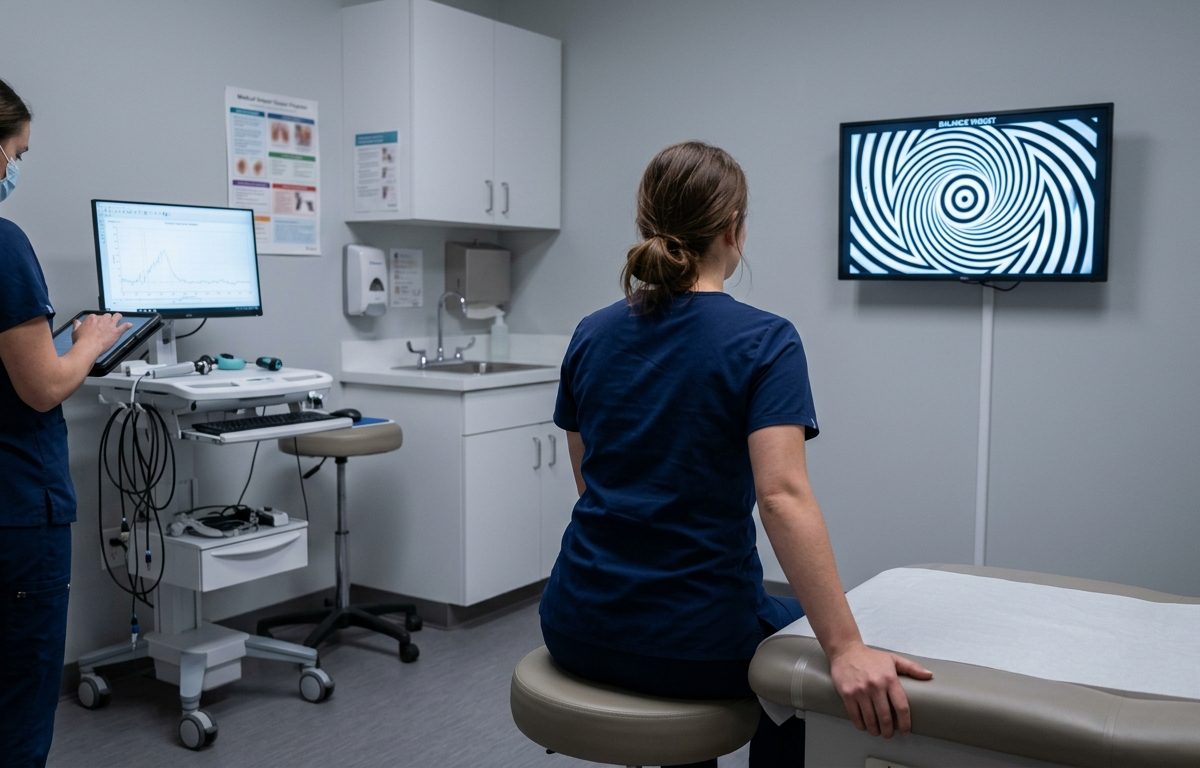
A useful workup for visual vertigo should do more than ask whether the room spins. It should identify patterns. That usually includes a detailed history, trigger review, balance testing, eye movement assessment, motion sensitivity screening, and a look at how the visual and vestibular systems interact during real tasks.
At a clinic level, that may include:
- review of symptom timing, duration, triggers, and recovery pattern
- screening for migraine, concussion history, and vestibular history
- oculomotor testing such as tracking, saccades, and gaze stability
- balance and gait testing
- visual motion sensitivity or habituation screening
- cervical and postural contributors when appropriate
This type of process helps determine whether the person seems most limited by vestibular hypofunction, migraine-related sensitivity, post-concussion visual overload, PPPD-style persistent dizziness, or another mixed presentation. That distinction matters because treatment should match the mechanism.
What visual vertigo treatment may include
Treatment is usually built around vestibular and sensorimotor rehabilitation rather than passive care alone. Clinical practice guidelines and review literature support several core strategies when they are selected appropriately and progressed carefully.
1. Gaze stabilization
These exercises work on keeping visual targets clear during head movement. They may help when the vestibular system is not stabilizing vision efficiently.
2. Habituation and graded exposure
This approach gradually exposes the person to symptom-provoking visual motion in controlled doses. The goal is to reduce overreaction to motion rather than avoiding every trigger forever.
3. Balance and postural training
When the nervous system becomes less confident in balance, people often stiffen, move less naturally, and become even more visually dependent. Balance training can help restore more reliable sensory integration.
4. Oculomotor rehabilitation
If tracking, saccades, convergence, or visual endurance are part of the problem, specific visual tasks may be included in care.
5. Trigger-specific progression
For some patients, the most meaningful step is not a generic exercise sheet. It is a structured progression toward real-world triggers such as supermarket aisles, scrolling, busy intersections, or large-box retail stores.
What to avoid when symptoms are flaring
It is understandable to avoid every symptom trigger, but total avoidance can make the system more sensitive over time. At the same time, pushing too hard too fast can backfire. The best middle ground is usually graded exposure with a clear plan. That means choosing a difficulty level the nervous system can handle, repeating it consistently, and increasing complexity step by step.
Patients also often benefit from tracking sleep, hydration, visual load, stress, migraine triggers, and recent illness, because those factors can lower the threshold for dizziness and motion sensitivity. A flare in one area can make a previously manageable store or screen suddenly feel overwhelming.
When visual vertigo may overlap with concussion or migraine
Visual vertigo often appears in patients with concussion recovery problems or vestibular migraine patterns. After a concussion, the brain may become less efficient at handling eye movements, motion processing, and multisensory integration. In migraine-prone patients, visual motion may become a strong symptom amplifier even when classic headache is not the main complaint. That is why a narrow one-size-fits-all treatment plan can miss the mark.
For related topics, patients often benefit from reading about concussion symptoms and recovery patterns and migraine-related dizziness patterns when those issues are part of the picture.
When to seek help
If busy environments repeatedly trigger dizziness, if the problem has been hanging on after vertigo, illness, or concussion, or if the symptoms are causing avoidance of normal activities, it is worth getting checked. New neurologic symptoms, severe headache, fainting, chest pain, new hearing loss, or other urgent changes should be assessed through the appropriate medical channel promptly.
For persistent but non-emergency symptoms, a more detailed vestibular and neurologic evaluation may help clarify whether the pattern looks like visual dependence, vestibular dysfunction, concussion-related sensory overload, migraine-associated dizziness, or another problem that needs a different referral path.
How San Diego Chiropractic Neurology approaches these cases
At San Diego Chiropractic Neurology, visually induced dizziness is approached as a functional problem to be assessed carefully, not just labeled broadly. The clinic looks at the interaction between eye movements, vestibular processing, motion tolerance, posture, and symptom triggers. When rehabilitation is appropriate, the plan is built around the person’s actual symptom profile and progressed gradually.
Patients dealing with dizziness in visually busy settings may also find it helpful to review the clinic’s pages on vertigo and dizziness and vestibular therapy for a broader picture of evaluation and rehabilitation options.
Bottom line
Visual vertigo can make ordinary places feel exhausting and unpredictable, but it is a recognizable pattern. When the cause is identified clearly, care can focus on the systems that are actually driving the sensitivity. That usually means a structured evaluation and a rehabilitation plan that targets motion tolerance, balance, gaze stability, and visual-vestibular integration rather than generic reassurance alone.
Call (619) 344-0111 or book a free consultation if you want to explore whether a detailed dizziness and balance evaluation may help clarify the next step.
Medical disclaimer: This article is for educational purposes only and is not medical advice. It does not replace individualized evaluation, diagnosis, or treatment by a licensed medical professional. If you have severe, sudden, or concerning symptoms, seek appropriate urgent medical care.
Frequently Asked Questions
What is visual vertigo?
Visual vertigo is dizziness or disorientation triggered by visually busy or fast-moving environments such as grocery stores, crowds, scrolling screens, or traffic.
Why do grocery stores make me dizzy?
Grocery stores combine bright lighting, long aisles, patterned floors, and lots of peripheral motion. For people with visual dependence or vestibular dysfunction, that sensory load can overwhelm balance processing.
Can visual vertigo happen after a concussion?
Yes. After a concussion, some people become more sensitive to motion, screens, and busy environments because visual and vestibular processing may be less efficient during recovery.
What does treatment usually include?
Treatment often includes vestibular rehabilitation, gaze stabilization, habituation, balance training, and graded exposure to visual triggers when those strategies fit the evaluation findings.
References
- Hall CD, et al. Vestibular Rehabilitation for Peripheral Vestibular Hypofunction: Updated Clinical Practice Guideline. J Neurol Phys Ther. 2022.
- Staab JP. Persistent Postural-Perceptual Dizziness. Continuum (Minneap Minn). 2022.
- Popkirov S, Staab JP, Stone J. Persistent postural-perceptual dizziness. Nat Rev Dis Primers. 2018.
- Pavlou M, et al. Visually induced dizziness and rehabilitation evidence update. J Neurol. 2024.
- McDonnell MN, et al. Vestibular rehabilitation for chronic dizziness: systematic review. J Neurol. 2025.
Not sure what is driving your symptoms?
Talk with our Functional Neurology Trained team on a free phone consultation. We will tell you honestly whether we can help.