Visual Migraine Treatment San Diego: What Non-Drug Care May Include
Free phone consultation with our San Diego functional neurology team. No obligation.
Visual migraine symptoms can be unsettling. Some people notice shimmering lights, zigzag lines, blind spots, screen intolerance, motion sensitivity, or dizziness. Others feel head pressure, nausea, neck tension, or brain fog before or during an episode. In San Diego, many people searching for visual migraine treatment are not just asking what the symptom is called. They want to know why it keeps happening, what may be triggering it, and what non-medication options may help them function better day to day.
Visual migraine symptoms do not always look the same from person to person. Some episodes happen with head pain. Others happen with little or no headache. That is part of what makes the condition confusing. A person may think they have an eye problem, a balance problem, or a sinus issue when the real pattern is more neurologic and sensory in nature. A structured evaluation can help sort through those overlapping patterns so care is aimed at the right problem instead of guessing.
At San Diego Chiropractic Neurology, the focus is on a non-invasive evaluation of how visual, vestibular, cervical, and neurologic systems may be interacting. That matters because persistent migraine-related symptoms often have more than one driver. A patient may have light sensitivity, visual motion intolerance, neck pain, and dizziness all at once. When those patterns are identified clearly, rehabilitation can be more targeted and practical.
Research on persistent post-concussion and vestibular symptoms supports individually tailored nonpharmacological care, including graded exercise, vestibular rehabilitation, and interdisciplinary management when symptoms linger. Although visual migraine is not identical to concussion, the same principle applies: recurring neurologic symptoms often respond best when care is matched to the specific symptom pattern rather than treated as one generic complaint. Exercise intolerance, autonomic stress, visual sensitivity, and vestibular mismatch can all feed the cycle.
What is a visual migraine?
The term “visual migraine” is often used informally to describe migraine episodes that involve visual symptoms. These symptoms may include flashing lights, shimmering patterns, blind spots, blurred vision, difficulty focusing, sensitivity to screens, or discomfort in busy visual environments. Some people also report dizziness, nausea, disorientation, or trouble tolerating grocery stores, traffic, or scrolling on a phone.
In many cases, these symptoms fit within a migraine spectrum. That spectrum can involve sensory overload, abnormal visual processing, neck-related input, sleep disruption, stress physiology, and vestibular dysfunction. Migraine is not always just a headache problem. It can affect how the brain handles motion, light, visual detail, and environmental stimulation.
Because the symptom picture can be broad, evaluation matters. A person with “visual migraine” may actually be dealing with vestibular migraine, persistent motion sensitivity, post-concussion visual dysfunction, cervicogenic triggers, or a mixture of several issues. That is one reason quick label-based treatment often falls short.
Why symptoms can keep coming back
Recurring visual migraine symptoms often involve a trigger-load problem rather than a single cause. A person may be able to tolerate one stressor, but not five at once. Poor sleep, dehydration, prolonged screen time, neck tension, missed meals, visual overexposure, motion-rich environments, and stress can all lower tolerance. Once that threshold is crossed, symptoms may build quickly.
For some people, the biggest driver is visual sensitivity. For others, it is vestibular mismatch, poor autonomic regulation, or mechanical stress from the neck. That is why a useful plan does more than tell patients to avoid triggers forever. It tries to identify the biggest symptom generators and improve tolerance gradually.
This is also where patients often feel stuck. They may have already tried rest, general advice, or medication changes, but still feel limited by screens, driving, fluorescent lights, or crowded places. When that happens, it makes sense to look more closely at the neurologic and sensory systems involved.
What a non-drug evaluation may include
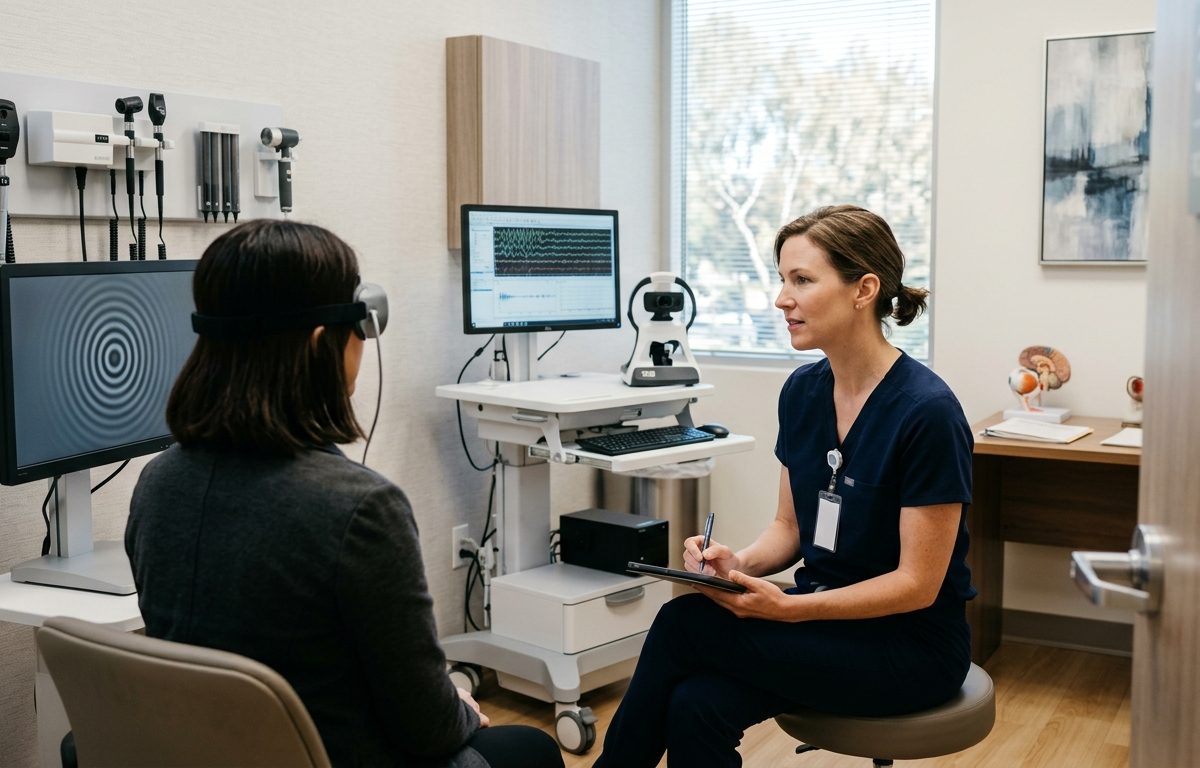
Non-drug care starts with identifying the pattern. A visual migraine evaluation may look at symptom history, onset pattern, frequency, environmental triggers, neck involvement, dizziness, visual motion sensitivity, exercise tolerance, and whether symptoms behave more like vestibular migraine, visual overload, or a combined sensory issue.
Depending on the case, evaluation may include:
- Visual tracking and eye movement screening
- Convergence and focusing tolerance
- Motion sensitivity and visual dependence patterns
- Balance and vestibular screening
- Cervical spine and neck-trigger assessment
- Light sensitivity and screen tolerance history
- Exertional tolerance and symptom threshold review
This approach helps answer practical questions. Does scrolling trigger symptoms because of visual motion sensitivity? Does head movement or neck stiffness amplify the episodes? Does busy visual input cause dizziness because vestibular processing is lagging? Is low exercise tolerance adding to the pattern? Those questions help direct care much better than assuming every migraine episode is the same.
How visual and vestibular problems can overlap
Many people with visual migraine symptoms also describe dizziness, motion sensitivity, imbalance, or discomfort in places with a lot of movement. That overlap is not unusual. The brain constantly blends information from the eyes, inner ear, body position sensors, and neck. When that integration becomes inefficient, symptoms can show up in busy environments, while reading, or when shifting focus between near and far targets.
That is one reason visual migraine symptoms can feel worse in grocery stores, on freeways, inside large retail spaces, or while using a computer. These settings place a high demand on visual motion processing and sensory filtering. If the system is already irritable, even routine tasks can feel overwhelming.
Vestibular rehabilitation is one nonpharmacological option with support in the literature for persistent symptom patterns involving dizziness and motion sensitivity. When appropriate, visual exercises and vestibular exercises may be introduced gradually to help improve tolerance rather than simply asking the patient to avoid all symptom triggers forever.
The role of the neck in visual migraine symptoms
Neck dysfunction is easy to overlook when patients focus on visual symptoms or headache. But neck tension, stiffness, and altered cervical input can amplify dizziness, head pressure, motion sensitivity, and migraine-like episodes. Some patients notice their symptoms build after long hours at a desk, poor posture, driving, or after a prior whiplash or head injury.
Manual treatment and cervical-focused care have also been included among nonpharmacological strategies discussed in persistent symptom research. That does not mean every migraine is a neck problem. It means the neck can be part of the overall trigger pattern, and missing that piece can leave patients partially improved but still limited.
When the neck is contributing, care may focus on reducing mechanical irritation, improving tolerance to head movement, and restoring better coordination between cervical input, eye movement, and balance systems.
Can exercise help if symptoms are easily triggered?
Yes, but only if it is dosed appropriately. One of the most helpful shifts in concussion and neurologic rehabilitation literature has been the move away from the idea that complete rest is always best. Sub-symptom threshold aerobic exercise may help support recovery and normalize physiologic stress responses when it is introduced carefully and matched to tolerance.
That same principle can matter for patients with migraine-related dizziness and visual overload. If a person is completely deconditioned, or if even mild exertion increases symptoms quickly, graded activity may need to be introduced in a structured way. The goal is not to push through symptoms blindly. The goal is to find a tolerable starting point and build capacity over time.
For some people, that means simple walking progression. For others, it may involve more formal exertional threshold work as part of a broader rehab plan. Either way, the key is that exercise should be individualized. Too much too soon can aggravate symptoms. Too little for too long can also keep people stuck.
How conventional care and rehabilitation care fit together
This distinction matters. Conventional medical care is important when visual symptoms are new, severe, progressive, or associated with concerning neurologic signs. Medication management, emergency evaluation, ophthalmology, neurology, and primary care all have an important role depending on the situation.
Rehabilitation-focused care has a different role. It looks at function: how the brain is handling visual input, movement, exertion, neck input, and day-to-day activity demands. At San Diego Chiropractic Neurology, the clinic’s role is not to replace emergency or medical management. It is to evaluate neurologic performance patterns and build a rehabilitation plan aimed at improving regulation, tolerance, and function.
That distinction is especially important for patients who have already been told their imaging is normal but still do not feel normal. A normal scan does not automatically explain why reading, driving, screens, or busy spaces still feel so hard. Functional testing and symptom-guided rehabilitation may help fill that gap.
What non-medication treatment may include
Non-medication treatment depends on the findings, but may include a combination of:
- Education on trigger load and pacing
- Visual tolerance and eye movement exercises when indicated
- Vestibular rehabilitation for dizziness and motion sensitivity
- Cervical care when neck-related triggers are present
- Gradual return-to-exercise planning
- Screen and environmental modification strategies
- Home exercises aimed at sensory tolerance and neurologic regulation
For some patients, the biggest win is understanding their pattern clearly for the first time. Once they know whether the main issue is visual overload, vestibular mismatch, neck involvement, exertional intolerance, or a combination, the plan becomes more practical and less random.
Patients dealing with related symptoms may also benefit from learning more about migraine-related symptom patterns, dizziness and vertigo evaluation, vestibular therapy, and neuro-visual rehabilitation when those systems appear involved.
When to seek an evaluation
It makes sense to seek an evaluation when symptoms keep returning, when visual environments feel harder to tolerate, or when work, driving, reading, screens, or exercise are becoming limited. It also makes sense when the problem has been labeled broadly but no one has looked closely at the sensory and neurologic pieces that may be keeping symptoms active.
In San Diego, this issue is especially relevant for people juggling commuting, heavy device use, office lighting, fitness routines, and active family schedules. Many everyday environments place a real load on the visual and vestibular systems. If those systems are already irritable, symptoms can become a constant interruption instead of an occasional event.
An evaluation can help clarify whether the pattern looks primarily migraine-related, vestibular, cervical, post-concussive, or mixed. That clarity often shapes better decisions about what type of care is worth pursuing next.
What patients should expect from a good plan
A good plan should be individualized, measurable, and realistic. It should explain which systems seem involved, what the early priorities are, which triggers matter most, and how progress will be tracked. It should also make room for adjustments. Some patients respond quickly to environmental changes and graded rehab. Others need a slower build because they are reacting to multiple triggers at once.
Most of all, a good plan should reduce confusion. Many patients with visual migraine symptoms have heard broad advice like “just rest,” “avoid stress,” or “drink more water,” but still feel stuck. Those basics may help, but they are rarely enough when the underlying issue involves sensory processing, vestibular interaction, neck contribution, or exertional intolerance.
If the right pattern is identified, non-drug care may help improve tolerance, reduce symptom spirals, and make normal daily activities feel manageable again. That is the real goal: better function, better clarity, and a plan that fits how the symptoms actually behave.
FAQs About Visual Migraine Treatment San Diego
Can visual migraine happen without a severe headache?
Yes. Some people have strong visual symptoms with only mild headache or no significant head pain at all. That is one reason the condition can be confused with an eye or balance problem.
What non-medication treatments may help visual migraine symptoms?
Depending on the findings, non-medication care may include vestibular rehabilitation, visual exercises, cervical care, graded aerobic activity, trigger-load management, and environmental modifications.
Why do grocery stores, screens, or driving trigger symptoms?
These environments place a heavy demand on visual motion processing and sensory filtering. If visual and vestibular systems are irritated or poorly coordinated, busy environments may trigger dizziness, disorientation, or migraine symptoms.
When should visual migraine symptoms be evaluated?
Evaluation is worth considering when symptoms keep recurring, interfere with work or driving, or when dizziness, motion sensitivity, or neck pain overlap with visual complaints.
Is this the same as standard medical migraine treatment?
No. Medical care may include diagnosis, medication discussions, and referral decisions. Rehabilitation-focused care looks more closely at function, tolerance, sensory triggers, and non-drug strategies to improve day-to-day performance.
Call (619) 344-0111 or book a free consultation to discuss whether a functional neurology and rehabilitation-based evaluation may be appropriate for recurring visual migraine symptoms in San Diego.
Medical disclaimer: This article is for educational purposes only and is not medical advice. New, severe, or rapidly worsening neurologic symptoms, vision changes, or headache symptoms should be evaluated promptly by an appropriate licensed medical professional.
References
- Rytter HM, Graff HJ, Christensen HB, et al. Nonpharmacological Treatment of Persistent Postconcussion Symptoms in Adults: A Systematic Review and Meta-analysis and Guideline Recommendation. JAMA Netw Open. 2021;4(11):e2132221. https://pmc.ncbi.nlm.nih.gov/articles/PMC8579233/
- Leddy JJ, Haider MN, Ellis MJ, Willer BS. Exercise is Medicine for Concussion. Curr Sports Med Rep. 2018;17(8):262-270. https://pmc.ncbi.nlm.nih.gov/articles/PMC6089233/
- Scripps Health. Brain Injury Rehab Outpatient Program. https://www.scripps.org/services/physical-rehabilitation/brain-injury-rehab
- San Diego Sports Medicine. Concussion Clinic. https://www.sdsm.com/blog/concussion-clinic/
Not sure what is driving your symptoms?
Talk with our Functional Neurology Trained team on a free phone consultation. We will tell you honestly whether we can help.