Vestibular Therapy San Diego: What to Know Before You Start
Free phone consultation with our San Diego functional neurology team. No obligation.
Dizziness can disrupt almost every part of the day. Some people feel a brief spinning sensation when they roll in bed. Others feel unsteady in grocery store aisles, uncomfortable in busy traffic, or wiped out after looking up from a computer. When those symptoms keep returning, many people start searching for vestibular therapy San Diego because they want a clearer explanation and a plan that feels specific to what they are experiencing.
Vestibular therapy is a form of rehabilitation built around the balance system. It is not one single exercise and it is not just a generic dizziness program. A good plan is based on testing. It looks at how the inner ear, eyes, neck, brain, posture, and movement systems are working together. At San Diego Chiropractic Neurology, care is framed around that broader functional neurology and rehabilitation picture, with the goal of improving tolerance, stability, and day-to-day function.
For many patients in San Diego, the right first step is not guessing whether the problem is “vertigo” in general. It is figuring out which dizziness pattern is present and which exercises match that pattern. Research supports vestibular rehabilitation for peripheral vestibular hypofunction and related balance complaints, with meaningful gains in dizziness and gait outcomes when the program is targeted to the deficit.
What vestibular therapy is designed to do
The vestibular system helps the body know where it is in space. It works with the eyes, neck, muscles, and brain to keep vision stable and balance organized during movement. When one part of that system is not working well, symptoms can show up as spinning, rocking, floating, imbalance, visual sensitivity, nausea, or a sense that the body is delayed compared with the environment.
Vestibular therapy is designed to challenge and retrain those pathways in a controlled way. Depending on the exam, that may include gaze stabilization drills, balance retraining, habituation for motion sensitivity, positional work, walking tasks, visual-vestibular integration, or home exercises that gradually increase tolerance.
This matters because not all dizziness behaves the same way. A person with benign paroxysmal positional vertigo may need repositioning maneuvers first. A person with vestibular hypofunction may need repeated head-eye coordination drills. A person with lingering dizziness after concussion may need a broader visual-vestibular and balance progression. Studies and clinical guidelines support that symptom drivers should be identified before a plan is built.
Who may benefit from vestibular rehabilitation
People often assume vestibular therapy is only for classic spinning vertigo. In reality, it can be relevant for a wider range of complaints, including:
- Positional vertigo that keeps returning
- Residual dizziness after an Epley maneuver or other repositioning care
- Unsteadiness while walking
- Motion sensitivity in stores, traffic, or crowded spaces
- Visual intolerance with scrolling, screens, or fast head turns
- Dizziness after concussion
- Chronic imbalance linked to vestibular weakness
- Sensations of rocking, floating, or disorientation
Some patients also have overlap with migraine, neck pain, or post-concussion symptoms. In those cases, the exam has to separate what is primarily vestibular from what is being amplified by visual load, cervical input, autonomic stress, or neurologic fatigue. That is one reason a more detailed rehabilitation model can be helpful.
What an evaluation usually includes
A vestibular therapy evaluation should do more than ask whether dizziness is present. It should ask what triggers it, how long it lasts, what direction symptoms move in, and whether there are hearing, headache, visual, neck, or neurologic factors alongside it.
Testing often includes:
- Symptom history and trigger review
- Eye tracking and gaze stability testing
- Positional testing for vertigo patterns such as BPPV
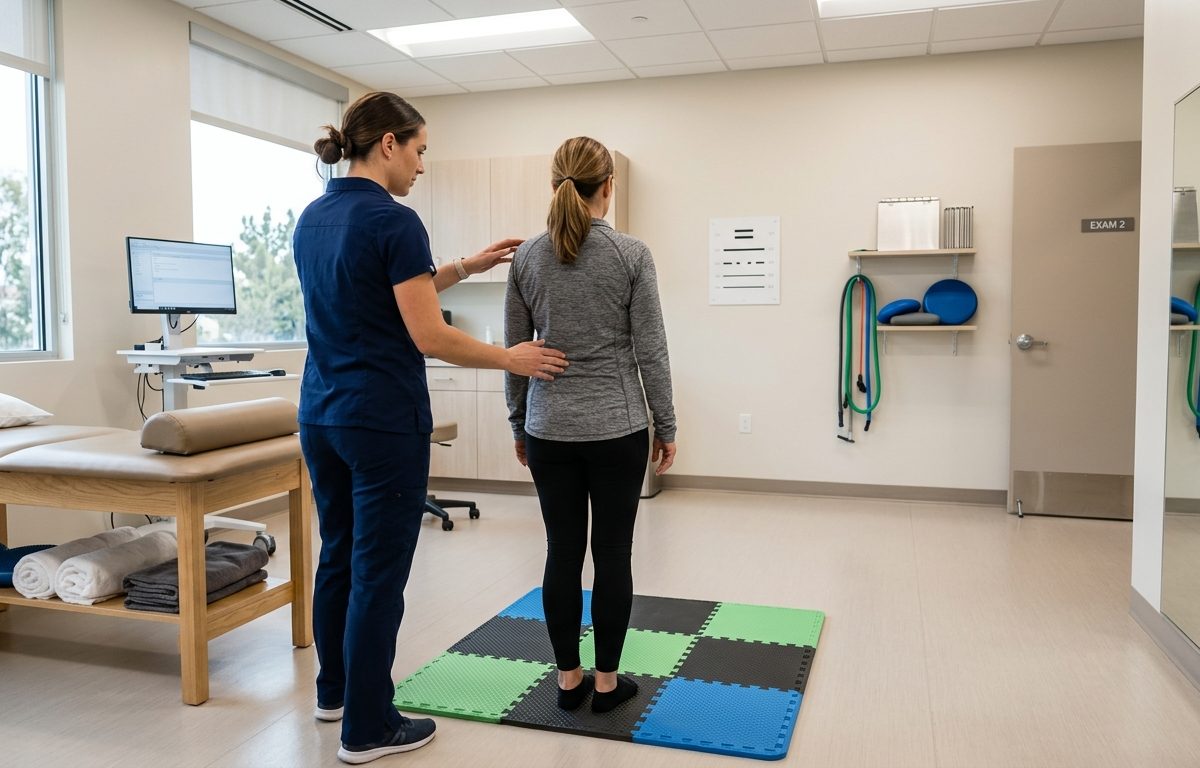
- Balance testing on different surfaces
- Walking and turning assessment
- Head movement tolerance
- Visual motion sensitivity screening
- In some cases, cervical and post-concussion screening
That type of workup helps determine whether the main issue looks more like a positional vertigo problem, vestibular hypofunction, post-concussion dizziness, visually induced dizziness, or a mixed picture. It also helps identify when a person needs conventional medical evaluation or ENT/neurology coordination rather than a rehab-first plan.
Vestibular therapy is not just the Epley maneuver
This is one of the most common misunderstandings. The Epley maneuver is a specific repositioning procedure used for certain forms of BPPV. It can be very helpful when the diagnosis fits. But it is not the same thing as vestibular rehabilitation as a whole.
Clinical guidance for BPPV supports repositioning as first-line management, while also recognizing that some people still have lingering imbalance, movement sensitivity, or recurrence patterns that call for broader rehab and follow-up. If dizziness remains after a maneuver, that does not automatically mean the maneuver “failed.” It may mean there is residual sensitivity, another canal is involved, or the main issue was never purely positional to begin with.
That is why a clinic offering vestibular therapy should be able to explain what part of the balance system is being trained and why.
How exercises are matched to the problem
The best vestibular rehab plans are not copy-and-paste. They are built around what the exam shows.
Gaze stabilization
These drills are used when vision becomes blurry or unstable with head movement. The goal is to improve how the eyes stay locked on a target while the head moves.
Habituation
These exercises are used when certain motions reliably provoke dizziness, such as bending, turning, or being in busy visual settings. The goal is not to ignore symptoms. It is to use graded exposure so the brain becomes less reactive over time.
Balance retraining
These drills work on postural control in standing and walking. They may include narrow-base stance, foam surfaces, turns, stepping patterns, and dual-task challenges when appropriate.
Positional treatment
If positional testing is positive, treatment may include canalith repositioning maneuvers and follow-up reassessment rather than general exercises alone.
Visual-vestibular integration
Some people tolerate stillness but feel off when the environment moves. In those cases, the plan may include graded visual motion exposure and eye-head coordination strategies. Patients with overlap symptoms may also benefit from related rehabilitation strategies discussed on the clinic’s concussion page or through broader balance and visual work.
What the timeline can look like
Many people want to know how fast vestibular therapy works. The honest answer is that it depends on the pattern, duration, and complexity of symptoms. BPPV can sometimes respond quickly when the diagnosis is correct. Vestibular hypofunction may improve over several weeks with consistent home practice. Post-concussion dizziness or persistent motion sensitivity may take longer because more systems are involved.
Progress is also affected by how specific the program is. A targeted plan that is adjusted as symptoms change tends to work better than a generic packet of exercises. Evidence reviews consistently support individualized vestibular rehabilitation rather than one-size-fits-all management.
In practical terms, patients are often looking for gains such as:
- Less spinning with bed mobility or head turns
- Better balance while walking
- Less nausea in stores or traffic
- Improved tolerance for screens and reading
- More confidence in normal daily movement
How functional neurology fits in
At a clinic with a functional neurology orientation, vestibular therapy is usually part of a larger rehabilitation process rather than a stand-alone menu item. The goal is to understand how vestibular input interacts with eye movements, balance, coordination, symptom tolerance, and neurologic performance.
That can matter when dizziness is not purely an inner-ear problem. Some patients have persistent visual dependence. Some have post-concussion mismatch between vestibular, ocular, and balance systems. Some have dizziness that is worsened by cervical motion, stress load, or sensory integration problems. In those cases, the rehab plan may include vestibular work alongside graded balance and visual tasks rather than relying on one maneuver or one explanation.
Consensus work on persistent perceptual dizziness also supports the idea that chronic dizziness can involve maladaptive processing of movement and visual input, not only a simple mechanical inner-ear event. That makes good evaluation even more important.
When urgent evaluation matters
Not all dizziness should go directly into exercise-based care. Sudden severe dizziness with new neurologic symptoms, fainting, chest pain, major weakness, facial droop, severe headache, double vision, or difficulty speaking needs urgent medical attention. The same is true when dizziness is accompanied by sudden hearing loss or other red-flag changes.
Vestibular therapy works best when the person is appropriately screened first. A responsible clinic should help identify when rehabilitation is appropriate and when conventional medical workup needs to happen first.
Why local context matters in San Diego
People searching for vestibular therapy in San Diego are often trying to solve a daily function problem, not just learn a definition. They may be commuting, working on screens, exercising outdoors, driving on busy freeways, or managing symptoms in crowded visual environments. A rehabilitation plan should reflect that real-world demand.
That is part of why local, individualized care matters. The right plan should connect symptoms to daily tasks and build a progression that makes those tasks easier again. For some patients, that means getting through a grocery store without feeling off balance. For others, it means turning their head while walking without drifting, or getting back to work after concussion-related dizziness.
What to ask before starting care
If you are comparing options for vestibular therapy San Diego, it helps to ask a few direct questions:
- Will the evaluation include positional testing, gaze stability, and balance assessment?
- How will the clinic decide whether symptoms are vestibular, visual, cervical, or mixed?
- Will exercises be adjusted based on symptom response?
- How much home exercise is expected?
- When does the clinic recommend ENT, neurology, or urgent medical follow-up instead?
Good answers to those questions usually indicate a more thoughtful process.
Bottom line
Vestibular therapy can be a useful option for people dealing with dizziness, motion sensitivity, and balance problems, but the value depends on matching the program to the actual source of symptoms. That starts with testing, not assumptions. A targeted plan may include repositioning, gaze stabilization, habituation, balance retraining, or broader visual-vestibular rehabilitation depending on the findings.
For patients in San Diego, the most helpful next step is usually a structured evaluation that can sort out what type of dizziness pattern is present and what kind of rehab makes sense. If you want to learn more about related balance concerns, the clinic also provides information on vertigo, neuro-visual rehabilitation, and other neurologic rehabilitation services.
Call (619) 344-0111 or book a free consultation to learn whether a vestibular rehabilitation evaluation is the right next step.
Medical disclaimer: This article is for educational purposes only and is not medical advice, diagnosis, or a substitute for emergency or physician care. Individual symptoms and care decisions should be evaluated by a qualified licensed medical professional.
Frequently asked questions
What conditions can vestibular therapy help with?
Vestibular therapy may help with positional vertigo, vestibular hypofunction, motion sensitivity, balance problems, and some lingering dizziness patterns after concussion when the evaluation supports that approach.
What happens during a vestibular therapy evaluation?
An evaluation may include symptom history, eye movement testing, positional testing, balance assessment, gait observation, and head movement tolerance testing to determine which systems are contributing to symptoms.
How long does vestibular therapy take?
Timelines vary. Some positional vertigo cases improve quickly, while vestibular weakness, chronic motion sensitivity, or post-concussion dizziness may take several weeks of progressive exercise and reassessment.
Is vestibular therapy the same as the Epley maneuver?
No. The Epley maneuver is a specific repositioning treatment for certain BPPV patterns. Vestibular therapy is broader and may include balance, gaze stabilization, habituation, and other rehabilitation strategies.
When should dizziness be evaluated urgently?
Urgent evaluation is important if dizziness comes with new neurologic symptoms, chest pain, fainting, sudden severe headache, trouble speaking, facial droop, major weakness, or sudden hearing loss.
References
- Hall CD, et al. Vestibular rehabilitation for peripheral vestibular hypofunction: updated clinical practice guideline. J Neurol Phys Ther. 2022. PubMed.
- Bhattacharyya N, et al. Clinical Practice Guideline: Benign Paroxysmal Positional Vertigo (Update). Otolaryngology–Head and Neck Surgery. 2017. PubMed.
- Murray DA, et al. Effectiveness of vestibular rehabilitation after concussion: a systematic review. Int J Sports Phys Ther. 2022. PubMed.
- Staab JP, et al. Diagnostic criteria for persistent postural-perceptual dizziness. J Vestib Res. 2017. PubMed.
Not sure what is driving your symptoms?
Talk with our Functional Neurology Trained team on a free phone consultation. We will tell you honestly whether we can help.