Vertigo When Rolling Over in Bed Treatment
Free phone consultation with our San Diego functional neurology team. No obligation.
Vertigo when rolling over in bed treatment often starts with one important question: is the dizziness truly positional, and if so, what is triggering it? For many people, a brief spinning sensation when rolling to one side, lying back, or getting out of bed points toward benign paroxysmal positional vertigo, often called BPPV. That said, not every rolling-in-bed dizziness episode is the same. Some people also notice nausea, visual motion sensitivity, neck-related symptoms, balance problems, or lingering disequilibrium after the brief spinning stops.
At San Diego Chiropractic Neurology, the focus is on figuring out whether symptoms match a common positional vertigo pattern, whether a broader vestibular issue may be involved, and whether rehabilitation may help if dizziness keeps interfering with daily life. A clear exam matters because the right next step for a short BPPV episode is different from the right next step for ongoing dizziness, post-concussion symptoms, or mixed vestibular complaints.
Why rolling over in bed can trigger vertigo
When dizziness happens specifically during rolling, lying back, or sitting up, the pattern often suggests that the inner ear is reacting to head-position changes. In BPPV, tiny calcium carbonate particles called otoconia move into a semicircular canal where they do not belong. When the head changes position, those particles shift and create an abnormal signal that can cause a short burst of spinning vertigo.
This is why people with BPPV often say things like:
- "The room spins when I turn over in bed."
- "I get dizzy when I lie down flat."
- "It hits when I look up or sit up quickly."
That positional pattern is useful, but it is still only part of the story. A thorough evaluation also looks at how long the spinning lasts, whether one side consistently triggers it, whether there is nystagmus during testing, and whether symptoms behave like a straightforward inner-ear problem or something more complex.
Is it always BPPV?
No. BPPV is common, but it is not the only reason someone may feel dizzy when rolling over in bed. Other possibilities can include vestibular migraine, cervicogenic dizziness, lingering post-concussion vestibular dysfunction, anxiety-driven motion sensitivity, or less commonly, central neurologic causes that need a different medical workup.
That does not mean every positional dizziness episode is alarming. It just means that an article online should never replace a real exam when the pattern is unusual. Red flags may include:
- new neurologic symptoms
- double vision
- fainting
- weakness or numbness
- trouble speaking
- hearing changes that do not fit the usual pattern
- symptoms that do not behave like short positional episodes
When symptoms are brief, clearly position-triggered, and reproducible, BPPV remains high on the list. But if symptoms continue between position changes, keep returning despite repeated maneuvers, or feel mixed with migraine, concussion, or neck complaints, broader assessment is reasonable.
What evaluation should include
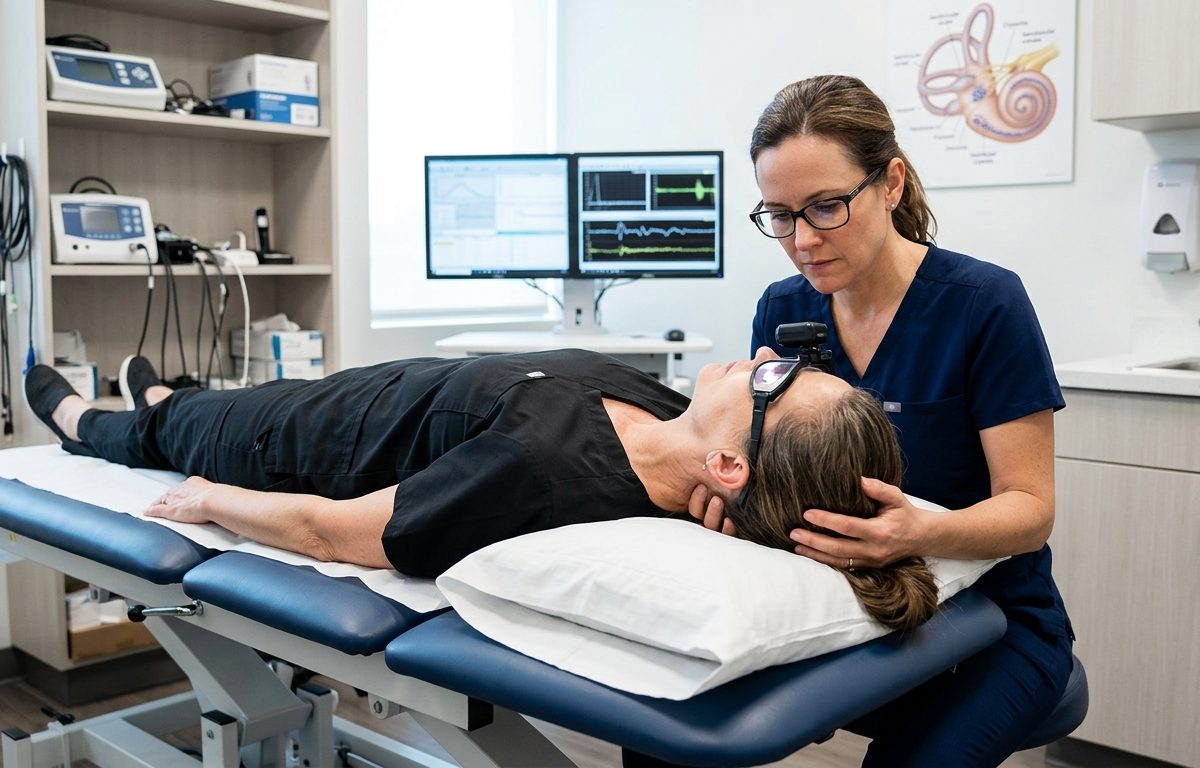
For vertigo when rolling over in bed treatment, the first step is not guessing. It is pattern recognition plus examination. A useful visit usually includes a history of triggers, symptom timing, balance complaints, nausea, visual symptoms, recent illness or head injury, and whether symptoms started after rolling one particular way in bed.
A structured vestibular and neurologic exam may include:
- positional testing such as Dix-Hallpike or supine roll testing
- observation for nystagmus
- eye movement testing
- balance and gait assessment
- head movement tolerance testing
- screening for neck-related contributors
The updated BPPV guideline supports positional testing because the exact symptom pattern and eye findings help identify which canal may be involved and whether canalith repositioning is likely to help. If testing does not match a clean BPPV pattern, that is useful too. It may point toward a different vestibular or neurologic pathway that needs attention.
What treatment may look like if it is BPPV
If the pattern clearly fits BPPV, the standard first-line approach is usually a canalith repositioning maneuver. For posterior canal BPPV, this often means a form of the Epley maneuver or a related repositioning sequence. These maneuvers are designed to guide displaced particles out of the involved canal so the inner ear can stop producing the abnormal spinning signal.
For many patients, that works well. Some improve quickly. Others need repeat maneuvers or follow-up testing. A common mistake is assuming that every failed internet maneuver means the diagnosis was wrong. Sometimes the maneuver was done incorrectly, the wrong canal was targeted, more than one canal is involved, or residual motion sensitivity is still present after the main BPPV episode improves.
That is one reason a real exam can save time. Instead of repeating generic online advice, the care plan can be matched to the actual positional pattern found during testing.
What if dizziness continues after repositioning?
This is where many patients get stuck. The spinning may improve, but they still feel off when moving through stores, turning quickly, riding in a car, bending over, or getting into bed. In those situations, residual dizziness, balance confidence loss, visual dependence, or broader vestibular dysfunction may still be in play.
That does not necessarily mean the original BPPV diagnosis was wrong. It can mean the acute trigger improved while the nervous system still needs help recalibrating. In those cases, vestibular rehabilitation may be useful. Rehabilitation can focus on:
- gaze stability
- balance retraining
- motion tolerance
- visual-vestibular integration
- gradual exposure to provoking movements
At the clinic, this is where a functional neurology and rehabilitation lens can matter. The role is not to make sweeping promises. It is to evaluate how the brain, inner ear, eyes, posture, and movement systems are working together, then support adaptation and tolerance with a structured plan when simple repositioning is not the full answer.
How vestibular rehabilitation may help
Vestibular rehabilitation is not the same as a canalith repositioning maneuver. Repositioning aims to correct a mechanical inner-ear problem. Rehabilitation aims to improve how the nervous system processes movement, position, and visual input over time. Evidence supports vestibular rehab for peripheral vestibular dysfunction and for persistent dizziness patterns where graded movement and sensory integration are part of recovery.
Someone in San Diego dealing with recurring positional dizziness may benefit from rehabilitation when:
- symptoms linger after BPPV maneuvers
- balance still feels unsteady
- busy visual settings trigger symptoms
- there is overlap with neck pain or concussion history
- rolling in bed is only one part of a larger dizziness picture
For related background, patients often also review vertigo evaluation and care options and the clinic's vestibular therapy approach.
When rolling-in-bed vertigo needs a broader look
Some symptom patterns deserve a wider lens from the start. Examples include dizziness that began after a concussion, dizziness mixed with headache or migraine features, symptoms linked strongly to neck movement after injury, or episodes that feel less like short room-spinning and more like rocking, swaying, or visual overload.
Those scenarios may call for broader clinical reasoning. For example:
- Vestibular migraine may create positional sensitivity without classic BPPV mechanics.
- Concussion-related dizziness may involve eye movement control, neck input, motion sensitivity, or balance integration issues. See concussion-related dizziness context.
- Cervicogenic contributors may make head turns and positional changes feel disorienting even when inner-ear testing is not strongly positive.
That is why a careful exam matters more than assuming all vertigo is the same. It helps determine whether the best next step is a repositioning maneuver, vestibular rehab, medical referral, or a combined plan.
What patients can do in the meantime
While waiting for evaluation, it can help to notice the exact triggers. Which side brings it on? Does lying flat trigger it more than rolling? Does it last seconds or minutes? Is there nausea? Does it stop completely between episodes, or is there a lingering sense of imbalance? Details like these can make the exam more efficient.
Patients should also be cautious with repeated self-treatment if symptoms are unclear. Online maneuvers can be useful when the diagnosis is already known, but repeated guessing can also aggravate nausea, create frustration, and delay the right workup. If symptoms are severe, unusual, or accompanied by concerning neurologic signs, urgent medical evaluation is more appropriate than trial-and-error self-care.
Keeping a short symptom log can be useful. Patients often forget whether symptoms are stronger when rolling right versus left, whether the dizziness is a clear room-spinning sensation or more of a floating feeling, and whether nausea or imbalance lingers afterward. Those details matter because they help distinguish a classic positional pattern from a broader dizziness presentation.
Simple practical steps may also help reduce provocation until the issue is assessed. Moving more slowly during bed transfers, pausing before standing, and avoiding repeated rapid head turns can make mornings more manageable. These steps do not fix the underlying cause, but they may reduce symptom spikes while a patient is waiting for proper testing.
Why local evaluation matters
For people in San Diego, one advantage of a local vestibular-focused evaluation is that it can move beyond generic advice. Instead of simply saying "it might be crystals," the visit can clarify whether rolling-in-bed vertigo fits a positional inner-ear pattern, whether the eye findings match that pattern, and whether additional rehabilitation is needed for recovery.
That is especially helpful for people who have already tried a maneuver at home, felt only partial improvement, or keep having recurrences. BPPV can recur, and residual dizziness is not unusual. A more specific plan can help reduce confusion and unnecessary repetition.
When to seek care
Vertigo when rolling over in bed treatment should be evaluated sooner when symptoms are frequent, disruptive, recurrent, or mixed with other neurologic or balance complaints. Even when BPPV is the likely cause, confirming the pattern matters because the right maneuver depends on the canal involved. And when the pattern is not straightforward, a broader vestibular and neurologic assessment helps guide the next step safely.
If positional dizziness has been interfering with sleep, morning routines, driving confidence, or day-to-day movement, it is reasonable to get it checked rather than continuing to guess. The goal is to identify what is driving the episodes and whether repositioning, rehabilitation, or additional medical referral makes the most sense.
Many people wait because the episodes are brief, but short episodes can still have an outsized effect. Poor sleep, fear of turning in bed, hesitation with bending, and avoidance of normal movement can gradually shrink activity tolerance. Getting clarity early can help prevent that cycle from becoming the bigger problem.
Call (619) 344-0111 or book a free consultation to discuss dizziness, positional vertigo, and vestibular rehabilitation options.
FAQ
Why do I get vertigo when I roll over in bed?
A short burst of spinning when rolling in bed often points to a positional vestibular problem such as BPPV. That said, other vestibular or neurologic causes can also create position-related dizziness, which is why an exam matters.
Is rolling-over vertigo always BPPV?
No. BPPV is common, but vestibular migraine, concussion-related dizziness, cervicogenic factors, and other vestibular conditions can also create positional symptoms.
What is the Epley maneuver and does it help?
The Epley maneuver is a canalith repositioning maneuver commonly used for posterior canal BPPV. It can help when the diagnosis and canal pattern are correct.
When should positional vertigo be evaluated more thoroughly?
A broader evaluation is useful when symptoms are persistent, recurrent, atypical, or mixed with headache, neck pain, visual symptoms, imbalance, or concussion history.
Can vestibular rehab help after BPPV?
Yes. Vestibular rehab may help when residual dizziness, balance issues, or motion sensitivity continue after the main positional spinning improves.
Medical disclaimer: This article is for educational purposes only and is not medical advice, diagnosis, or a substitute for emergency or physician care. New neurologic symptoms, severe headache, fainting, weakness, chest pain, or sudden hearing changes need prompt medical evaluation.
References
- Bhattacharyya N, Gubbels SP, Schwartz SR, et al. Clinical Practice Guideline: Benign Paroxysmal Positional Vertigo (Update). Otolaryngology-Head and Neck Surgery. 2017. https://pubmed.ncbi.nlm.nih.gov/28248609/
- von Brevern M, Radtke A, Lezius F, et al. Epidemiology of benign paroxysmal positional vertigo. Journal of Neurology, Neurosurgery & Psychiatry. 2007. https://pubmed.ncbi.nlm.nih.gov/17135456/
- McDonnell MN, Hillier SL. Vestibular rehabilitation for unilateral peripheral vestibular dysfunction. Cochrane Database of Systematic Reviews. 2015. https://pubmed.ncbi.nlm.nih.gov/25581507/
- Bronstein AM. Multisensory dizziness. Current Opinion in Neurology. 2019. https://pubmed.ncbi.nlm.nih.gov/30614842/
- Perez P, Franco V, Cuesta P, et al. Recurrence of benign paroxysmal positional vertigo. Otology & Neurotology. 2012. https://pubmed.ncbi.nlm.nih.gov/22472870/
Not sure what is driving your symptoms?
Talk with our Functional Neurology Trained team on a free phone consultation. We will tell you honestly whether we can help.