Spinal Stenosis Specialist San Diego: What to Look For Before Choosing Care
Free phone consultation with our San Diego functional neurology team. No obligation.
Searching for a spinal stenosis specialist san diego usually means symptoms have started interfering with daily life. Some people notice aching in the low back. Others feel heaviness, burning, numbness, or weakness into the buttocks or legs when they stand or walk for too long. For many, the bigger issue is not just pain. It is losing walking distance, feeling unstable, or wondering whether surgery is the only next step.
At San Diego Chiropractic Neurology, the goal is not to rush patients toward a label or a one-size-fits-all plan. The first job is to understand whether spinal stenosis is actually the best explanation for the symptom pattern, how severe the functional limitations are, and whether the problem looks more like nerve root irritation, disc involvement, gait intolerance, or a broader spine-and-neurologic issue.
A good evaluation matters because imaging alone does not tell the whole story. Research has shown that lumbar spinal stenosis is diagnosed best by matching the history, exam findings, and imaging rather than relying on scan findings in isolation. That is especially important in a city like San Diego, where many active adults want to stay moving, keep working, and avoid unnecessary escalation when conservative options may still be appropriate.
What spinal stenosis usually feels like
Spinal stenosis refers to narrowing in the spinal canal or nearby spaces where nerves travel. In the lower back, that narrowing can irritate or compress nerve structures enough to create a familiar cluster of symptoms. A common pattern is pain, tingling, heaviness, or weakness in the legs that gets worse with upright standing or walking and improves with sitting or bending forward.
This pattern is often called neurogenic claudication. Patients may describe it in practical terms:
- “I can shop only if I lean onto the cart.”
- “Walking downhill is harder than walking uphill.”
- “Standing in one place bothers me more than sitting.”
- “My legs feel tired, tight, or unreliable after a short distance.”
Not everyone presents the same way. Some people mainly feel low-back stiffness. Some feel radiating pain that overlaps with sciatica. Others feel balance changes, reduced endurance, or intermittent numbness. Because those symptoms can overlap with a herniated disc, peripheral nerve irritation, vascular issues, or deconditioning, choosing the right specialist starts with choosing the right evaluation.
What kind of specialist should evaluate spinal stenosis?
There is not one single type of doctor who owns every spinal stenosis case. The right starting point depends on the symptoms, the severity, and the questions that still need answering. For some people, the most important next step is a conservative spine and neurologic evaluation. For others, especially if there is progressive weakness or major neurologic loss, medical or surgical evaluation may need to happen quickly.
In practical terms, a useful spinal stenosis specialist should be able to do the following:
- Take a symptom history that distinguishes stenosis from disc-related pain and other lookalike problems.
- Screen gait, balance, reflexes, strength, sensation, and walking tolerance.
- Correlate imaging findings with the real symptom pattern.
- Identify red flags that require urgent medical escalation.
- Explain conservative options clearly when urgent escalation is not indicated.
That is one reason some San Diego patients look for a clinic that can assess both spine mechanics and neurologic function rather than focusing only on a procedure or only on a pain rating. At San Diego Chiropractic Neurology, the evaluation process is designed to answer a simple question first: what is driving the limitation, and what level of care is appropriate now?
Why imaging is not enough by itself
MRI and other imaging can be helpful, but they should not be treated as the whole diagnosis. Studies and clinical reviews have emphasized that narrowing on imaging can exist in people who do not have matching symptoms, while some symptomatic patients have complex findings that require careful interpretation. That means a scan result like “moderate stenosis” or “degenerative changes” is only part of the story.
A thorough evaluation looks at how the person functions in real life. How far can they walk? Does extension worsen symptoms? Does sitting reduce them? Is there a directional preference? Is the problem mostly leg-dominant, back-dominant, or balance-dominant? Are there signs that the symptoms fit better with a disc pattern, a mobility restriction, or a mixed presentation involving multiple tissues?
This is where a clinic that pays attention to movement, neurologic signs, and daily activity tolerance can add value. The goal is not to replace medical imaging. The goal is to place imaging into context.
Can spinal stenosis be managed without surgery?
Often, yes. Many people with lumbar spinal stenosis begin with conservative care when there is no progressive neurologic decline or emergency warning sign. Conservative care does not mean doing nothing. It means matching the plan to the symptom behavior, irritability, functional loss, and exam findings.
Depending on the case, a conservative plan may include:
- Activity modification that reduces repeated aggravation without shutting life down completely
- Mobility and positioning strategies that improve tolerance for standing and walking
- Rehabilitation for gait, balance, trunk control, and lower-extremity mechanics
- Supportive chiropractic or non-invasive spine care when appropriate
- Coordination with medical providers if medications, injections, or surgical opinions are warranted
Patients often ask whether all conservative care is the same. It is not. Generic exercise handouts may not help much if they ignore how symptoms behave during walking, extension, fatigue, or posture changes. A better approach is individualized and function-based. In this clinic, the focus is on how the nervous system and movement system are performing together, especially when walking tolerance, balance, or leg symptoms are the main complaint.
For some people, services such as non-surgical spinal decompression may be part of the broader discussion when symptoms overlap with disc or nerve root irritation. But that decision should come after the diagnostic picture is clearer, not before.
How spinal stenosis differs from a herniated disc
Spinal stenosis and disc problems can overlap, which is why self-diagnosis is unreliable. A herniated disc may create more abrupt, one-sided radiating pain, especially after a strain or flare, though real cases vary. Spinal stenosis more often builds over time and is more strongly tied to standing or walking intolerance, leg heaviness, and relief with sitting or bending forward.
That said, some patients have both. Others have degenerative changes with symptoms coming from a different source. A useful evaluation should test those possibilities rather than assuming that every leg symptom is the same. Patients comparing these conditions may also find it helpful to review the clinic’s pages on herniated disc and back pain for overlapping symptom patterns.
What happens during a spinal stenosis evaluation?
At San Diego Chiropractic Neurology, a spinal stenosis evaluation is built around function, not just a diagnosis label. The process may include:
- A detailed symptom history, including walking tolerance, standing tolerance, positions that relieve symptoms, and whether numbness or weakness is present
- Review of prior imaging, reports, and previous treatment responses
- Orthopedic and neurologic screening, including reflexes, strength, sensation, balance, and coordination
- Movement testing to see how the lumbar spine and lower extremities respond to different positions and tasks
- Discussion of whether the case looks appropriate for conservative care, medical co-management, or faster referral for additional workup
This matters because spinal stenosis is not only about anatomy. It is also about what the person can do. Some people mostly need help improving tolerance for daily movement. Some need clarification on whether the problem is more severe than they thought. Some need to know whether the symptoms fit the common stenosis pattern at all.
When spinal stenosis needs urgent medical attention
Not every case should stay in the conservative lane. Sudden or progressive weakness, new bowel or bladder changes, saddle anesthesia, or rapidly worsening neurologic symptoms require urgent medical attention. Severe pain with major functional decline should also be taken seriously, especially when symptoms are changing quickly.
A responsible spinal stenosis specialist should recognize those signs and escalate appropriately. That is part of good care. Conservative evaluation is valuable, but only when it is matched to the right case at the right time.
Why walking tolerance and balance deserve more attention
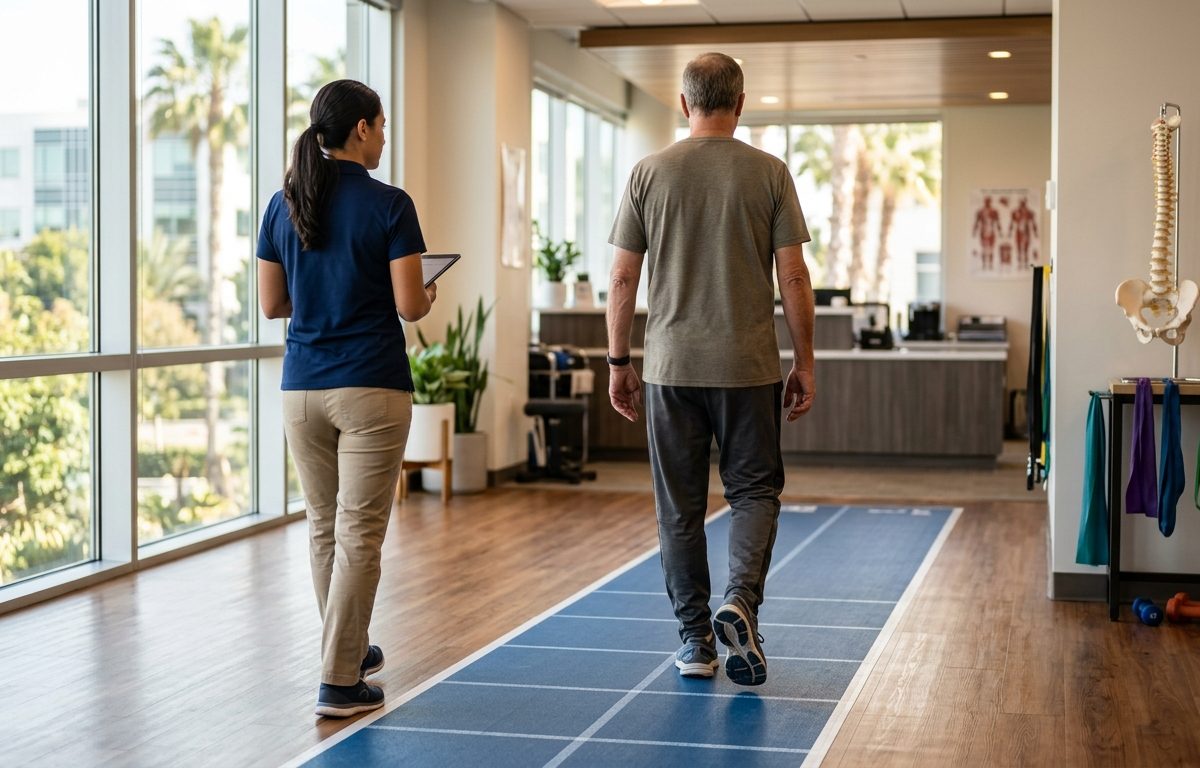
One of the most frustrating parts of spinal stenosis is how it changes normal life. A person may still be able to sit and rest comfortably, yet struggle with errands, travel, work, or exercise. Walking intolerance can shrink independence gradually. Some people also begin moving less confidently because their legs feel heavy or unreliable.
That is why a function-centered exam matters. Reviews of nonoperative care for lumbar spinal stenosis have highlighted the importance of looking at disability and walking capacity, not just pain intensity. In a rehabilitation-oriented setting, that helps shape a plan around mobility, pacing, posture tolerance, balance, and safe return to activity rather than simply watching symptoms drift over time.
For active adults in San Diego, that approach can be especially relevant. Surfing, golf, long walks, commuting, and standing-based work all place different demands on the spine and nervous system. The right care plan should reflect the way symptoms show up in real life.
Common reasons patients get delayed answers
Spinal stenosis symptoms are often mistaken for “normal aging,” simple tight hips, or general low-back strain. Some patients have already tried stretching, rest, massage, or random online exercises before they ever get a clear explanation for why walking tolerance keeps shrinking. Others are told their MRI explains everything even when the day-to-day symptom pattern has not been carefully matched to the scan.
That mismatch can create confusion. A patient may hear that the imaging looks severe but still function fairly well, or hear that the imaging looks mild while feeling clearly limited during standing and walking. In both situations, the right next step is usually a more complete functional assessment rather than a guess.
Another reason answers get delayed is that symptoms can fluctuate. Someone may feel better after resting for a weekend and assume the problem is resolving, only to flare again with errands, travel, or longer time on their feet. Because of that stop-and-start pattern, it helps to track not only pain but walking distance, standing tolerance, and what positions consistently ease the symptoms.
How conservative rehabilitation is usually judged
When conservative care is appropriate, progress should be measured with practical markers. Good signs may include increased walking distance, less leg heaviness, better balance confidence, improved recovery after standing, and reduced symptom intensity during normal tasks. Improvement is rarely measured only by whether a person is completely pain-free on day one.
This is another reason specialist evaluation matters. The right provider should be able to explain what improvement should look like, what would count as a poor response, and when the plan should be adjusted or escalated. In some cases, the best result of the first visit is not a treatment decision at all. It is clarity about which pathway makes sense next.
At San Diego Chiropractic Neurology, that means keeping the conservative lane honest. If symptoms, neurologic findings, or functional decline suggest the need for outside imaging review or medical referral, that should be stated clearly. If the case appears appropriate for non-invasive management, the plan should still be specific, measurable, and tied to the person’s actual limitations.
What to look for in a San Diego clinic
If you are comparing options, look for a clinic that can explain why it believes spinal stenosis is or is not the best fit, what exam findings support that conclusion, and what the next step should be if the picture changes. Clear reasoning matters more than buzzwords.
Good questions to ask include:
- How do you distinguish spinal stenosis from disc-related sciatica?
- How do you evaluate gait, balance, strength, and walking tolerance?
- When do you recommend medical or surgical consultation?
- What does conservative care actually include in my case?
- How will progress be measured besides pain alone?
At San Diego Chiropractic Neurology, the emphasis is on careful evaluation, non-invasive care when appropriate, and clear referral boundaries when a case needs a different level of intervention. That helps patients make decisions based on function and risk, not just fear.
Bottom line
Finding a spinal stenosis specialist san diego is really about finding the right next step for your symptom pattern. If walking or standing is becoming harder, if your legs feel heavy or numb, or if you are unsure whether the problem is stenosis, sciatica, or something else, a careful evaluation can help clarify the picture. The best starting point is not always the most aggressive option. It is the option that matches the history, exam, and functional limitations most accurately.
If you want a more complete non-invasive evaluation of spinal stenosis symptoms, walking intolerance, balance concerns, or overlapping disc-related complaints, San Diego Chiropractic Neurology can help determine whether conservative care makes sense and when outside medical evaluation should be part of the plan.
Call (619) 344-0111 or book a free consultation.
Medical disclaimer: This article is for educational purposes only and is not medical advice, diagnosis, or a substitute for personalized care. Urgent neurologic changes, bowel or bladder changes, progressive weakness, or severe worsening symptoms require prompt medical evaluation.
FAQ
What kind of specialist should you see for spinal stenosis?
You should look for a provider who can match symptoms, neurologic findings, and imaging rather than relying on one piece alone. Some cases belong first in conservative evaluation, while others need faster medical or surgical review.
Can spinal stenosis be managed without surgery?
Many cases begin with conservative care when there are no urgent red flags. The right plan depends on walking tolerance, neurologic findings, symptom severity, and how well symptoms match the imaging picture.
What symptoms suggest spinal stenosis instead of a herniated disc?
Spinal stenosis more often causes leg symptoms that build with standing or walking and improve with sitting or bending forward. A herniated disc may be more abrupt and one-sided, though overlap is common.
When is spinal stenosis an emergency?
New bowel or bladder changes, saddle anesthesia, rapidly worsening weakness, or major neurologic decline should be treated as urgent and evaluated right away.
What happens during a spinal stenosis evaluation?
A thorough evaluation reviews symptom behavior, walking tolerance, neurologic findings, balance, movement patterns, and prior imaging to decide whether conservative care, co-management, or urgent referral is the right next step.
References
- Katz JN, Zimmerman ZE, Mass H, Makhni MC. Diagnosis and Management of Lumbar Spinal Stenosis: A Review. JAMA. 2022.
- Genevay S, Atlas SJ. Lumbar spinal stenosis. Best Practice & Research Clinical Rheumatology. 2010.
- North American Spine Society guideline context summarized in JAMA review on lumbar spinal stenosis. 2022.
- NICE Guideline NG59: Low back pain and sciatica in over 16s. Updated guidance on serious pathology and referral considerations.
- Ammendolia C, et al. Nonoperative treatment evidence context for lumbar spinal stenosis and neurogenic claudication. 2019 review literature.
Not sure what is driving your symptoms?
Talk with our Functional Neurology Trained team on a free phone consultation. We will tell you honestly whether we can help.