Spinal Decompression for Spinal Stenosis San Diego: When It May Help
Free phone consultation with our San Diego functional neurology team. No obligation.
TL;DR: Spinal decompression for spinal stenosis san diego may help some people, but only when the symptom pattern and exam findings fit the right mechanical problem. A careful evaluation matters because some forms of stenosis respond better to unloading and rehabilitation than others.
Spinal decompression for spinal stenosis san diego is a question many people ask after walking becomes harder, leg pain starts to build, or standing upright feels worse than leaning forward. In San Diego, many patients are told they have stenosis based on imaging alone, but the more important question is whether the narrowing seen on a scan actually matches the symptoms, exam findings, and daily limitations. At San Diego Chiropractic Neurology, the focus is on careful evaluation, functional testing, and conservative care planning before assuming one approach fits every case.
Some people with stenosis have mostly back pain. Others have heaviness, tingling, or aching into the legs that builds with standing and walking. That difference matters. The best plan often depends on whether the problem looks more disc-driven, joint-driven, posture-driven, or related to how the nervous system is tolerating load and movement.
What exactly is spinal stenosis, and why can it hurt the legs?
Spinal stenosis means there is narrowing in spaces where nerves travel. In the lower back, that narrowing can involve the central canal or the openings where nerves exit. When the space becomes more limited, certain positions or walking demands can increase irritation around those nerves. According to a 2022 JAMA review, lumbar spinal stenosis commonly leads to leg pain, numbness, or fatigue with walking, often called neurogenic claudication.
Many patients notice a pattern: standing tall or walking for longer stretches makes symptoms worse, while sitting, bending forward, or leaning onto a cart provides relief. That pattern is useful because it helps distinguish stenosis-related symptoms from other causes of leg discomfort.
Can spinal decompression actually help spinal stenosis?
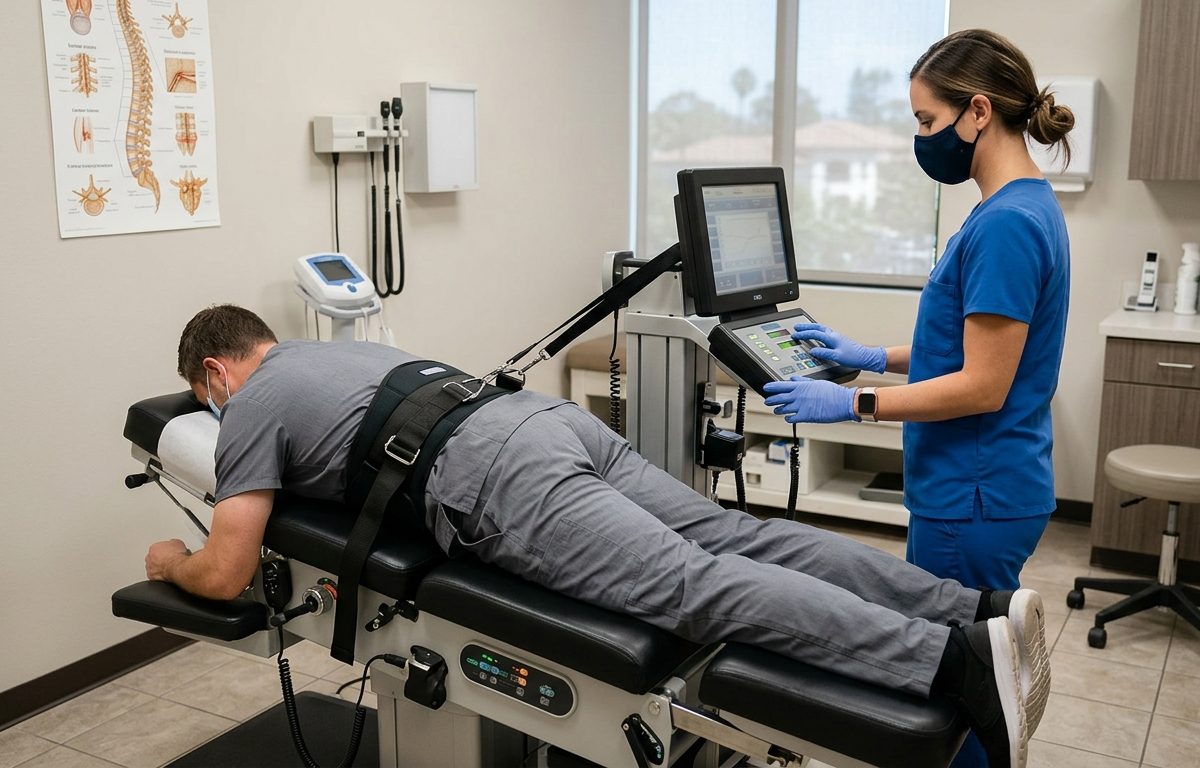
Sometimes, yes. Spinal decompression for spinal stenosis san diego may be reasonable when the problem includes a mechanical loading pattern that improves with unloading, flexion bias, or reduced pressure across irritated structures. In plain language, if opening space and changing load seems to reduce symptoms during evaluation, decompression may be worth considering as part of a broader plan.
That said, not all stenosis behaves the same way. Some cases are more related to disc changes, while others are driven more by thickened ligaments, arthritic joints, or bony narrowing. In those situations, decompression alone may be less helpful. Current evidence supports conservative care for many patients, but it also supports being selective rather than promising that one machine or one technique will solve every stenosis case.
That is why the clinic frames decompression as a tool, not a guarantee. It may help reduce mechanical stress in the right patient, especially when it is paired with rehabilitation, movement strategy changes, and symptom-guided progression.
Who is most likely to be a good candidate?
A good candidate usually has symptoms that match the diagnosis. That often means leg symptoms increase with standing or walking, improve with sitting or forward bending, and show clear mechanical behavior during the exam. Patients may also do better when imaging suggests narrowing that still has a meaningful disc or load-sensitive component rather than only rigid bony change.
Other useful clues include whether symptoms centralize or reduce during trial unloading, whether gait tolerance can be measurably improved, and whether the person can tolerate progressive rehabilitation afterward. A good evaluation also checks whether non-surgical spinal decompression fits the person’s broader goals, schedule, and functional limits.
When is spinal decompression less likely to help?
Spinal decompression is less likely to be the main answer when symptoms are being driven by severe fixed bony narrowing, significant instability, progressive neurologic loss, or a condition that needs a different level of medical evaluation. It is also less likely to help if the symptoms do not behave mechanically at all. For example, if walking tolerance does not change with position, if the leg pattern does not match the imaging, or if the exam suggests another cause, a decompression-first plan may be the wrong match.
Urgent evaluation matters when there is new weakness, saddle anesthesia, bowel or bladder change, or rapidly worsening neurologic function. Those are not watch-and-wait findings.
What does a good evaluation check before starting care?
A useful stenosis evaluation should do more than review an MRI report. It should compare symptoms, posture, walking tolerance, neurologic findings, flexibility, directional response, and load sensitivity. The goal is to determine whether the narrowing on imaging actually explains the day-to-day problem.
At minimum, the workup should look at gait endurance, symptom triggers, relief positions, balance demands, reflex and sensory changes when relevant, and whether certain movements calm or aggravate the legs. That makes it easier to decide whether decompression belongs in the plan or whether a different approach should lead.
Many patients also benefit from understanding adjacent issues such as spinal stenosis and degenerative disc conditions and how they differ from more general back pain. That distinction matters because treatment decisions are better when the driver of symptoms is clear.
What standard care sometimes misses before people assume surgery is the next step?
One common gap is assuming that the scan is the full story. Imaging can show stenosis in people with mild symptoms, and it can also miss how much posture, gait mechanics, nerve irritation, or deconditioning are shaping the person’s actual limits. Another gap is moving too quickly from pain relief attempts to a surgery conversation without fully checking whether the problem behaves like a conservative-care candidate.
This is where a more complete exam helps. Instead of asking only, “Is there stenosis?” the better question is, “What is driving this person’s walking intolerance, leg symptoms, and loss of function right now?” In some cases, that answer supports decompression plus rehab. In others, it points somewhere else. Getting that distinction right is what standard care can miss.
What does treatment usually include when decompression is a fit?
When decompression is appropriate, it is usually part of a broader conservative plan rather than the whole plan by itself. Care may include progressive mobility work, flexion-biased movement strategy when appropriate, walking tolerance progression, stability training, and symptom-guided changes in daily activity. The goal is to improve function, not just create a short window of relief.
Patients are also taught which symptom changes matter, when to slow down, and when further medical workup may be warranted. This article does not provide a step-by-step self-treatment protocol because the same movements can help one person and aggravate another.
FAQ
How do I know if spinal stenosis is causing my leg symptoms?
The pattern matters. Symptoms that build with walking or standing and improve with sitting or leaning forward are more suggestive of lumbar stenosis than symptoms that stay random across positions.
Is spinal decompression the same thing as surgery?
No. Decompression therapy in a clinic is a non-invasive conservative approach. Surgical decompression is an operative procedure used in a very different clinical context.
Can spinal decompression help if I have bone spurs?
Sometimes, but not always. If symptoms are strongly driven by rigid bony narrowing, decompression may be less useful than in cases where unloading changes symptoms more clearly.
What if sitting helps but walking makes my symptoms worse?
That is a common stenosis pattern and one reason an evaluation should look closely at walking tolerance, posture, and positional relief.
When should spinal stenosis be evaluated urgently?
Urgent evaluation is important if there is new or worsening weakness, bowel or bladder change, saddle anesthesia, or rapidly progressing neurologic symptoms.
Call (619) 344-0111 or book a free consultation
Medical disclaimer: This article is for educational purposes only and is not medical advice. It does not replace an in-person evaluation, diagnosis, or treatment recommendation from a qualified licensed clinician.
References
- Katz JN, Zimmerman ZE, Mass H, Makhni MC. Diagnosis and Management of Lumbar Spinal Stenosis: A Review. JAMA. 2022.
- North American Spine Society guideline materials on degenerative lumbar spinal stenosis.
- Genevay S, Atlas SJ. Lumbar spinal stenosis. Best Practice and Research Clinical Rheumatology. 2010.
Not sure what is driving your symptoms?
Talk with our Functional Neurology Trained team on a free phone consultation. We will tell you honestly whether we can help.