Spinal Decompression for Sciatica Treatment San Diego: When It May Fit
Free phone consultation with our San Diego functional neurology team. No obligation.
Sciatica can be frustrating because the label describes a symptom pattern rather than one single diagnosis. Some people have sharp pain that travels from the low back into the glute and leg. Others notice burning, tingling, numbness, or a sense that the leg gets heavy with standing or walking. When that happens, many people start searching for spinal decompression for sciatica treatment San Diego because they want a non-surgical option before jumping to injections or surgery.
That search makes sense, but the bigger question is not whether spinal decompression is trendy or available. The real question is whether it fits the reason the sciatic nerve is being irritated in the first place. At San Diego Chiropractic Neurology, the clinic looks at spinal, neurologic, and movement findings together so the care plan matches the problem rather than forcing every case into the same template.
For some patients, non-surgical spinal decompression can be a reasonable part of conservative care. For others, it is secondary to exercise progression, movement modification, gait work, or a broader workup. And for a smaller group, urgent medical or surgical referral matters more than any decompression program. That is why a structured evaluation comes first.
Sciatica usually refers to pain or neurologic symptoms that follow the path of the sciatic nerve, often because a lumbar nerve root is irritated. Lumbar disc herniation is a common source, but it is not the only one. Foraminal narrowing, spinal stenosis, inflammation, postural loading intolerance, and even non-spinal causes can create a similar story. If someone assumes every radiating leg symptom is a disc problem, they can easily end up with the wrong treatment plan.
This is also why good clinics do not treat the MRI alone. Imaging can be useful, but it is only one piece of the puzzle. Some people have significant disc changes on imaging with mild symptoms, while others have severe pain with findings that look modest on paper. The exam still matters. A careful history, neurologic screening, and movement assessment help clarify whether spinal decompression is likely to help, whether a different conservative strategy should lead, or whether more urgent follow-up is warranted.
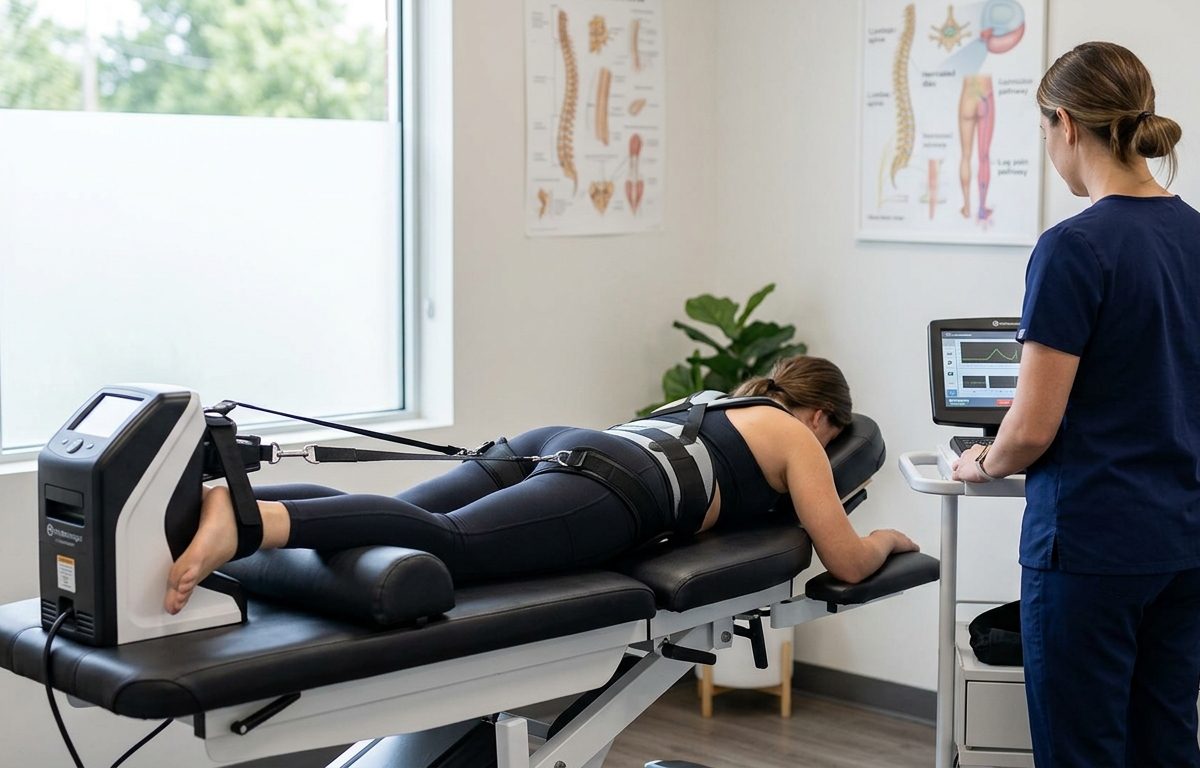
In general terms, spinal decompression is a form of mechanical traction designed to reduce compressive load across parts of the lumbar spine. The goal is usually to improve tolerance to positions, reduce irritation around the involved segment, and create a better environment for movement progression. The concept is appealing, especially when a person feels worse with prolonged sitting, bending, or axial loading. But it should be discussed honestly: evidence is mixed, the best studies are not overwhelmingly strong, and decompression should be positioned as a tool, not a miracle.
That balanced framing matters because many online pages overpromise. Some imply that decompression fixes every herniated disc or resolves every case of sciatica. That is not how responsible conservative care works. Better practice is to ask whether the patient’s symptoms, exam findings, irritability, and tolerance patterns suggest that unloading may help enough to earn a place in the plan.
A reasonable candidate for decompression often has symptoms consistent with disc-related or foraminal irritation, no major red-flag findings, and enough positional tolerance to participate safely. The clinic may also consider whether the person centralizes or peripheralizes with repeated movement, whether they worsen mainly with compression-based tasks, and whether they can still build function while symptoms are being calmed down. If the answer is yes, decompression may be integrated with rehab rather than used in isolation.
On the other hand, sciatica is not always a decompression problem. If a person’s symptoms are driven more by a severe inflammatory flare, a significant motor deficit, an unstable presentation, or a non-disc source of pain, the priority may be different. Some patients need more emphasis on activity modification, directional-preference exercise, progressive walking tolerance, hip and trunk control, or referral for another layer of medical evaluation. A clinic that skips this decision-making step can waste time and money.
There is also a major safety point: certain symptoms change the whole conversation. New bowel or bladder dysfunction, saddle anesthesia, rapidly progressive weakness, unexplained fever, trauma, cancer history, or severe unrelenting pain are not routine sciatica complaints. Those are red flags that may require urgent medical assessment instead of a routine decompression schedule. Any trustworthy page about spinal decompression for sciatica should say that clearly.
At San Diego Chiropractic Neurology, a sciatica workup is not just about asking where the pain travels. The evaluation may include lumbar movement testing, neurologic screening, reflexes, sensory changes, strength patterns, gait, balance, and the mechanical triggers that consistently aggravate or calm symptoms. That broader lens matters because people do not live on a treatment table. They need to sit, stand, walk, work, sleep, and move through daily life in San Diego without constant leg symptoms limiting them.
The functional neurology angle also helps frame the plan correctly. The clinic’s role is not to claim that one machine solves sciatica. The role is to assess how the nervous system and spine are handling load, position, motion, and symptom provocation, then use conservative tools that support regulation and function. In some cases that includes decompression. In others it may mean vestibular or balance considerations are secondary, while trunk control, sensory changes, and movement tolerance become the main targets.
Patients often ask how decompression compares with standard sciatica care. The honest answer is that it should usually sit inside standard conservative care rather than replace it. Guidelines for low back pain and sciatica consistently emphasize education, staying as active as tolerated, and individualized non-surgical management before invasive escalation for many patients. Decompression may complement that plan when it helps the patient tolerate movement better or reduces symptom provocation enough to make rehab possible.
Another common question is whether decompression means avoiding every other form of care. Usually, no. The most effective conservative plans are often multimodal. That can include guidance on positions, graded activity, home exercises, walking dosage, trunk and hip control work, and targeted strategies to reduce flare cycles. In that setting, decompression is less about passive dependence and more about creating a window for better movement quality and better day-to-day function.
People in San Diego also want to know whether they need an MRI before considering decompression. Not always. If the history and exam are straightforward and there are no red flags, conservative care often starts without immediate imaging. But prior imaging can still be helpful when symptoms have persisted, when the case is recurrent, or when the pattern does not line up neatly with routine mechanical sciatica. The key is using imaging thoughtfully, not reflexively.
It is equally important to understand when symptoms might point away from decompression as the main answer. Piriformis syndrome, peripheral nerve irritation, hip-related pain referral, or mixed lumbar and pelvic contributors can mimic classic sciatica. So can spinal stenosis patterns that behave differently from a typical disc presentation. That is one reason the clinic links sciatica evaluations with broader lumbar and neurologic reasoning rather than treating every radiating pain case the same way. Patients exploring sciatica symptoms or wondering whether a herniated disc may be involved often need that distinction before choosing a service path.
If decompression is used, expectations should stay realistic. Most people do not feel one dramatic permanent change after a single session. Instead, the clinic looks for patterns: less distal symptom spread, improved tolerance to sitting or walking, easier transitions, better straight-leg or movement tolerance, and fewer flare-ups between visits. If those markers do not move, the plan should be reconsidered instead of being repeated indefinitely.
This is where follow-up decision-making matters as much as the initial exam. A conservative care plan should have checkpoints. If symptoms are worsening, if neurologic deficits are progressing, or if the person is not making meaningful functional gains, the next step may be a different rehab focus, co-management, or another medical opinion. Staying flexible is part of good care.
A lot of patients searching for spinal decompression for sciatica treatment San Diego are trying to avoid surgery. That is understandable, and many people do improve without surgery. Still, surgery is not the enemy or a failure. It is one option in a continuum of care, especially when there is persistent disabling pain despite appropriate conservative management or when progressive neurologic findings change the risk-benefit discussion. The goal is to make that decision from a position of clarity, not fear.
For many patients, the best conservative starting point is a clinic that can evaluate both spinal mechanics and neurologic function, explain whether decompression is truly indicated, and build a plan that does not depend on hype. If decompression fits, it should fit for a reason. If it does not, the patient should hear that just as plainly.
That is the value of a more complete evaluation. Instead of asking whether spinal decompression is good or bad in the abstract, the clinic asks whether it fits this patient, this symptom pattern, and this stage of recovery. For the right case, that can be a useful part of care. For the wrong case, skipping straight to decompression may simply delay better answers.
Anyone in San Diego dealing with persistent radiating leg pain, numbness, or position-dependent symptoms should also look at the broader context of non-surgical spinal decompression and related back pain patterns before assuming the next step. Matching the intervention to the cause is what gives conservative care its best chance to work.
What a Good Evaluation Should Clarify First
Before any decompression plan starts, the most important question is whether the symptoms are truly consistent with a disc-related or compression-sensitive sciatica pattern. That means confirming where symptoms travel, what provokes them, whether numbness or weakness is present, how long symptoms have lasted, and whether prior episodes followed a similar course. It also means checking whether the patient can tolerate enough movement to make conservative care productive.
A useful evaluation should separate routine sciatica from cases that need faster escalation. If strength is dropping, if the foot is slapping, or if bowel, bladder, or saddle symptoms are present, conservative care alone is not the right next step. If the pattern is more stable, then decompression may be weighed alongside rehab progression and symptom-modification strategies.
What Spinal Decompression May and May Not Do
When spinal decompression helps, it usually helps by improving tolerance. Patients may notice less pressure into the leg, better sitting tolerance, or easier standing and walking after symptoms calm down. That can create room for better movement work. It does not mean the underlying issue has been magically erased, and it does not replace the need for an active plan.
When it does not help, repeating it endlessly is rarely the answer. A better response is to reassess the diagnosis, recheck loading patterns, and decide whether another conservative direction or medical referral makes more sense.
When to Seek Help Quickly
Sciatica deserves quicker attention when symptoms are severe, rapidly changing, or tied to significant numbness, weakness, or loss of function. It also deserves closer review when pain keeps returning and interferes with work, walking, exercise, or sleep despite rest and basic home measures. In those cases, a more complete spine and neurologic evaluation can help narrow the next step.
Why Patients in San Diego Search for This Option
Many local patients want to stay active, keep working, and avoid jumping too quickly into invasive care. That is why a careful conservative pathway matters. The goal is not to promise one universal solution. The goal is to decide whether decompression belongs in the plan and then combine it with the right rehabilitation strategy for the specific sciatica pattern.
FAQ
Can spinal decompression help sciatica?
It may help some people when sciatica is related to disc or nerve-root irritation and when the person is an appropriate candidate after evaluation. It is not the right fit for every cause of radiating leg pain.
How do you know if sciatica is coming from a disc problem?
A clinician looks at the symptom pattern, neurologic findings, movement testing, and when needed, prior imaging or a referral for updated imaging. Disc-related sciatica often follows a different pattern than piriformis-related pain or other causes.
When is spinal decompression not a good fit?
It may not fit when red flags are present, when symptoms suggest a non-disc source, or when a patient needs urgent medical or surgical assessment instead of routine conservative care.
How many sessions are usually recommended?
That depends on symptom duration, irritability, exam findings, and response to care. Most clinics reassess regularly rather than assuming one fixed number of visits works for everyone.
Next Steps
If radiating leg pain, numbness, or recurrent flare-ups are limiting daily function, a structured evaluation can help determine whether spinal decompression is appropriate or whether another conservative path fits better. Call (619) 344-0111 or book a free consultation.
Medical Disclaimer
This article is for educational purposes only and is not medical advice. Individual symptoms, diagnoses, and treatment decisions require evaluation by a qualified licensed healthcare professional. Seek urgent medical care for severe or progressive neurologic symptoms, bowel or bladder changes, saddle anesthesia, trauma, fever, or other red-flag symptoms.
References
- Dydyk AM, Das JM. Sciatica. StatPearls. Updated 2024. https://www.ncbi.nlm.nih.gov/books/NBK507908/
- Wegner I, et al. Traction for low-back pain with or without sciatica. Cochrane Database Syst Rev. 2013. https://pubmed.ncbi.nlm.nih.gov/23959683/
- World Health Organization. WHO guideline for chronic low back pain. 2023. https://www.who.int/publications/i/item/9789240081789
- National Institute for Health and Care Excellence. Low back pain and sciatica in over 16s: assessment and management. https://www.nice.org.uk/guidance/ng59
- Qaseem A, et al. Noninvasive treatments for acute, subacute, and chronic low back pain. Ann Intern Med. 2017. https://pubmed.ncbi.nlm.nih.gov/28192789/
Not sure what is driving your symptoms?
Talk with our Functional Neurology Trained team on a free phone consultation. We will tell you honestly whether we can help.