Spinal Decompression for Lower Back Pain San Diego: When It May Help
Free phone consultation with our San Diego functional neurology team. No obligation.
TL;DR: Spinal decompression for lower back pain San Diego patients ask about may help in selected cases, especially when symptoms suggest disc irritation or nerve-related pain rather than generic soreness. The key is not whether decompression sounds advanced. The key is whether the exam shows that it actually fits the pattern.
Many people searching for spinal decompression for lower back pain san diego are trying to sort through mixed messages. Some have been told decompression is the answer for almost any back problem. Others have heard it is hype. In reality, lower back pain is a broad category. Some cases are disc-related. Some are more mechanical or muscular. Some involve leg pain, numbness, or irritation along a nerve pathway. A careful evaluation helps separate those patterns before a treatment plan is chosen.
At San Diego Chiropractic Neurology, the clinic uses a conservative evaluation process to decide whether a patient may fit non-surgical spinal decompression as part of a broader care plan. The goal is not to push one treatment. The goal is to understand why the back pain behaves the way it does, what positions make it worse, whether neurologic symptoms are present, and whether a rehab-based plan makes more sense than passive care alone.
What is spinal decompression, and is it the same as surgery?
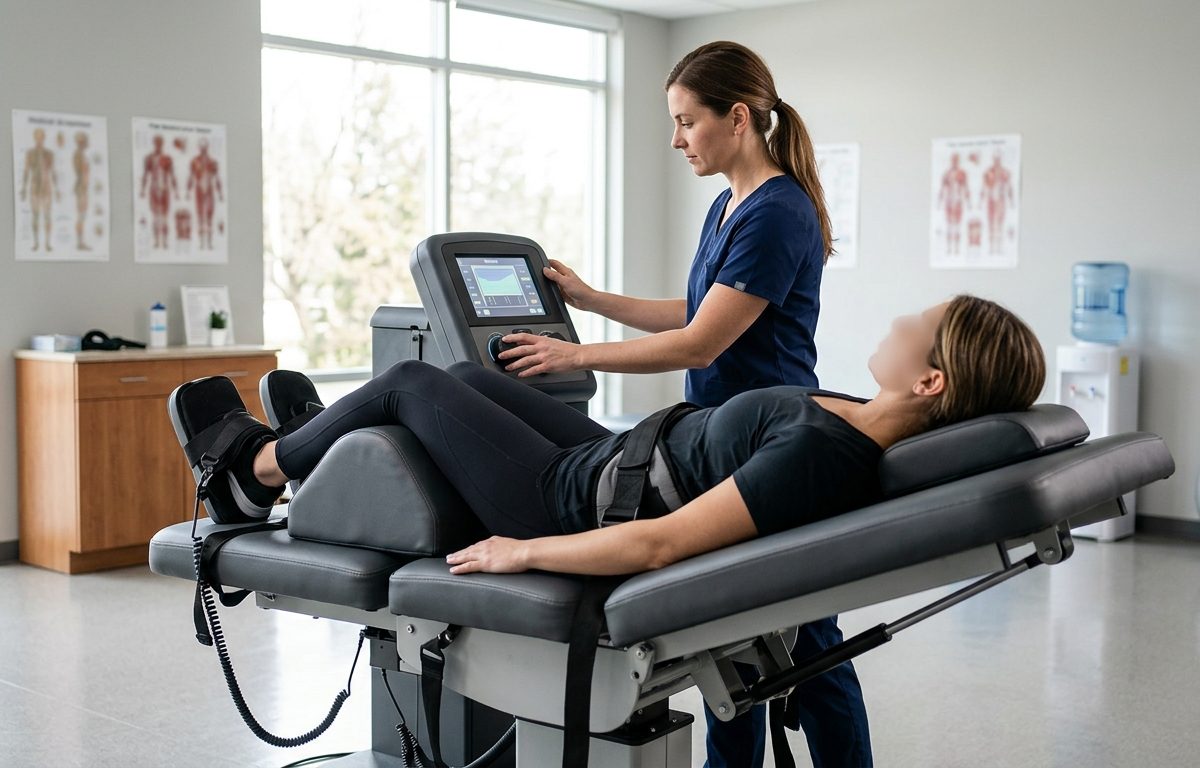
No. That distinction should be made early because it causes a lot of confusion. Non-surgical spinal decompression is a traction-based conservative treatment delivered in an outpatient setting. Surgical decompression is an operation performed for very different reasons. They are not interchangeable terms.
When people talk about decompression for lower back pain, they usually mean a table-based treatment intended to reduce loading across certain spinal segments for a controlled period of time. That may be discussed when the symptom pattern suggests disc involvement, nerve-root irritation, or load intolerance. It should not be presented as a universal solution for every sore or stiff low back.
That matters because broad low back pain guidelines do not support a one-size-fits-all passive approach. Education, movement-based care, classification, and patient-specific planning remain central. Decompression may be one option within that larger framework, not a replacement for it.
When may spinal decompression help lower back pain?
Spinal decompression may fit best when lower back pain is not acting like simple non-specific soreness. For example, some patients describe pain that increases with sitting, bending, lifting, coughing, or prolonged flexion. Others have pain that travels into the buttock or leg, or they report numbness and tingling that suggest nerve irritation. In those situations, the discussion often shifts from generic low back pain to a more disc-driven or radicular pattern.
That does not automatically mean decompression is appropriate. It means the case deserves more careful triage. A useful evaluation looks at pain behavior, neurologic findings, symptom centralization or peripheralization, load tolerance, and whether imaging or prior history points toward disc involvement. If those pieces line up, decompression may be considered as one part of a conservative plan.
In San Diego, many patients also want to avoid jumping straight from persistent back pain to injections or surgery. That is a reasonable question. The more important follow-up question is whether the symptoms actually match a pattern where decompression may be worth considering. Good candidacy matters more than enthusiasm for the treatment itself.
When is lower back pain less likely to respond to decompression?
Lower back pain is less likely to respond well when the recommendation is being made too broadly. If symptoms are mainly general stiffness, diffuse aching, severe inflammatory irritability, instability concerns, or a pattern that does not improve with unloading, decompression may not be the most logical first choice. It is also not the right lane for emergencies, progressive neurologic loss, fracture concerns, infection concerns, or bowel and bladder red flags that require immediate medical evaluation.
Patients are often frustrated because they have been given a single label like back pain, but that label does not explain the behavior of the symptoms. If pain is being driven more by deconditioning, hip mechanics, movement fear, or other factors outside a disc-dominant pattern, a rehab strategy may matter more than table-based care.
This is also why mixed evidence in the literature should be taken seriously. Some reviews suggest traction-style care may help selected people with radicular symptoms, but that does not justify applying it to every lower back pain case. A clinic should be able to explain why a patient seems like a fit, not just repeat that decompression is available.
What should an evaluation check before starting treatment?
A solid evaluation should answer a few basic questions. Is the pain staying local to the back, or does it move into the buttock or leg? Do numbness, tingling, or weakness change the picture? Are sitting and bending worse than walking and extension, or is the opposite true? Has the patient already tried exercise, medication, physical therapy, or rest, and what happened? Those details matter because they shape whether the lower back pain looks disc-related, nerve-related, mechanical, or mixed.
The exam should also assess movement tolerance, neurologic signs, reflexes when relevant, and which positions increase or reduce symptoms. If a patient has findings that point toward a broader spine issue, the clinic may also discuss related education pages on back pain and spinal stenosis and degenerative disc conditions so the care decision is made in context rather than in isolation.
For some San Diego patients, the best outcome of the visit is not starting decompression right away. The best outcome is clarifying whether decompression belongs in the plan at all, whether a different rehabilitation approach should come first, or whether the presentation needs medical escalation instead.
What does standard lower back pain care sometimes miss?
Standard lower back pain care sometimes lumps very different problems into one bucket. That can leave patients confused when generic advice does not match the way their symptoms actually behave. Someone with pain that spreads into the leg, worsens with compression, or changes with repeated movement may not need the same plan as someone with simple non-specific back tightness.
This is where a more specific evaluation can help. The question is not just where the pain is. The question is what mechanism seems to be driving it. If disc loading, nerve irritation, or positional intolerance appears to be part of the picture, then decompression may be worth discussing. If not, the better plan may center more on graded activity, mobility, neuromuscular retraining, or other conservative strategies supported by the exam findings.
Patients are often told either to rest indefinitely or to push through symptoms without a clear framework. Neither extreme is very helpful. A better approach is to identify the pattern, define the red flags, and match the treatment to the problem rather than forcing every problem into the same treatment menu.
How should patients think about decompression as part of a broader plan?
Decompression is best viewed as a tool, not an identity. If it fits, it should support a broader plan that also improves movement tolerance, function, and confidence with daily activity. If it does not fit, using it anyway can waste time and distract from the more appropriate path.
That is why the clinic frames spinal decompression for lower back pain san diego patients ask about as a candidacy question first. The visit should help clarify whether the symptom pattern fits, whether more foundational rehab is needed, and whether there are reasons to shift away from decompression altogether. That kind of reasoning usually serves patients better than a sales pitch.
Frequently asked questions
Is spinal decompression good for lower back pain?
It may help selected cases, especially when lower back pain appears related to disc irritation or nerve-related symptoms. It is not the best fit for every type of low back pain.
How is non-surgical spinal decompression different from surgery?
Non-surgical decompression is a conservative traction-based treatment used in an outpatient setting. Surgery is an operative procedure with different indications, risks, and goals.
Who is not a good candidate for spinal decompression?
People with emergency red flags, progressive neurologic decline, fracture or infection concerns, or a symptom pattern that does not suggest disc or nerve irritation may need a different path.
Can spinal decompression help if pain goes into the leg?
Sometimes. Leg-dominant symptoms may suggest a radicular pattern, which is one reason decompression may be discussed in selected cases. The exam still needs to confirm whether that logic fits.
What should I try before committing to a treatment plan?
Start with a thorough evaluation that clarifies the symptom pattern, checks for red flags, and explains whether decompression, rehabilitation, or medical escalation makes the most sense for your case.
Call (619) 344-0111 or book a free consultation
Medical disclaimer: This article is for educational purposes only and is not medical advice, diagnosis, or a substitute for individualized care. Treatment decisions should be based on a licensed clinician's evaluation of your symptoms, history, and exam findings.
References
- Vanti C, et al. Vertical traction for lumbar radiculopathy: a systematic review. Arch Physiother. 2021.
- George SZ, et al. Interventions for the Management of Acute and Chronic Low Back Pain: Revision 2021. J Orthop Sports Phys Ther. 2021.
- Qaseem A, et al. Noninvasive Treatments for Acute, Subacute, and Chronic Low Back Pain. Ann Intern Med. 2017.
- Dydyk AM, et al. Radicular Back Pain. NCBI Bookshelf. Updated 2024.
Not sure what is driving your symptoms?
Talk with our Functional Neurology Trained team on a free phone consultation. We will tell you honestly whether we can help.