Spinal Decompression for Degenerative Disc Disease San Diego: When It May Help
Free phone consultation with our San Diego functional neurology team. No obligation.
TL;DR: spinal decompression for degenerative disc disease san diego may fit when symptoms behave like disc-sensitive back or leg pain and the exam shows traction-based care is a reasonable match. The key question is not whether degeneration appears on imaging, but whether the patient's symptom pattern actually supports decompression.
Patients searching for spinal decompression for degenerative disc disease san diego often want a clear answer about whether non-surgical care may help them avoid a more invasive path. At San Diego Chiropractic Neurology, the starting point is not the MRI label alone. Degenerative disc disease is common, especially with age, and imaging changes do not always explain why a person hurts or why pain travels into the leg.
That is why a careful evaluation matters before anyone jumps into traction-based care. In the right case, non-surgical spinal decompression may be part of a broader conservative plan for disc-sensitive symptoms, nerve irritation, or load-intolerant back pain. In the wrong case, it can be the wrong emphasis, especially when symptoms reflect stenosis, severe irritability, progressive neurologic loss, or another pain driver that needs a different approach.
What does degenerative disc disease actually mean?
Degenerative disc disease is a descriptive term, not one single diagnosis with one single treatment. It usually refers to age-related or wear-related disc changes such as loss of hydration, reduced disc height, annular changes, or other structural findings on imaging. Many people have those changes without major symptoms, which is why the label alone does not tell the whole story.
What matters more is how the patient feels and how symptoms behave. Some people have back-dominant pain with sitting intolerance. Others have pain that radiates into the buttock or leg. Others have stiffness, walking intolerance, or overlapping stenotic features. Those patterns guide whether decompression makes sense much more than the phrase degenerative disc disease on a report.
Can spinal decompression help degenerative disc disease?
Spinal decompression for degenerative disc disease san diego may help selected patients when the symptoms behave like disc-sensitive or nerve-sensitive mechanical pain and the person tolerates unloading well. The goal is not to reverse aging or permanently change the spine. The goal is to reduce irritation across involved structures for a period of time while the rest of the rehabilitation plan works on function, tolerance, and daily activity.
That is an important distinction. Evidence around traction-related care for low back pain is mixed overall, which means it should not be sold as a universal answer. It is better used as a targeted option for the right presentation rather than as an automatic package for anyone with disc degeneration on MRI.
What kinds of symptoms may point in that direction?
Patterns that sometimes support a decompression trial include back pain that worsens with compression or prolonged sitting, leg symptoms that suggest nerve-root irritation, or pain that behaves more like a disc-loading problem than a generalized pain syndrome. A history of symptoms centralizing when the spine is unloaded may also matter. Even then, the exam still has to support the plan.
When is decompression a reasonable option for disc degeneration?
It may be reasonable when the patient's story, exam, and imaging line up in a way that suggests disc-related mechanical sensitivity rather than a broad, nonspecific pain complaint. That can include back pain with a predictable load pattern, radiating symptoms that are not rapidly worsening, or a history showing that conservative care has been only partly effective so far.
It may also make sense when the person is trying to stay in a non-surgical lane and the evaluation suggests the spine is a good mechanical fit for traction-based unloading. In practice, that decision should account for movement tolerance, nerve tension findings, sensory changes, strength, reflexes, walking tolerance, and whether the patient becomes more comfortable or more irritated with unloading attempts.
Why is the evaluation more important than the label?
In San Diego, patients often hear the same generic message from multiple clinics: the MRI shows degeneration, so decompression must be the next step. That is too simplistic. A disc degeneration label can sit alongside back pain, stenotic symptoms, a herniated disc, or sciatica, and those do not all respond the same way. The exam helps separate those patterns before treatment begins.
Who is not a good candidate for decompression?
Not every patient with degenerative disc disease should start with decompression. Progressive neurologic weakness, severe or escalating numbness, suspected fracture, infection, tumor, bowel or bladder changes, or other red-flag findings call for a different level of workup and coordination. Some people with significant stenotic walking intolerance or symptom aggravation under traction-like loading may also be poor fits.
Patients whose pain is widespread, poorly defined, or driven by multiple overlapping issues may need a broader rehabilitation strategy first. The same is true when the main problem is not disc-sensitive mechanical pain at all. If the exam does not support decompression, pushing forward anyway usually creates more confusion than progress.
Why does evaluation matter before traction-based care?
Evaluation matters because low back complaints are often oversimplified. Standard labels can hide important differences between disc-sensitive pain, nerve-root irritation, stenotic patterns, and pain that reflects general movement intolerance. A stronger evaluation looks at symptom behavior, range tolerance, neurologic findings, walking capacity, directional preference, and how the patient responds to loading or unloading.
That process improves decision-making. Instead of asking whether decompression is good or bad in the abstract, the real question becomes whether this patient's pattern makes decompression a logical tool. Conservative care guidelines consistently support matching treatment to the clinical presentation rather than making decisions from imaging alone.
What does standard care sometimes miss before decompression is considered?
Standard care sometimes moves too quickly from an imaging phrase to a treatment sale. When a report says degenerative disc disease, patients may be told they have found the explanation and the solution in one step. But disc degeneration is often common background information rather than a complete explanation for symptoms.
What can get missed is whether the patient really has a disc-dominant pattern, a nerve-dominant pattern, a stenotic pattern, or a mixed picture. That matters because decompression may be a reasonable part of care for one pattern, may add little in another, and may be the wrong emphasis in a third. Better decision-making starts with matching the treatment to the symptom behavior rather than forcing every back problem into the same machine-based plan.
What should patients expect if decompression is part of the plan?
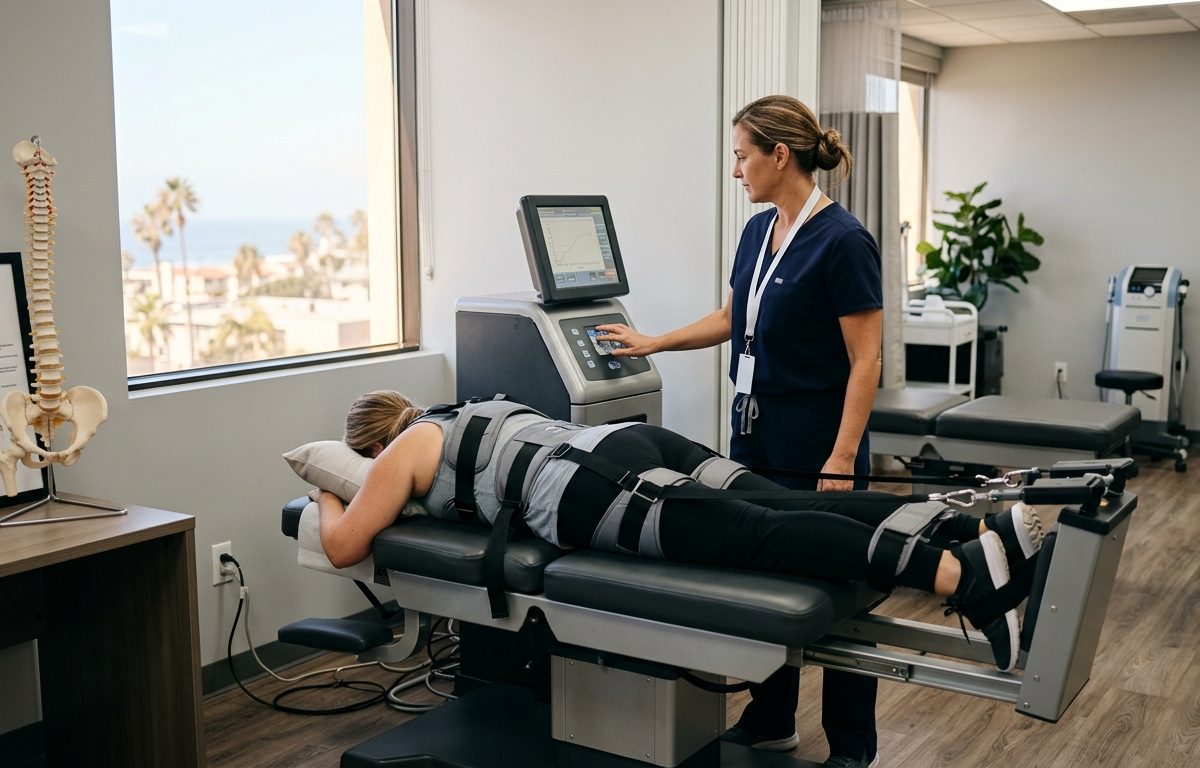
Patients should expect a monitored conservative process, not a promise. If decompression is used, it is typically one part of a broader plan that may also include movement guidance, rehab, education, and changes based on symptom response over time. The important issue is whether function, tolerance, and symptom behavior start moving in the right direction.
Patients should also know that this is not something to copy as a complete home protocol. It is reasonable to explain the concept of unloading, but step-by-step self-treatment instructions are not appropriate because traction-style loading can aggravate the wrong case or miss a contraindication. Guided care is safer than improvising based on internet summaries.
Frequently asked questions about spinal decompression for degenerative disc disease san diego
Is degenerative disc disease the same as a herniated disc?
No. Degenerative disc disease is a broader description of disc changes over time, while a herniated disc refers to a more specific structural problem. They can overlap, but they are not the same thing.
Can spinal decompression help disc degeneration?
It may help selected patients when symptoms behave like disc-sensitive or nerve-sensitive mechanical pain and the exam supports unloading as a reasonable fit.
When should I avoid decompression therapy?
If symptoms are worsening neurologically, if red flags are present, or if traction-like loading clearly aggravates the condition, decompression may not be appropriate.
Does MRI alone show whether decompression will help?
No. MRI can show disc changes, but symptom behavior and the physical exam are still needed to determine whether decompression makes sense.
What else might be included with decompression care?
Depending on the case, the plan may also include rehabilitation, movement guidance, education, and other conservative strategies aimed at improving tolerance and function.
Related care: non-surgical spinal decompression, herniated disc, and back pain.
Call (619) 344-0111 or book a free consultation
Medical disclaimer: This article is for educational purposes only and is not medical advice, diagnosis, or a substitute for individualized care. New, severe, or worsening neurologic symptoms require prompt medical evaluation.
- Brinjikji W, et al. Systematic literature review of imaging features of spinal degeneration in asymptomatic populations. AJNR. 2015.
- Delitto A, et al. Interventions for the management of acute and chronic low back pain. J Orthop Sports Phys Ther. 2021.
- VA/DoD Clinical Practice Guideline for the Diagnosis and Treatment of Low Back Pain. 2022.
- Genevay S, Atlas SJ. Lumbar spinal stenosis. Best Pract Res Clin Rheumatol. 2010.
- Kreiner DS, et al. Lumbar disc herniation with radiculopathy guideline summary review. Spine J. 2014.
Not sure what is driving your symptoms?
Talk with our Functional Neurology Trained team on a free phone consultation. We will tell you honestly whether we can help.