Spinal Decompression for Bulging Disc San Diego: When It May Help
Free phone consultation with our San Diego functional neurology team. No obligation.
A bulging disc can sound alarming, especially when back pain, leg pain, numbness, or sitting intolerance start interfering with normal life. Many people searching for spinal decompression for bulging disc san diego want a simple answer: does spinal decompression actually help? The honest answer is that it may help some patients, but only after a careful evaluation shows that the symptoms, physical findings, and overall care plan make sense for it.
At San Diego Chiropractic Neurology, the clinical goal is not to force every disc-related case into one treatment path. The goal is to understand why symptoms are happening, whether the disc finding actually matches the pain pattern, what movement or neurologic limitations are present, and which conservative options may fit best. Spinal decompression can be one part of that plan, but it works best when it is used thoughtfully and combined with the right rehabilitation strategy.
What a bulging disc actually means
A bulging disc means the outer portion of a spinal disc extends beyond its usual boundary. That does not always mean the disc is torn, and it does not automatically explain every symptom. Imaging studies have shown that disc bulges are common even in people without pain, which is why a scan result should never be treated like the whole story.
That matters because two people can have similar MRI wording and very different problems. One person may have local low back pain tied mostly to movement sensitivity. Another may have radiating leg symptoms, tingling, or weakness that suggest nerve root irritation. A third may have a disc bulge on imaging that is incidental, while the main driver is actually joint irritation, posture load intolerance, or deconditioning.
That is why an evaluation should connect the imaging, symptom pattern, and physical exam before recommending decompression, exercise, or any other intervention.
Can spinal decompression help a bulging disc?
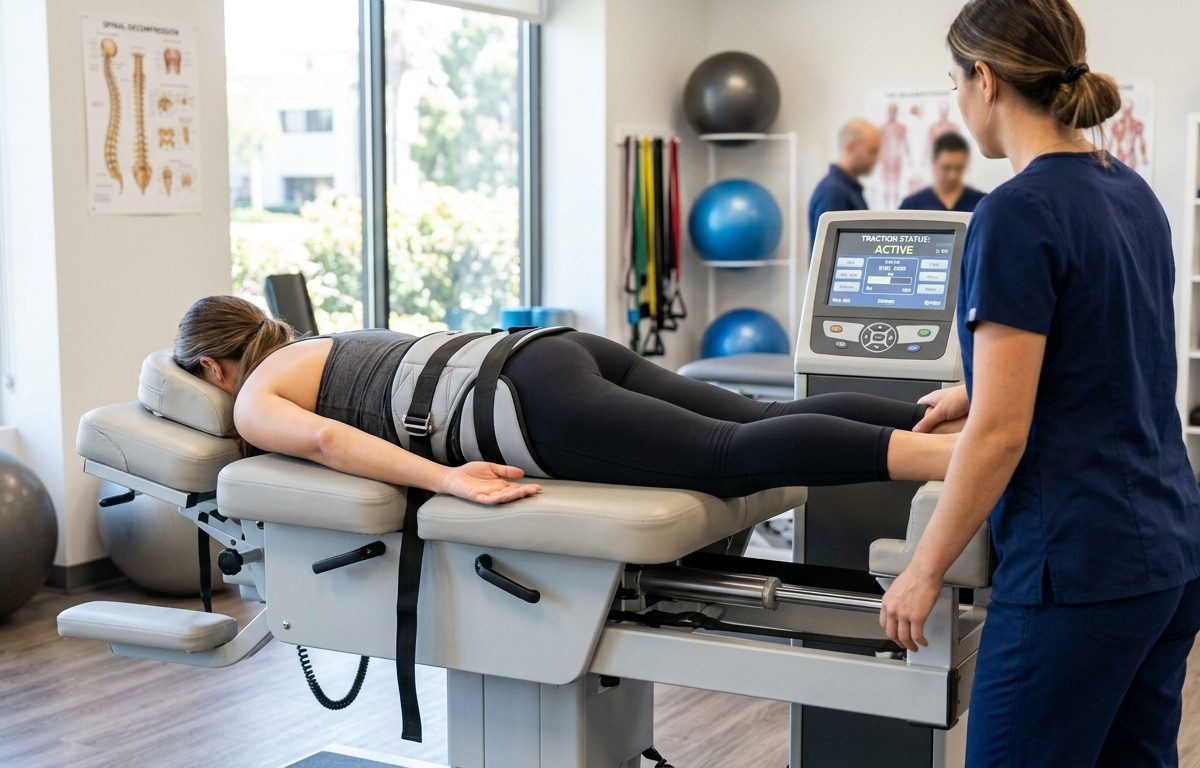
Spinal decompression may help some patients with disc-related back pain or radiating symptoms by reducing compressive load, improving tolerance to certain positions, and creating a better environment for movement-based recovery. The research is not a blank check, though. Reviews on traction-based care suggest that some selected patients with lumbar radiculopathy may experience short-term improvement, especially when decompression is part of a broader program rather than a stand-alone fix.
In practical terms, decompression may be more reasonable when:
- symptoms are aggravated by compression-based loading,
- the patient has disc-related back or leg pain without urgent surgical red flags,
- positioning on the table is tolerated,
- the care plan also includes mobility, stability, and progressive rehabilitation.
It may be less appropriate when symptoms are dominated by severe instability, non-mechanical pain patterns, progressive neurologic loss, or when the examination points toward a different primary driver entirely.
Why evaluation matters before recommending decompression
Good care starts with the question, “What is the most likely pain generator here?” not “How fast can we start decompression?” In a clinic evaluation, that usually means looking at:
- where symptoms travel,
- whether coughing, bending, sitting, standing, or walking change them,
- whether numbness, reflex change, weakness, or balance issues are present,
- how the lumbar spine and hips move,
- which positions reduce or centralize symptoms,
- whether urgent referral signs are present.
For example, a patient in San Diego with back pain and calf symptoms after long drives may respond very differently than someone with sudden foot weakness or bladder changes. Those are not small differences. They change whether conservative care is reasonable, whether imaging is needed, and whether decompression should be considered at all.
Who may be a better fit for conservative care first
Clinical guidelines generally support conservative management first for many low back and radicular cases unless there are major red flags or progressive neurologic deficits. That conservative path can include education, activity modification, manual care, decompression when appropriate, and structured rehabilitation.
Patients who may be reasonable candidates for a non-surgical plan often include those with:
- back pain with or without leg symptoms that have persisted but are still mechanically influenced,
- pain that changes with posture or loading,
- no major progressive neurologic decline,
- a desire to explore non-invasive care before escalating.
At the same time, conservative care should not be oversold. If symptoms are escalating quickly, if weakness is developing, or if the exam suggests a more serious problem, that changes the recommendation.
When decompression may be only one piece of the plan
A bulging disc rarely improves because of one single therapy in isolation. Most successful conservative plans are layered. Decompression may be used to improve tolerance to movement, reduce symptom intensity temporarily, or create a window where the patient can do the work that matters next.
That next phase often includes:
- mobility work for hips and lower thoracic segments,
- core and trunk endurance training,
- gait and load tolerance progression,
- ergonomic changes for sitting and lifting,
- home strategies that reduce repeated flare triggers.
This broader frame matters because a bulging disc is often affected by how the whole system handles load. If the patient returns immediately to the same aggravating patterns with no change in strength, movement control, or daily mechanics, symptom relief may not last.
What an MRI can and cannot tell you
Many patients assume they need immediate imaging before starting care. Sometimes imaging is important, but not every case needs it right away. Appropriateness guidelines support imaging when serious pathology is suspected, when deficits are severe or progressive, or when results would clearly change management.
An MRI can help show disc contour, nerve root contact, stenosis, and other structural details. What it cannot do by itself is prove that one exact structure is the sole reason for pain. That is why it still needs to be interpreted alongside symptom behavior and exam findings.
If you already have imaging, the more useful question is whether it matches what your body is doing now. If you do not have imaging, the question is whether the clinical picture makes it necessary yet.
Signs a bulging disc needs urgent medical review
Some symptoms should not wait for a routine conservative plan. Urgent medical review is generally appropriate if symptoms include:
- progressive leg weakness,
- loss of bowel or bladder control,
- saddle numbness,
- major trauma, fever, unexplained weight loss, or cancer history with new severe back pain,
- rapidly worsening neurologic symptoms.
Those findings raise a different level of concern and may require urgent imaging or specialty referral rather than routine decompression care.
How San Diego patients often describe this problem
In a busy city like San Diego, disc-related symptoms commonly flare during long commuting, desk-heavy work, repetitive lifting, surfing, gym training, and travel. Many patients delay evaluation because symptoms come and go at first. Then sitting gets harder, leg symptoms start traveling farther, or sleep becomes disrupted.
That pattern is one reason early evaluation can help. Even when surgery is not being considered, understanding whether symptoms fit a disc pattern, a stenotic pattern, a hip-spine interaction, or a broader low back pain presentation can make conservative care far more efficient.
How spinal decompression compares with other non-surgical options
Patients comparing options are often choosing between decompression, general chiropractic care, physical therapy, medication management, or waiting it out. The best choice depends on the exam, not on marketing language.
Spinal decompression may be useful when the symptom pattern suggests traction-sensitive disc or nerve root irritation. General rehabilitation may matter more when weakness, endurance, and movement control are the bigger problem. Education and activity modification often matter in every case. The most realistic approach usually combines several of these rather than pretending one option solves everything.
For patients exploring broader disc-related resources, these related pages may help: non-surgical spinal decompression, herniated disc, and back pain. Patients with radiating leg symptoms may also benefit from reading the clinic’s sciatica page.
What to expect during a conservative evaluation
A thorough visit usually focuses on more than a pain score. The clinical team may review symptom history, aggravating and relieving factors, prior imaging, neurologic findings, posture and gait, and how daily activities are being limited.
From there, the plan may include:
- whether decompression appears reasonable,
- what home activity modifications to start right away,
- which movements to avoid temporarily,
- what rehabilitation progression may help restore tolerance,
- whether outside imaging or referral should happen first.
That kind of structure can be especially helpful for people who have already tried generic exercises or short-term passive care without a clear explanation of what their symptoms were actually responding to.
What patients should keep in mind about results
Some patients respond quickly to decompression-based care. Others improve more gradually as load tolerance, strength, and movement confidence build. A bulging disc does not require a miracle narrative to improve. It requires a realistic plan, a good fit between the diagnosis and the treatment, and consistent follow-through.
That is also why claims that any one therapy “puts discs back in place” or guarantees surgical avoidance should be viewed cautiously. Disc-related symptoms can improve, but the path is usually more nuanced than that.
When it makes sense to get checked
If back pain or leg symptoms have been hanging on, returning repeatedly, or limiting normal activity, it may be time for a closer look. That is especially true when sitting, bending, lifting, or walking tolerance has clearly changed.
For someone searching for spinal decompression for bulging disc san diego, the best next step is usually not guessing based on the MRI wording alone. It is getting a structured evaluation to determine whether spinal decompression fits the problem, whether another conservative strategy makes more sense, or whether medical referral should come first.
How recovery often progresses over time
Recovery from disc-related symptoms is often gradual rather than linear. Patients may notice better sitting tolerance one week, easier walking the next, and then temporary flare-ups after heavier activity. That pattern does not automatically mean care is failing. It often means the spine and surrounding tissues are still adapting to load. In a conservative program, those changes are tracked alongside neurologic findings, movement quality, and tolerance to daily tasks so the plan can be adjusted instead of guessed.
Recovery from disc-related symptoms is often gradual rather than linear. Patients may notice better sitting tolerance one week, easier walking the next, and then temporary flare-ups after heavier activity. That pattern does not automatically mean care is failing. It often means the spine and surrounding tissues are still adapting to load. In a conservative program, those changes are tracked alongside neurologic findings, movement quality, and tolerance to daily tasks so the plan can be adjusted instead of guessed.
Recovery from disc-related symptoms is often gradual rather than linear. Patients may notice better sitting tolerance one week, easier walking the next, and then temporary flare-ups after heavier activity. That pattern does not automatically mean care is failing. It often means the spine and surrounding tissues are still adapting to load. In a conservative program, those changes are tracked alongside neurologic findings, movement quality, and tolerance to daily tasks so the plan can be adjusted instead of guessed.
Recovery from disc-related symptoms is often gradual rather than linear. Patients may notice better sitting tolerance one week, easier walking the next, and then temporary flare-ups after heavier activity. That pattern does not automatically mean care is failing. It often means the spine and surrounding tissues are still adapting to load. In a conservative program, those changes are tracked alongside neurologic findings, movement quality, and tolerance to daily tasks so the plan can be adjusted instead of guessed.
Recovery from disc-related symptoms is often gradual rather than linear. Patients may notice better sitting tolerance one week, easier walking the next, and then temporary flare-ups after heavier activity. That pattern does not automatically mean care is failing. It often means the spine and surrounding tissues are still adapting to load. In a conservative program, those changes are tracked alongside neurologic findings, movement quality, and tolerance to daily tasks so the plan can be adjusted instead of guessed.
Recovery from disc-related symptoms is often gradual rather than linear. Patients may notice better sitting tolerance one week, easier walking the next, and then temporary flare-ups after heavier activity. That pattern does not automatically mean care is failing. It often means the spine and surrounding tissues are still adapting to load. In a conservative program, those changes are tracked alongside neurologic findings, movement quality, and tolerance to daily tasks so the plan can be adjusted instead of guessed.
Recovery from disc-related symptoms is often gradual rather than linear. Patients may notice better sitting tolerance one week, easier walking the next, and then temporary flare-ups after heavier activity. That pattern does not automatically mean care is failing. It often means the spine and surrounding tissues are still adapting to load. In a conservative program, those changes are tracked alongside neurologic findings, movement quality, and tolerance to daily tasks so the plan can be adjusted instead of guessed.
FAQ
Can spinal decompression help a bulging disc?
It may help some patients, especially when symptoms appear mechanically related and the examination supports a traction-sensitive pattern. It is usually best used as part of a broader conservative program.
Is a bulging disc the same as a herniated disc?
No. They are related but not identical terms. A bulge is typically a broader disc contour change, while a herniation usually refers to a more focal disc displacement.
How many spinal decompression sessions are usually recommended?
That depends on symptom severity, irritability, exam findings, and how the patient responds early in care. There is no one number that fits every case.
When should bulging disc symptoms be checked urgently?
Urgent medical review is appropriate for progressive weakness, bowel or bladder changes, saddle numbness, major trauma, or rapidly worsening neurologic symptoms.
Call (619) 344-0111 or book a free consultation to discuss whether a non-invasive evaluation is the right next step.
Medical disclaimer: This article is for educational purposes only and is not medical advice. Individual symptoms, diagnoses, and care decisions should be evaluated by a licensed healthcare professional.
References
- Brinjikji W, et al. Systematic literature review of imaging features of spinal degeneration in asymptomatic populations. AJNR Am J Neuroradiol. 2015. https://pubmed.ncbi.nlm.nih.gov/25430861/
- Vanti C, et al. Vertical traction for lumbar radiculopathy: a systematic review. Phys Ther. 2021. https://pubmed.ncbi.nlm.nih.gov/33382419/
- VA/DoD Clinical Practice Guideline for the Diagnosis and Treatment of Low Back Pain. 2022. https://www.healthquality.va.gov/guidelines/Pain/lbp/
- Patel ND, et al. ACR Appropriateness Criteria Low Back Pain. 2021. https://pubmed.ncbi.nlm.nih.gov/34794594/
Not sure what is driving your symptoms?
Talk with our Functional Neurology Trained team on a free phone consultation. We will tell you honestly whether we can help.