Who Is a Good Candidate for Spinal Decompression?
Free phone consultation with our San Diego functional neurology team. No obligation.
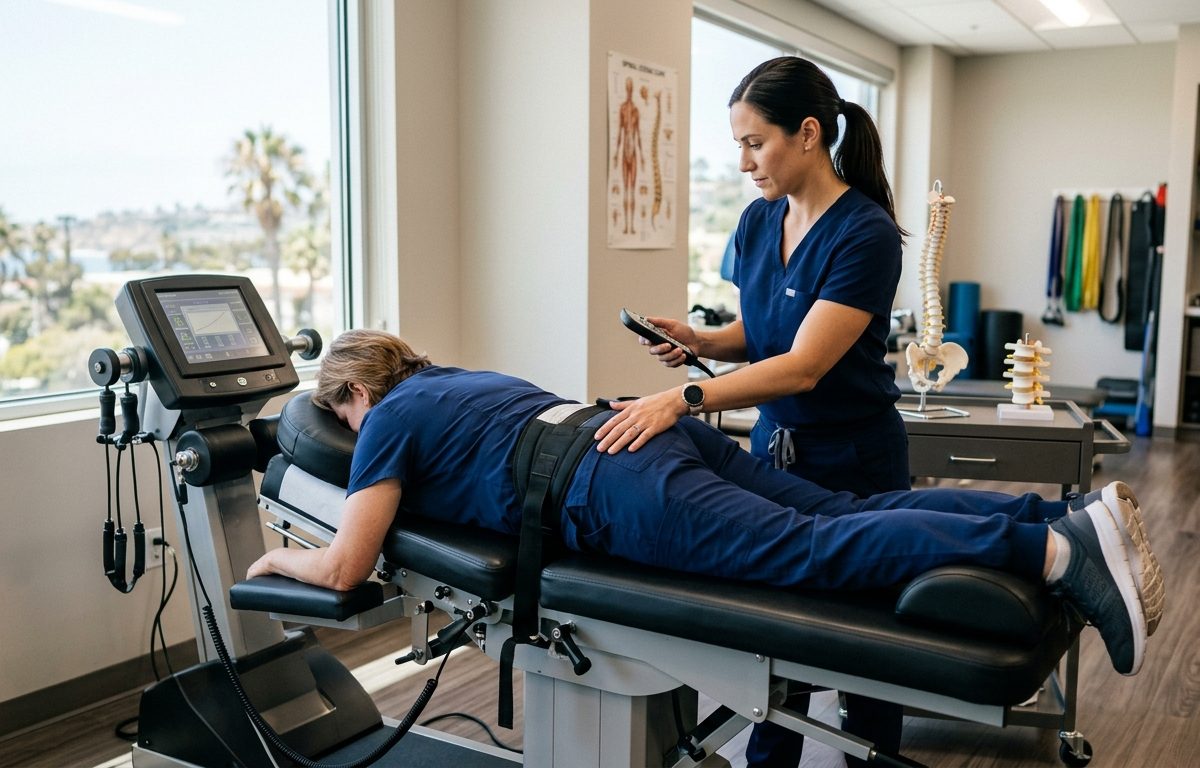
Questions about spinal decompression candidacy in San Diego usually come up after back, buttock, or leg symptoms have started limiting normal activity. Non-surgical spinal decompression is a form of supervised mechanical traction that may be considered in some conservative spine-care plans, especially when symptoms suggest disc irritation or nerve-root sensitivity. It is not a default answer for every painful spine condition, and it should not be recommended only because a table is available.
At San Diego Chiropractic Neurology, the team looks at symptom behavior, movement tolerance, neurologic findings, and medical history before deciding whether non-surgical spinal decompression belongs in the plan. That matters because the best candidate is not simply the person with the most pain. It is the person whose presentation actually fits the treatment and whose symptoms can be monitored safely over time.
Who is usually a good candidate for spinal decompression?
A reasonable candidate often has symptoms that suggest a mechanical and possibly disc-related problem rather than a vague, unexplained pain pattern. That can include back pain that travels into the buttock or leg, positions that load the spine and reproduce symptoms, or symptom behavior that points toward nerve-root irritation. Some people also report sitting intolerance, coughing or sneezing pain, or recurring flare-ups linked to bending and lifting.
Research on mechanical traction and decompression is mixed, but some reviews suggest selected patients with lumbar disc herniation or radicular symptoms may experience short-term benefit when traction is part of broader conservative care. That does not mean every person with radiating pain is automatically a match. It means candidacy starts with the clinical pattern, not the marketing claim.
Symptoms that may fit the pattern
- Pain that travels in a pattern consistent with sciatica or nerve irritation
- Symptoms associated with a known or suspected herniated disc
- Mechanical pain that changes with position, loading, or movement
- Symptoms that remain irritable despite reasonable early conservative care
- Tolerance for lying in the treatment position and reporting symptom changes clearly
The strongest early sign of good candidacy is not a diagnosis label alone. It is whether the person can be examined, whether the symptom pattern makes sense, and whether the clinician can explain why traction-based care belongs in the plan.
Who may not be a good candidate?
Some people are poor candidates because the symptom source is unclear, their condition may require a different level of care, or the treatment position and pulling force may not be tolerated well. A history of trauma, fracture, infection concern, severe osteoporosis, certain cancers, instability, recent surgery, or implanted hardware may require a different approach or medical clearance. Pregnancy and significant systemic illness also need to be disclosed before care begins.
People whose symptoms are dominated by progressive weakness, bowel or bladder changes, saddle numbness, or rapidly worsening neurologic findings should not treat decompression as a try-it-and-see option. Those warning signs need urgent medical evaluation. A person may also be a poor candidate when the real problem is not likely to respond to traction at all, such as pain driven more by another joint, another tissue, or a non-mechanical cause.
What should an evaluation check before treatment starts?
History and irritability
The evaluation should clarify when symptoms started, whether they travel, what positions provoke them, and whether numbness, tingling, weakness, balance changes, or sleep disruption are present. The pattern helps determine whether the presentation is likely disc-related, nerve-related, or something else entirely.
Neurologic and movement findings
A useful exam often includes gait, strength, reflexes, sensation, and movement testing. These findings help identify whether the nervous system is becoming more or less tolerant and whether conservative care remains appropriate. A good spinal decompression candidacy decision depends on this step because imaging alone does not tell you how the person is functioning today.
Treatment tolerance
Even when the diagnosis seems to fit, the person still has to tolerate the position, harness, and traction force. The 2022 randomized trial on non-surgical decompression for lumbar radiculopathy reported no treatment-related adverse events, but it also highlighted the need to monitor for increased pain, fatigue, and muscle spasm during care. That is why symptom response should guide progression instead of assuming more force is always better.
Can spinal decompression help disc-related leg pain?
It may help some people, especially when disc-related irritation or radicular pain appears to be part of the presentation. Evidence does not support promising a fixed number of visits or a guaranteed outcome, but selected patients may find that symptoms centralize, daily tolerance improves, or radiating pain becomes easier to manage when decompression is paired with a broader rehabilitation plan.
That broader plan can matter as much as the table itself. Education, load management, movement retraining, and progressive exercise often shape the overall outcome. Decompression is best understood as one tool that may reduce sensitivity enough for other parts of care to become more effective.
What does standard care sometimes miss when picking treatment?
Standard care sometimes turns candidacy into a simple yes-or-no answer based on pain location or a scan report. That misses the more important question: what is the nervous system and spine doing under load right now, and what kind of care is actually appropriate?
Two people can both be told they have a disc issue and still need very different plans. One may be a reasonable spinal decompression candidacy case because the symptoms are mechanically sensitive and the neurologic exam is stable. Another may need medical workup first because the symptoms are progressing or the pattern does not fit a traction-based approach. Functional Neurology Trained clinicians may use neurologic and movement findings to guide rehabilitation and to decide when referral is the better next step.
What should you ask before starting care in San Diego?
If you are considering care in San Diego, ask what findings make you a candidate, what findings would change the plan, and how the clinic monitors symptom response during treatment. Ask whether the plan includes more than table time, and ask when medical referral is recommended. The clinic's frequently asked questions can help you prepare for that conversation.
Patients often arrive hoping one treatment will solve everything. A better starting point is to understand whether decompression fits the diagnosis, whether the symptoms are stable enough for conservative care, and whether the plan matches the demands of work, commuting, lifting, exercise, or sport.
Frequently asked questions
Can spinal decompression help sciatica?
It may help selected patients when sciatica reflects a mechanical or disc-related irritation pattern, but candidacy still depends on the exam and symptom response.
Is spinal decompression right for every herniated disc?
No. A disc finding on imaging does not automatically mean decompression is the right treatment. Symptoms, neurologic findings, and tolerance still matter.
Who should avoid spinal decompression?
People with warning signs like progressive weakness, bowel or bladder changes, saddle numbness, suspected fracture, infection concern, or other serious medical issues should seek the appropriate medical evaluation first.
Do I need imaging before spinal decompression?
Not always. Imaging can be useful when it answers a clear clinical question, but a current examination is still needed because scans alone do not determine candidacy.
What if my symptoms get worse during treatment?
Tell the clinician immediately. Increased pain, new numbness, or poor tolerance should prompt reassessment rather than simply continuing the same settings.
Call (619) 344-0111 or book a free consultation
Medical disclaimer: This article is for education and does not diagnose or treat an individual condition. Seek appropriate medical care for urgent or worsening symptoms.
References
- Macario A, Richmond C, Auster M, et al. Motorized spinal decompression for chronic discogenic low back pain. Pain Pract. 2006. https://pubmed.ncbi.nlm.nih.gov/17147594/
- Wang W, Long F, Wu X, Li S, Lin J. Efficacy of mechanical traction for lumbar disc herniation. Medicine (Baltimore). 2019. https://pubmed.ncbi.nlm.nih.gov/31456418/
- Randomized trial of non-surgical decompression for lumbar radiculopathy. 2022. https://pubmed.ncbi.nlm.nih.gov/36527219/
- Jensen RK, Kongsted A, Kjaer P, Koes B. Diagnosis and treatment of sciatica. J Clin Med. 2021. https://pmc.ncbi.nlm.nih.gov/articles/PMC8200038/
- Berry JA, Elia C, Saini HS, Miulli DE. A review of lumbar radiculopathy. Cureus. 2019. https://pmc.ncbi.nlm.nih.gov/articles/PMC6858271/
Not sure what is driving your symptoms?
Talk with our Functional Neurology Trained team on a free phone consultation. We will tell you honestly whether we can help.