Post Concussion Syndrome Treatment Without Medication: What a Rehab-Focused Plan May Include
Free phone consultation with our San Diego functional neurology team. No obligation.
When symptoms linger after a concussion, many people start looking for options beyond medication. That is understandable. Headaches, dizziness, brain fog, light sensitivity, neck pain, and exercise intolerance can disrupt work, school, driving, workouts, and daily routines. In many cases, the biggest question is not just how to feel better, but why symptoms are still there in the first place.
For many patients in San Diego, a non-drug approach starts with a more complete evaluation. Persistent symptoms after concussion are often not caused by one issue alone. They may reflect a mix of vestibular dysfunction, visual strain, cervical involvement, migraine overlap, autonomic changes, sleep disruption, or reduced exercise tolerance. When those drivers are identified clearly, rehabilitation can be more specific and more useful.
At San Diego Chiropractic Neurology, the focus is on non-invasive evaluation and rehabilitation. The goal is not to make unrealistic outcome claims about brain injury recovery. The goal is to understand which systems appear stressed, which activities are still provoking symptoms, and which rehabilitation strategies may help improve tolerance, function, and daily performance.
What does post concussion syndrome mean?
The term post concussion syndrome is often used when symptoms continue longer than expected after a concussion. That can include headaches, dizziness, visual discomfort, fatigue, nausea, balance problems, anxiety, difficulty concentrating, and sensitivity to motion, light, or sound. Some symptoms improve steadily. Others fluctuate, especially when work, school, screens, traffic, exercise, or busy environments increase the load on the nervous system.
That is one reason a generic “just rest and wait” plan may stop being helpful. Updated concussion guidance supports a more active, targeted recovery approach after the earliest rest period, especially when symptoms persist. Instead of assuming all symptoms have the same cause, a structured exam can sort them into patterns that guide next steps.
Why medication is not the only option
Medication may be part of conventional care for some patients, especially when headaches, sleep issues, mood symptoms, or nausea are severe. But medication does not always explain why symptoms are still being triggered. A rehab-based approach asks different questions:
- Is dizziness being triggered by head movement, visual motion, or position changes?
- Are headaches being amplified by neck dysfunction or migraine overlap?
- Is reading hard because the eyes are not coordinating well after the injury?
- Does exertion bring symptoms on because exercise tolerance has dropped?
- Do standing, heat, or busy environments worsen symptoms because autonomic regulation is under strain?
Those questions matter because persistent post-concussion symptoms are often domain-specific. A person who mainly struggles with motion sensitivity may need a different rehabilitation plan than a person whose biggest issue is neck pain and headaches. The same is true for someone whose symptoms flare most during exercise, long screen sessions, or crowded visual environments.
What a non-drug concussion evaluation may include
A more complete assessment often looks beyond the original injury history alone. It may include:
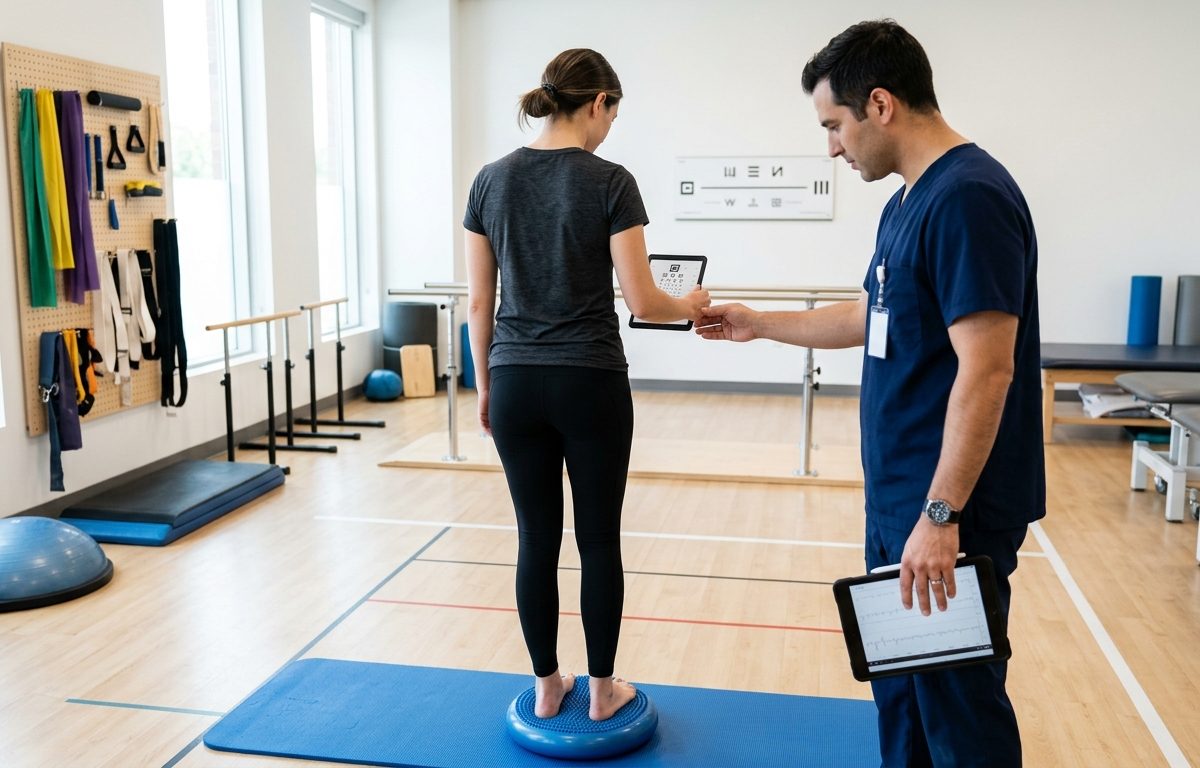
Vestibular screening
The vestibular system helps process head motion, balance, and spatial orientation. If it is not working smoothly, patients may feel dizzy in grocery stores, when turning quickly, or when moving through visually busy spaces. Vestibular findings are common in persistent concussion cases and often respond better when they are identified directly.
Oculomotor and visual testing
Concussion can affect tracking, convergence, and visual processing tolerance. That can make reading, scrolling, computer work, and classroom tasks surprisingly difficult. Patients may report eye strain, blurred focus, fatigue, nausea, or brain fog after screen time. A targeted visual screen helps determine whether these symptoms appear linked to oculomotor stress.
Cervical assessment
Neck dysfunction can contribute to headache, dizziness, visual discomfort, and motion sensitivity after a concussion. This is an important point because some “concussion symptoms” may partly reflect cervical involvement, especially after falls, sports contact, or car accidents. Cervicovestibular rehabilitation has shown value in patients with persistent symptoms that include dizziness, neck pain, and headaches.
Exercise tolerance assessment
Some patients feel worse with light cardio, stairs, or daily activity. Others feel fine at rest but crash later. A structured symptom-limited exercise screen can help show whether physiologic intolerance is still present. Research on sub-symptom aerobic exercise suggests that graded activity may support recovery more effectively than prolonged inactivity once serious complications have been excluded.
Migraine and symptom-pattern review
Migraine overlap is common after concussion, even in patients who did not think of themselves as “migraine patients” before. Light sensitivity, head pressure, nausea, visual aura-like episodes, and motion-triggered headaches may all point toward a migraine component. That matters because the rehab plan, pacing advice, and referral decisions may need to reflect it.
Autonomic and daily tolerance review
Some people notice symptom spikes with standing, heat, long days, stress, or poor hydration. That does not automatically mean a separate autonomic evaluation, but it can suggest that regulation and tolerance are not yet back to baseline. Knowing that helps shape pacing, recovery expectations, and return-to-activity planning.
What non-medication treatment may involve
Once the main symptom drivers are clearer, rehabilitation can become more focused. Depending on the case, a non-drug plan may include:
- Vestibular rehabilitation for dizziness, motion sensitivity, or balance problems
- Visual or oculomotor rehabilitation for reading fatigue, tracking trouble, and screen intolerance
- Cervical rehab strategies when neck dysfunction appears to be contributing to headaches or dizziness
- Sub-symptom aerobic exercise progression for exertional intolerance
- Return-to-work, school, and screen pacing strategies
- Environmental exposure progression for busy spaces, driving, or shopping triggers
The point is not to push through symptoms blindly. It is to challenge the system in a controlled way, watch the response, and build tolerance over time. In persistent concussion care, that kind of targeted progression is often more practical than broad advice to simply avoid all triggers forever.
How this differs from conventional medical care
Conventional medical care still matters. Emergency red flags, imaging decisions, medication management, neurologic referral, and broader medical evaluation sit in that layer of care. A clinic like San Diego Chiropractic Neurology is not replacing that role. Instead, the functional neurology and rehabilitation role is to assess how symptoms are showing up across balance, eye movements, motion tolerance, exercise tolerance, and daily function, then build a non-invasive rehab plan around those findings.
That distinction matters. Patients with persistent symptoms often need both good medical oversight and a clear rehabilitation strategy. A rehab-focused plan is about supporting function, regulation, tolerance, and recovery capacity. It is not about claiming that one modality directly treats every cause of post-concussion syndrome.
When to seek a more complete evaluation
A more thorough concussion evaluation may be worth considering if:
- Symptoms are lasting weeks or months
- Dizziness is triggered by movement, stores, traffic, or screens
- Headaches keep returning with activity or concentration
- Reading, scrolling, or computer work causes eye strain or brain fog
- Exercise brings symptoms back quickly
- Neck pain seems tied to headache or dizziness
- You feel “mostly better” but still cannot tolerate normal life at your old level
Persistent symptoms are frustrating because improvement can be partial and uneven. But that does not always mean recovery has stopped. Sometimes it means the remaining drivers have not been separated clearly enough.
Why a structured plan matters in San Diego
San Diego patients often want to return to active routines quickly. Work commutes, fitness, surfing, cycling, school demands, and screen-heavy jobs can all expose lingering deficits fast. A generic handout may not be enough for that reality. A structured plan can help clarify what is actually provoking symptoms and what type of progression may be reasonable.
That may include guidance around busy visual environments, exertion, screen load, hydration, sleep consistency, and staged return to activity. It may also include referrals or co-management when symptoms suggest that another medical layer should be involved.
Internal resources that may help
Patients dealing with lingering dizziness or visual motion sensitivity after concussion may also find it helpful to review these related resources:
What to expect from a rehab-focused approach
A strong non-drug plan is not just “do exercises and hope.” It should start with pattern recognition, move into targeted rehabilitation, and adjust based on response. Some patients improve most with vestibular progression. Others need more cervical work, visual retraining, or exercise pacing. In many cases, the best plan combines more than one track because symptoms are being driven by more than one system.
That is why detailed evaluation matters. If symptoms are still limiting work, exercise, driving, reading, or daily life, it may be time to look more closely at what is maintaining them.
FAQ
Can post concussion syndrome improve without medication?
Yes, in many cases improvement may come from targeted rehabilitation, pacing, and identification of the main symptom triggers. Medication may still be useful for some people, but it is not the only path.
What kinds of non-drug treatment may help lingering concussion symptoms?
Depending on the findings, options may include vestibular rehabilitation, visual or oculomotor exercises, cervical rehab, graded aerobic exercise, and structured return-to-activity planning.
How long can post concussion symptoms last?
Recovery time varies. Some people improve quickly, while others have symptoms that continue for weeks or months. Persistent symptoms deserve a more targeted evaluation rather than assumptions alone.
When should someone seek a more complete concussion evaluation?
If dizziness, headaches, brain fog, screen intolerance, neck pain, or exercise intolerance are not resolving, or if they keep returning with normal activity, a more complete evaluation may help clarify next steps.
Can dizziness and brain fog after concussion come from more than one problem?
Yes. Persistent symptoms often reflect overlap between vestibular, visual, cervical, migraine, exertional, and autonomic factors rather than one single cause.
Call (619) 344-0111 or book a free consultation to discuss whether a more complete, non-invasive concussion evaluation may be appropriate.
Medical disclaimer: This article is for educational purposes only and is not medical advice. It is not a substitute for evaluation, emergency care, or treatment from a licensed medical professional. If you have severe headache, repeated vomiting, worsening confusion, new weakness, seizure, loss of consciousness, or other urgent symptoms after a head injury, seek immediate medical care.
References
- Patricios J, et al. Consensus statement on concussion in sport: the 6th International Conference on Concussion in Sport—Amsterdam 2022. Br J Sports Med. 2023. https://bjsm.bmj.com/content/57/11/695
- Ellis MJ, et al. Targeted evaluation and active rehabilitation for persistent post-concussion symptoms. Contemporary review literature on domain-based concussion care.
- Schneider KJ, et al. Cervicovestibular rehabilitation in sport-related concussion: a randomised controlled trial. Br J Sports Med. 2014. https://pubmed.ncbi.nlm.nih.gov/24855132/
- Leddy JJ, et al. Early targeted heart rate aerobic exercise versus placebo stretching for sport-related concussion. Lancet Child Adolesc Health. 2021. https://pubmed.ncbi.nlm.nih.gov/34600629/
Not sure what is driving your symptoms?
Talk with our Functional Neurology Trained team on a free phone consultation. We will tell you honestly whether we can help.