Neurologic Rehabilitation San Diego: What a Structured Program May Include
Free phone consultation with our San Diego functional neurology team. No obligation.
Neurologic rehabilitation is a broad term, and that is exactly why many patients feel unsure about what it actually means. Some people hear it after a concussion. Others hear it when dizziness, balance problems, visual motion sensitivity, coordination issues, or persistent brain fog have not fully settled. In each case, the central question is the same: what kind of evaluation and rehabilitation plan makes sense for the way the nervous system is functioning right now?
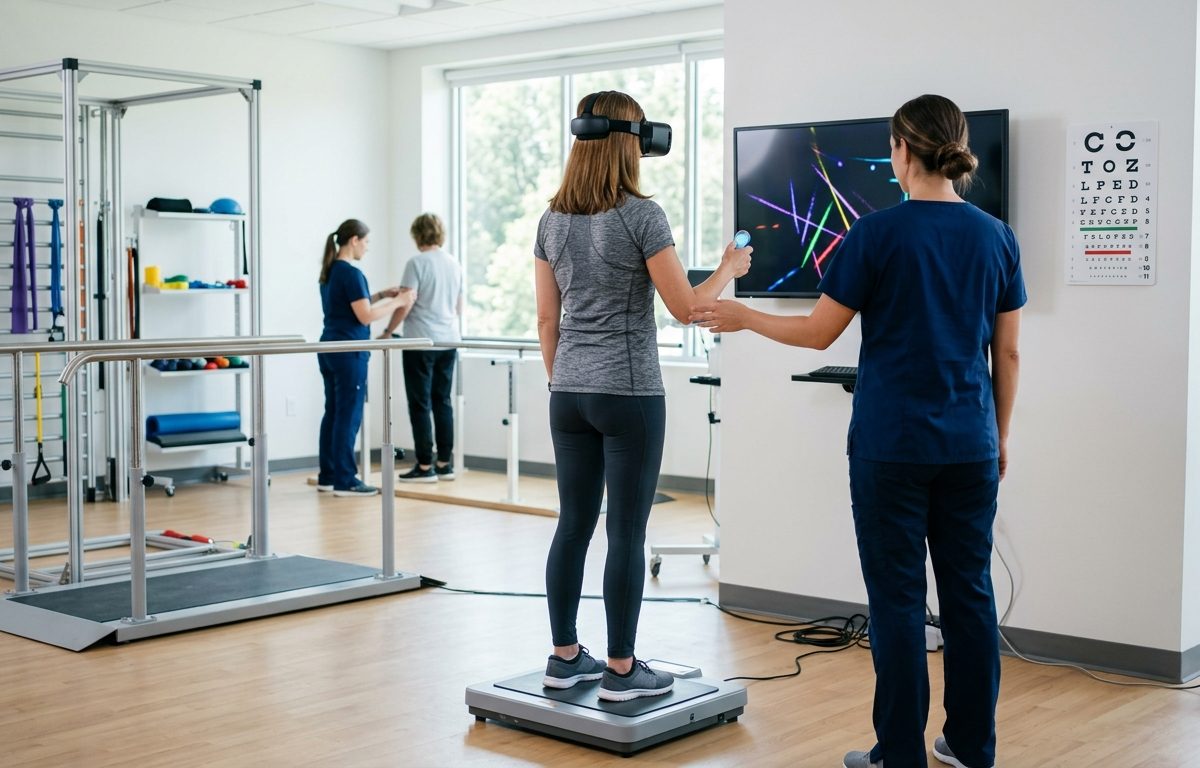
At San Diego Chiropractic Neurology, neurologic rehabilitation is approached as a structured process. The goal is not to force one generic protocol onto every patient. The goal is to identify which systems appear overloaded, underperforming, poorly coordinated, or difficult to tolerate, then build a practical rehabilitation plan around those findings. That may involve vestibular work, visual tracking exercises, graded balance training, coordination drills, sensory integration tasks, or guided progression back into daily activity.
This matters because neurologic symptoms rarely show up in isolation. A patient may report dizziness but also struggle with neck-related triggers, visual motion sensitivity, headache, fatigue, concentration problems, or reduced tolerance for busy environments. Another patient may mainly notice imbalance, but careful testing can reveal eye movement issues, poor sensory integration, or difficulty stabilizing during head turns. A useful rehabilitation program has to match the actual pattern, not just the headline symptom.
What neurologic rehabilitation usually means
In practical terms, neurologic rehabilitation is a targeted plan designed to improve function. It focuses on how the brain and nervous system coordinate movement, balance, visual input, posture, and symptom tolerance. Depending on the patient, the emphasis may be on restoring confidence with walking, reducing dizziness with motion, improving tolerance for reading or screens, sharpening coordination, or increasing capacity for work, exercise, and normal routines.
That is one reason a generic rest-and-wait approach often falls short for persistent symptoms. Early rest may be appropriate in some situations, but many patients improve more effectively when rehabilitation becomes active, progressive, and symptom-guided. Research in both vestibular and concussion care supports individualized rehabilitation that is dosed to the patient’s tolerance and adjusted over time.
Neurologic rehabilitation also depends on repetition and relevance. Neuroplasticity research suggests that the nervous system responds best when activities are specific, meaningful, and repeated in a way that builds adaptation without overwhelming the patient. In other words, the right challenge matters. Too little challenge may not move things forward. Too much challenge may simply flare symptoms and reduce compliance.
Who may benefit from neurologic rehabilitation?
A neurologic rehabilitation program may be considered when symptoms are interfering with daily life and a more structured functional evaluation is needed. Common examples include:
- Persistent dizziness or imbalance
- Symptoms after a concussion or mild traumatic brain injury
- Motion sensitivity in stores, traffic, or screens
- Visual-vestibular complaints such as difficulty reading or focusing while moving
- Coordination problems or clumsiness
- Persistent headaches with sensory overload
- Difficulty returning to exercise, work, school, or driving
Not every patient with these symptoms needs the same rehabilitation path. That is why the first step is usually not treatment. It is clarification. A clinic needs to understand whether the problem pattern looks primarily vestibular, visual, cervicogenic, post-concussion, autonomic, balance-related, or multi-factorial. In many patients, more than one layer is contributing at the same time.
What a good evaluation should include
Before a rehabilitation plan is built, the clinic should be able to explain what it is seeing. A thorough neurologic rehabilitation evaluation usually looks at symptom behavior, balance, gait, eye movements, head movement tolerance, coordination, posture, and the way different sensory systems work together. The exact exam varies, but the point is to identify patterns that can guide progression.
For example, one patient may feel dizzy mainly when turning the head quickly. Another may be stable until visual motion enters the picture. A third may tolerate standing still but lose confidence when walking, scanning, and thinking at the same time. Those are different rehabilitation problems, and they should not be treated as if they are identical.
In San Diego, patients often come in after trying a few disconnected steps on their own: rest, stretching, basic home exercises, or general physical therapy. Sometimes those steps help. Sometimes they do not go far enough because the underlying pattern was never clearly mapped. A structured neurologic rehabilitation evaluation can help define what to emphasize first and what to avoid overloading too soon.
Common components of a neurologic rehabilitation program
Vestibular rehabilitation
When dizziness, imbalance, or head-motion intolerance is part of the picture, vestibular rehabilitation may be one layer of care. This can include gaze stabilization, habituation, balance progression, and head-movement tolerance training. Evidence supports vestibular rehabilitation for many vestibular disorders, especially when it is individualized and progressed appropriately. Patients exploring this area may also want to review the clinic’s vestibular therapy overview.
Visual-vestibular training
Some patients do not simply feel dizzy; they feel visually overloaded. Reading, scrolling, grocery stores, traffic, or fast environmental movement may aggravate symptoms. In those cases, visual tracking, fixation stability, convergence support, and controlled visual motion exposure may matter. This is often especially relevant after concussion and in complex dizziness presentations.
Balance and gait progression
Balance problems are not always obvious until task demands rise. A patient may feel fine standing in place but struggle when walking while turning the head, stepping over obstacles, or navigating busy environments. A good program builds from basic control to more functional demands, which may include surface changes, dual-task loading, and dynamic movement progression.
Coordination and motor control work
Neurologic rehabilitation can also focus on movement quality. Some patients need help improving timing, coordination, postural control, or movement confidence. The exercises are usually simple at first but are selected to challenge the right systems in a way that is repeatable and measurable.
Gradual return-to-activity planning
Rehabilitation is not just about what happens in the clinic. It also has to bridge back into life. That may include a guided return to walking, exercise, work, school demands, driving, or sport-related conditioning. Concussion research in particular supports active, symptom-limited recovery rather than indefinite avoidance of activity. Patients with concussion-related concerns can also review the clinic’s concussion page for broader context.
How neurologic rehabilitation differs from a generic exercise program
Many exercise programs can improve conditioning. Neurologic rehabilitation is narrower and more specific. It is designed around the way the nervous system is processing inputs and coordinating outputs. The aim is not simply to get the patient moving more. The aim is to choose the right kinds of movement, sensory demand, and progression for the patient’s symptom pattern.
That distinction matters when symptoms are provoked by visual motion, head turns, balance challenges, mental load, or combined-task activity. A general wellness plan might be helpful for overall health, but it may not answer why certain neurologic triggers keep showing up. A more focused rehabilitation model can help connect symptoms to function and function to progression.
Is neurologic rehabilitation the same as physical therapy?
Not exactly. There can be overlap, and some physical therapists provide excellent neurologic or vestibular rehabilitation. The difference is not always about title alone; it is about the evaluation model and the program design. A patient should understand what systems are being assessed, how progress will be measured, and why the assigned exercises match the symptom pattern.
At a clinic like San Diego Chiropractic Neurology, the emphasis is often on the interaction between vestibular, visual, balance, sensory, and coordination findings. That can make the rehabilitation plan feel more tailored for patients whose symptoms are complex, persistent, or difficult to sort out through a more general approach.
How long does a neurologic rehabilitation program take?
That depends on the reason for care, the severity and duration of symptoms, and how consistently the patient can follow through. Some people improve with a relatively short course of focused exercises and activity progression. Others need longer monitoring because symptoms are multi-layered or fluctuate with work, sleep, stress, or exertion.
A realistic plan should set expectations early. Patients should know what the initial goals are, what kinds of symptom responses are expected, how progress will be adjusted, and what signs suggest the program is moving in the right direction. Clear pacing is often more useful than aggressive volume.
What patients in San Diego should look for before beginning care
If you are searching for neurologic rehabilitation in San Diego, look for a clinic that can explain its reasoning clearly. Patients should be able to ask:
- What systems are being evaluated?
- What pattern do you think is driving my symptoms?
- How will the exercises be progressed?
- How will you tell if the plan is helping?
- What should I do at home between visits?
Those questions matter because a good rehabilitation program should feel organized, not random. It should give patients a roadmap. It should also account for how symptoms behave in real environments, whether that means reading, working at a computer, walking in crowds, driving, or moving through visually busy spaces.
Patients dealing with dizziness or balance symptoms may also benefit from reviewing related resources such as vertigo, neuro-visual rehabilitation, and the clinic FAQ page.
Why progression matters in real-world neurologic rehabilitation
One of the most helpful parts of a structured neurologic rehabilitation plan is that it creates a sequence. Patients are not just handed a list of exercises and told to guess their way through recovery. Instead, the program should move from lower-demand tasks to higher-demand tasks in a way that reflects how symptoms behave in the real world. That means watching how a patient responds to head turns, screen exposure, walking with visual complexity, dual-task challenges, and increasing levels of physical or cognitive demand.
This progression matters because many neurologic symptoms are context dependent. A patient may tolerate a quiet room but struggle in a grocery store. Another may feel fine during simple balance drills but become symptomatic during faster head movement, busy traffic, or sustained screen work. A thoughtful rehabilitation plan accounts for those differences and uses them to decide what to advance next, what to hold steady, and what still needs more support.
It also helps patients understand that temporary symptom activation is not always the same thing as setback. In many rehabilitation models, especially vestibular and post-concussion care, the goal is to work within an appropriate symptom threshold so the nervous system is challenged without being overwhelmed. That balance often improves consistency, confidence, and long-term follow-through.
When to consider a more structured workup
If symptoms are lingering, recurring, or interfering with normal routines, it may be time for a more structured evaluation. That does not automatically mean the problem is severe. It means the patient may need better clarity. For many people, that clarity is what turns a frustrating recovery into a manageable one.
Neurologic rehabilitation works best when it is specific, measurable, and individualized. The nervous system responds to targeted input, not guesswork. For patients in San Diego dealing with dizziness, balance problems, post-concussion symptoms, or complex sensory overload, a focused rehabilitation plan may be the step that helps care finally make more sense.
FAQ
What does neurologic rehabilitation include?
It may include balance training, vestibular exercises, visual-vestibular work, coordination drills, symptom-guided activity progression, and home exercises based on the patient’s exam findings.
Who may benefit from neurologic rehabilitation?
Patients with dizziness, balance problems, post-concussion symptoms, visual motion sensitivity, coordination issues, or persistent neurologic symptoms that affect daily life may benefit from a structured evaluation.
Is neurologic rehabilitation the same as physical therapy?
There can be overlap, but neurologic rehabilitation is often more specifically organized around nervous-system function, symptom triggers, and sensory-motor integration patterns.
How long does a neurologic rehabilitation program last?
Program length varies. Some patients improve in a shorter course, while others need a longer progression depending on symptom complexity, consistency, and tolerance.
Call (619) 344-0111 or book a free consultation to discuss whether a structured neurologic rehabilitation evaluation may be the right next step.
Medical disclaimer: This article is for educational purposes only and is not personal medical advice. Individual evaluation is necessary to determine the most appropriate next steps for any symptom pattern.
References
- Winstein CJ, et al. Guidelines for Adult Stroke Rehabilitation and Recovery. Stroke. 2016. https://pubmed.ncbi.nlm.nih.gov/27145936/
- Hall CD, et al. Vestibular Rehabilitation for Peripheral Vestibular Hypofunction. J Neurol Phys Ther. 2022. https://pubmed.ncbi.nlm.nih.gov/34864777/
- Leddy JJ, et al. Active Recovery from Concussion. Curr Opin Neurol. 2018. https://pubmed.ncbi.nlm.nih.gov/29481485/
- Kleim JA, Jones TA. Principles of experience-dependent neural plasticity. J Speech Lang Hear Res. 2008. https://pubmed.ncbi.nlm.nih.gov/18978205/
Not sure what is driving your symptoms?
Talk with our Functional Neurology Trained team on a free phone consultation. We will tell you honestly whether we can help.