Functional Neurology Clinic San Diego: What to Expect and Who It May Help
Free phone consultation with our San Diego functional neurology team. No obligation.
People searching for a functional neurology clinic San Diego are often trying to solve a frustrating problem that has not responded to simple advice alone. That may include persistent dizziness, post-concussion symptoms, migraine-related sensitivity, balance problems, brain fog, visual motion intolerance, or symptoms that seem to flare with busy environments, exercise, screens, or position changes. In many of these cases, the next useful step is not guessing. It is a more complete neurologic and functional assessment followed by a rehabilitation plan that matches the findings.
At San Diego Chiropractic Neurology, the focus is on non-invasive evaluation and rehabilitation. The clinic looks at how the nervous system is processing balance input, eye movement control, head and neck position, sensory integration, exertional tolerance, and day-to-day triggers. Instead of offering one generic program for everyone, the goal is to identify which systems are underperforming and then build a targeted plan to support better regulation, tolerance, and function.
For people in San Diego dealing with chronic dizziness, migraine patterns, post-concussion symptoms, or complex neurologic complaints, that kind of structured approach can be more useful than trying random exercises found online. Clinical guidance matters because symptoms that look similar on the surface can come from very different mechanisms.
What is a functional neurology clinic?
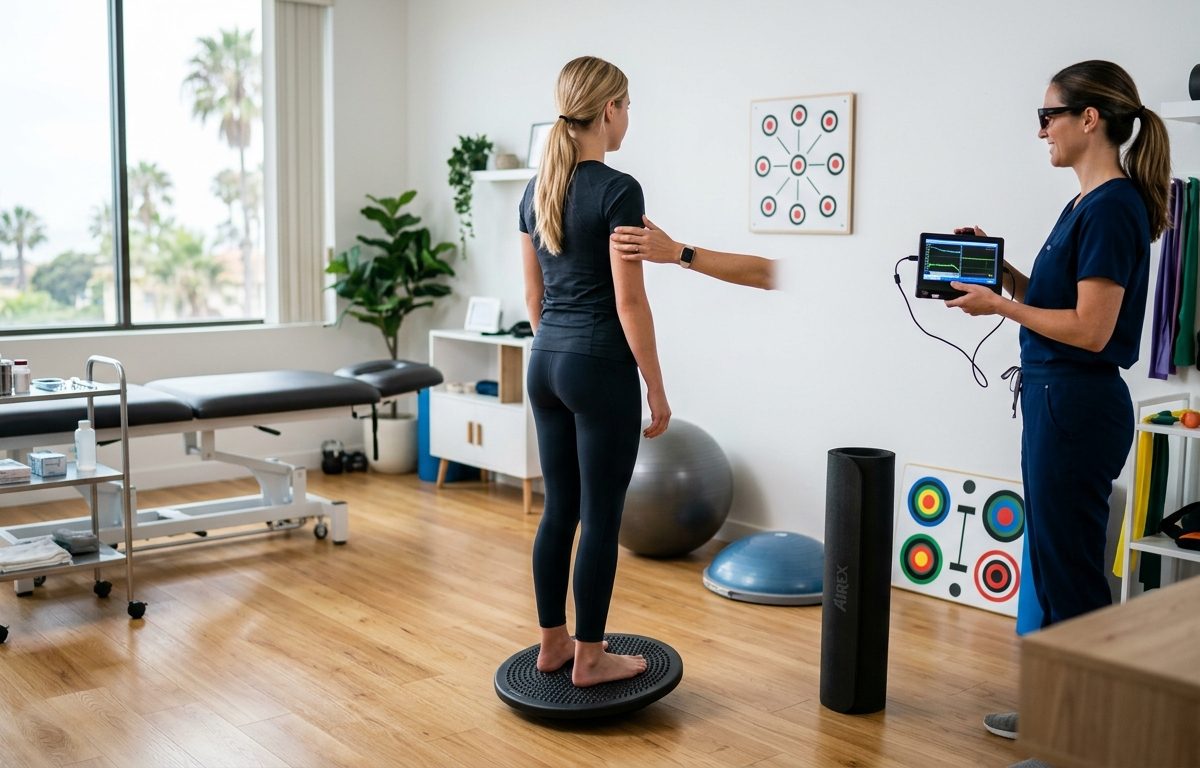
A functional neurology clinic is a setting that evaluates how the nervous system is working in real life rather than looking only for one isolated diagnosis label. That means the exam can include balance testing, eye tracking, vestibular screening, coordination, gait, reaction to head movement, visual motion sensitivity, autonomic symptom patterns, cervical influences, and other neurologic performance markers.
The word “functional” here refers to how the system performs. It does not mean vague care. A structured functional neurology evaluation uses repeatable tasks and symptom responses to understand where the problem may be showing up most clearly. For example, one person may primarily struggle with gaze stabilization and motion sensitivity after a concussion, while another may have dizziness that is more positional or more strongly linked to vestibular dysfunction. Someone else may have migraine with sensory overload and poor tolerance for visually busy environments.
That distinction matters because rehabilitation tends to work best when it is specific. Vestibular rehabilitation, graded sensory exposure, visual-motor exercises, and exertional progression are not interchangeable. They should be selected based on the exam, the symptom pattern, and the person’s capacity that day.
Who may benefit from a functional neurology clinic in San Diego?
A functional neurology clinic may be a fit for people who have symptoms affecting balance, orientation, head movement tolerance, concentration, visual comfort, or neurologic endurance. Common reasons people seek care include:
- Persistent dizziness or vertigo
- Post-concussion symptoms that linger beyond the first recovery window
- Migraine patterns with dizziness, motion sensitivity, or visual triggers
- Balance problems or unsteadiness
- Brain fog or cognitive fatigue with sensory overload
- Exercise intolerance after a neurologic event
- Visual motion sensitivity in stores, traffic, or on screens
- Neck-related dizziness or mixed symptom patterns
In San Diego, these issues often affect active adults, students, athletes, professionals, and older adults who want a practical plan they can follow. Some have already had imaging or prior evaluations and still feel like they do not have a roadmap. Others have been told to just wait, but they are unsure whether the current symptoms are normal, improving, or stuck.
That is where a detailed assessment can help. It may clarify whether symptoms align more with vestibular dysfunction, post-concussion recovery needs, migraine-related neurologic sensitivity, autonomic stress, cervical contribution, or some combination of those patterns. The clinic’s role is not to replace emergency or specialist medical care when red flags exist. The role is to assess functional deficits and build a rehabilitation strategy when non-emergency symptoms remain limiting.
What happens during the first visit?
The first visit usually starts with a detailed history. That includes when symptoms began, what makes them better or worse, whether there was an injury or illness trigger, what prior care has already been tried, and how symptoms affect work, driving, exercise, sleep, reading, or daily routines.
From there, the exam may look at:
- Eye movements and visual tracking
- Gaze stability during head motion
- Balance under different sensory conditions
- Walking and turning tolerance
- Positional responses
- Neck movement and symptom provocation
- Visual motion sensitivity
- Exertional tolerance or recovery response
- Coordination and timing tasks
Not every person needs every test. The point is to find the smallest useful set of findings that explains the symptom behavior. A strong plan is usually built from that pattern rather than from a one-size-fits-all diagnosis label.
For example, someone with symptoms after a concussion may need a blend of vestibular, visual, and exertional progression work. Someone with dizziness triggered by rolling in bed may need a more positional vestibular approach. Someone with migraine and motion sensitivity may need careful sensory pacing and graded exposure. The visit should end with a clearer explanation of what appears to be driving symptoms and what the next rehab steps are likely to involve.
How rehabilitation is typically structured
Rehabilitation in a functional neurology clinic should be individualized, progressive, and measurable. The best plans are challenging enough to create adaptation but not so aggressive that they trigger unnecessary setbacks. In practical terms, that often means short bouts of targeted exercises, symptom monitoring, pacing guidance, and adjustments over time based on response.
Depending on the case, the plan may include vestibular rehabilitation, visual-motor drills, coordination work, graded balance tasks, walking progression, sensory integration tasks, or guided return-to-activity steps. The intent is to improve tolerance, accuracy, confidence, and day-to-day function rather than simply “push through” symptoms.
Research supports targeted vestibular rehabilitation for many people with vestibular hypofunction and related balance complaints. Concussion rehabilitation literature also supports moving beyond prolonged rest alone when persistent symptoms remain, using structured and symptom-guided progression instead. That does not mean every person recovers on the same timeline. It means a tailored plan is often more productive than waiting without direction.
How this differs from general chiropractic or general physical therapy
Some patients wonder whether a functional neurology clinic is just another name for general chiropractic or a standard therapy visit. The difference is usually in the exam focus and the rehab targeting. A functional neurology approach tends to spend more time on how visual, vestibular, neurologic, and sensory systems are interacting with symptoms.
That can be especially important for people whose symptoms do not fit neatly into one body region. If someone has dizziness with head movement, sensitivity to grocery store aisles, headaches with screen time, and poor exercise tolerance after a concussion, a purely orthopedic approach may miss part of the picture. A functional exam can help organize those symptoms into a more coherent plan.
At the same time, a good clinic should know when a person needs another layer of care. Red flags, sudden severe neurologic change, fainting of unknown cause, acute stroke-like symptoms, severe new headache, or progressive medical concerns require the appropriate medical pathway. Rehabilitation works best when the right people are in the right lane.
Conditions commonly addressed in this setting
At San Diego Chiropractic Neurology, people often arrive with symptom patterns that overlap across more than one category. A few common examples include:
- Concussion and post-concussion symptoms: especially when dizziness, motion sensitivity, balance trouble, or visual strain linger. Learn more about concussion care.
- Vertigo and dizziness: including positional dizziness, visual motion sensitivity, and balance-related symptoms. See the clinic’s page on vertigo and dizziness.
- Migraine-related neurologic symptoms: especially when headache overlaps with dizziness, light sensitivity, or motion triggers. The migraine resource explains this pattern further.
- Vestibular and balance rehabilitation needs: including guided work for gaze stability, walking tolerance, and head-movement tolerance. See vestibular therapy.
- Visual strain or eye-movement dysfunction: especially when reading, scrolling, or busy environments bring on symptoms. Learn about neuro-visual rehabilitation.
These links are useful because they show how a broad functional neurology clinic can still organize care into specific symptom pathways. That helps patients understand what they are actually working on rather than feeling lost in a generic program.
Why a San Diego patient may want a clinic-centered plan
San Diego patients often want care that fits an active life. Whether someone wants to return to work, surfing, running, school, driving, gym training, or just feeling steady in crowded stores, the rehab plan has to connect to real goals. A clinic-centered plan starts with what symptoms are limiting, then builds from there.
That matters because neurologic symptoms often fluctuate. A person may feel almost normal at rest but unravel in a visually busy environment. Another may do fine in the morning and struggle later in the day. Another may tolerate walking but not quick turns, head movement, or screen transitions. A thoughtful rehab program can break those patterns into trainable pieces.
The goal is not perfection in one visit. The goal is better function over time, with enough specificity that the person understands why each part of the plan is there.
How long does progress usually take?
Recovery timelines vary widely. Some patients respond quickly once the main symptom driver is identified. Others need a slower progression, especially when symptoms have been present for a long time or involve overlap between vestibular, visual, migraine, and neck-related factors.
In general, a realistic program should show direction before it shows final results. Early wins may include better tolerance for walking, less dizziness with turning, improved confidence in busy environments, or shorter recovery time after activities. Over time, goals may expand toward reading, screen work, exercise, travel, school, or other daily demands.
That is another reason evaluation quality matters. A stronger starting map usually leads to a cleaner progression. If the wrong system is being targeted, people may work hard and still feel stuck.
When to seek another level of care first
A functional neurology clinic is not the right first stop for every situation. Immediate or urgent medical evaluation is important for sudden severe headache, new weakness, facial droop, speech difficulty, loss of consciousness, chest pain, shortness of breath, new seizures, or other emergency symptoms. Patients with unexplained fainting, rapidly worsening neurologic signs, or systemic medical concerns may also need broader medical workup first.
When emergency issues have been ruled out and symptoms remain persistent, that is often when a rehabilitation-focused exam becomes more useful. It can help translate an open-ended symptom story into a practical next-step plan.
What to look for when choosing a functional neurology clinic
If someone is comparing options, a few questions help:
- Does the clinic explain the evaluation process clearly?
- Will the plan be individualized to dizziness, concussion, migraine, visual, vestibular, or autonomic findings?
- Are expectations realistic instead of overly promotional?
- Is progress measured by function and tolerance, not just vague promises?
- Does the clinic connect symptoms to a rehabilitation strategy you can understand?
Those basics often matter more than buzzwords. Clear reasoning, careful assessment, and a targeted plan are what usually make rehabilitation feel productive.
Next steps
If you are looking for a functional neurology clinic San Diego, the most useful next step is usually a focused evaluation that looks at how your symptoms behave across balance, vision, movement, exertion, and daily activity. That kind of visit can help clarify whether the problem appears more vestibular, post-concussion, migraine-related, cervical, or mixed, and what a realistic rehabilitation plan may involve.
Call (619) 344-0111 or book a free consultation to learn whether a non-invasive neurologic rehabilitation evaluation at San Diego Chiropractic Neurology may be the right fit.
Medical disclaimer: This article is for educational purposes only and is not medical advice, diagnosis, or a substitute for emergency care or evaluation by a licensed medical professional.
Frequently asked questions
What is a functional neurology clinic?
A functional neurology clinic evaluates how neurologic systems such as balance, eye movements, sensory integration, and exertional tolerance are performing, then uses those findings to guide rehabilitation.
What conditions may bring someone to a functional neurology clinic in San Diego?
Common reasons include persistent dizziness, post-concussion symptoms, migraine-related sensitivity, balance problems, visual motion intolerance, and neurologic fatigue patterns that interfere with daily life.
What happens during the first visit?
The first visit usually includes a symptom history, review of triggers and prior care, and testing of balance, eye movements, walking, head-motion tolerance, visual sensitivity, and related neurologic performance measures.
Is functional neurology the same as vestibular therapy?
Not exactly. Vestibular therapy can be one part of a broader functional neurology rehabilitation plan, but some people also need visual, coordination, sensory, cervical, or exertional progression work.
How long does neurologic rehabilitation usually take?
It varies. Some people improve quickly once the main driver is identified, while others need a slower progression based on symptom duration, complexity, and tolerance.
References
- Hall CD, Herdman SJ, Whitney SL, et al. Vestibular Rehabilitation for Peripheral Vestibular Hypofunction: Clinical Practice Guideline. J Neurol Phys Ther. 2022. https://pubmed.ncbi.nlm.nih.gov/34864777/
- Leddy JJ, Sandhu H, Sodhi V, Baker JG, Willer B. Rehabilitation of Concussion and Post-concussion Syndrome. Sports Health. 2012. https://pmc.ncbi.nlm.nih.gov/articles/PMC3435903/
- Newman-Toker DE, Edlow JA. TiTrATE: A Novel Approach to Diagnosing Acute Dizziness and Vertigo. Neurol Clin. 2015. https://pubmed.ncbi.nlm.nih.gov/26231272/
- Alsalaheen BA, Mucha A, Morris LO, et al. Vestibular rehabilitation for dizziness and balance disorders after concussion. J Neurol Phys Ther. 2010. https://pubmed.ncbi.nlm.nih.gov/20588094/
- Reneker JC, Cheruvu VK, Yang J, James MA, Cook CE. Physical examination and multimodal rehabilitation for persistent mild traumatic brain injury symptoms: a systematic review. Brain Inj. 2017. https://pubmed.ncbi.nlm.nih.gov/28530515/
Not sure what is driving your symptoms?
Talk with our Functional Neurology Trained team on a free phone consultation. We will tell you honestly whether we can help.