Decompression Therapy vs Physical Therapy: Which Is Right for You?
Free phone consultation with our San Diego functional neurology team. No obligation.
Decompression Therapy vs Physical Therapy: Which Is Right for You?
When people search for decompression therapy vs physical therapy, they are often comparing two very different forms of care for back pain, leg symptoms, or a disc-related concern. The most useful comparison is not a simple contest. Decompression is a specific, usually passive traction-based modality. Physical therapy is a broad rehabilitation discipline that may include exercise, manual techniques, education, and retraining for daily activities.
Evidence does not support promising one universal answer. The right starting point depends on how symptoms behave, whether there are neurologic findings, what movements are tolerated, and whether the goal is symptom relief, improved strength, better walking, or a return to work or sport. A San Diego Chiropractic Neurology evaluation can help organize those factors before a plan is selected.
What is the difference between decompression therapy and physical therapy?
Decompression is a focused traction modality
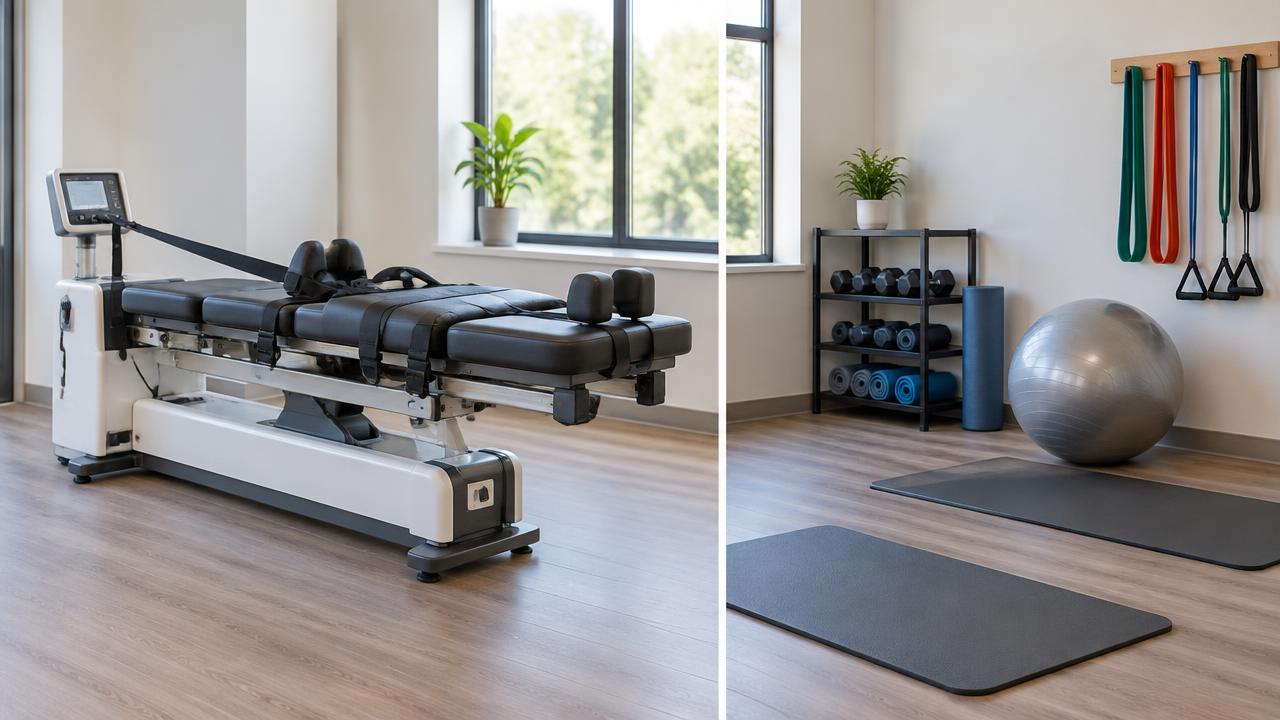
Non-surgical spinal decompression generally uses a motorized table or related system to apply controlled pulling and unloading forces to the spine. The clinician selects positioning and loading based on the region involved, symptom behavior, and safety considerations. The purpose is to change mechanical stress temporarily and assess how the person responds.
Decompression is not the same as surgical decompression, and it should not be presented as a guaranteed way to move a disc back into place. Research on motorized decompression has been limited by small studies, differing protocols, and mixed patient groups. A 2006 systematic review concluded that the effectiveness of motorized decompression for chronic discogenic low back pain remained unproven because of these limitations.
Physical therapy is active rehabilitation
Physical therapy usually builds capacity through movement. Depending on the evaluation, a plan may include trunk and hip strengthening, motor-control work, aerobic conditioning, mobility training, education, and graded return to activities. The emphasis is often on improving how the person moves and functions over time rather than relying on one table-based procedure.
Exercise-based rehabilitation has broader support across low back pain guidelines. A 2023 systematic review and network meta-analysis found that several exercise approaches, including motor-control and stabilization exercise, can improve pain and function compared with usual care or no intervention. That does not mean every exercise is appropriate for every person. It means active rehabilitation is an important part of many well-designed plans.
Does decompression therapy work better than physical therapy?
Current evidence does not justify saying that decompression consistently works better than physical therapy. A 2023 systematic review of mechanical traction added to physical therapy found short-term improvements in some low back pain populations, including people with lumbar radiculopathy. However, the evidence was low or very low quality, and no traction approach clearly outperformed another.
The Cochrane review of traction for low back pain reached a cautious conclusion: traction offers little or no meaningful benefit for many groups, although uncertainty remains about whether selected subgroups may respond differently. The 2021 Academy of Orthopaedic Physical Therapy guideline emphasizes exercise and other active interventions and does not support routine mechanical traction for chronic low back pain with leg pain.
These findings do not make decompression irrelevant. They do mean that it should be offered with realistic expectations, appropriate screening, and a way to monitor whether it is helping. A passive modality may be considered as one part of care when the examination supports it, but it should not replace attention to strength, coordination, endurance, and daily function.
When might decompression be considered?
A clinician may consider decompression therapy when a person has a mechanical pattern that appears compatible with controlled unloading and no important contraindications. The decision may involve the location and timing of pain, the presence of leg symptoms, the effect of position, prior imaging, and findings from a neurologic and musculoskeletal examination.
Screening matters. Progressive weakness, bowel or bladder changes, saddle numbness, fever, unexplained weight loss, major trauma, or severe unrelenting pain may require prompt medical evaluation rather than a routine decompression appointment. A history of fracture risk, cancer, infection, significant osteoporosis, or certain vascular and spinal conditions can also change the care pathway.
A safe plan should define what will be monitored. That can include walking tolerance, sleep disruption, strength, sensory changes, functional tasks, and whether symptoms centralize or spread. If the response is poor or concerning, the plan should be reconsidered rather than continued automatically.
Why does physical therapy matter even if traction is used?
Symptoms can improve temporarily when a painful region is unloaded, but daily life still places demands on the spine. Physical therapy helps address those demands by building capacity and improving movement options. It may also help a person understand how to pace activities and return to normal tasks without depending on a passive session.
For example, someone with back and leg symptoms may need more than reduced spinal loading. They may also need progressive hip and trunk strength, balance work, walking tolerance, and strategies for lifting or prolonged sitting. These goals fall within active rehabilitation. After lumbar surgery, a 2022 systematic review found that strengthening, stabilization, and aerobic exercise can add benefit beyond education or advice alone.
Physical therapy does not have to mean pushing through worsening symptoms. Exercise selection, dosage, and progression should be adjusted to the person's irritability and findings. Supervision is especially important when symptoms include numbness, tingling, weakness, or a change in walking.
What does standard care miss in this comparison?
Standard comparisons often frame decompression and physical therapy as competing choices. That can miss the most important question: what does the examination show, and how is the person responding? A passive modality without functional progression may leave important limitations unaddressed. Exercise prescribed without considering symptom behavior or neurologic signs may also be difficult to tolerate.
A broader evaluation can connect the mechanical complaint with coordination, balance, reflexes, sensation, gait, and movement control. This does not mean every back problem is a neurologic disorder. It means that neurologic findings can affect safety, referral decisions, and exercise selection. The team at San Diego Chiropractic Neurology can use those findings to determine whether decompression therapy, rehabilitation, chiropractic care, medical referral, or a combination makes sense.
How can I choose care in San Diego?
Start by asking what will be assessed, how progress will be measured, and what happens if the first approach is not helping. Be cautious of claims that promise a fixed number of visits, permanent relief, or a guaranteed disc correction. A credible plan should explain its limits and coordinate with medical care when red flags or significant neurologic changes are present.
For some people, active rehabilitation is the clearest starting point. For others, a carefully screened course of non-surgical spinal decompression may be considered alongside movement-based care. Some may benefit from chiropractic care in San Diego or a referral for additional evaluation. People with radiating leg symptoms can also review sciatica symptoms and care.
The goal is not to choose the most impressive-sounding technology. It is to choose a plan that is safe, measurable, and connected to the person's functional goals. A consultation can clarify whether decompression, physical therapy, or a combined approach is appropriate.
Frequently asked questions
Is decompression therapy the same as physical therapy?
No. Decompression is a focused traction-based modality. Physical therapy is a broader rehabilitation service that may include exercise, education, manual care, and functional training.
Is spinal decompression better than exercise therapy?
There is not strong evidence that it is better for everyone. Exercise has broad guideline support, while traction may have a role for selected people when the examination and response support it.
Can decompression and physical therapy be used together?
They can be combined when clinically appropriate. Decompression may be used as one monitored component, while physical therapy addresses strength, movement, endurance, and daily function.
How do I choose between decompression and physical therapy in San Diego?
Ask for an examination, evidence-informed expectations, measurable goals, and a clear plan for reassessment. The safest choice is the one that fits your findings and functional needs.
Can decompression help if I have sciatica?
It may be considered for selected people with radiating symptoms, but the plan should be guided by the exam, symptom behavior, and safety factors rather than by the label alone.
Do I need exercise even if decompression helps?
Often, yes. Relief from unloading does not replace the need to rebuild strength, coordination, and tolerance for daily activity.
Call (619) 344-0111 or book a free consultation to discuss your symptoms and care options.
Medical disclaimer: This article is for general education and is not a diagnosis or a substitute for evaluation by a qualified healthcare professional. Seek prompt medical care for severe or rapidly worsening symptoms, progressive weakness, bowel or bladder changes, saddle numbness, fever, or major trauma.
References:
- https://pubmed.ncbi.nlm.nih.gov/17147594/
- https://pubmed.ncbi.nlm.nih.gov/38035307/
- https://pubmed.ncbi.nlm.nih.gov/36939359/
- https://www.cochrane.org/evidence/CD003010_traction-low-back-pain
- https://www.jospt.org/doi/10.2519/jospt.2021.0304
- https://pubmed.ncbi.nlm.nih.gov/36041721/
Not sure what is driving your symptoms?
Talk with our Functional Neurology Trained team on a free phone consultation. We will tell you honestly whether we can help.