Concussion Balance Problems Treatment: Why Balance Can Feel Off After a Head Injury
Free phone consultation with our San Diego functional neurology team. No obligation.
Balance problems are one of the most frustrating symptoms people notice after a concussion. Some feel unsteady when walking. Others feel pulled to one side, uneasy in crowds, or off balance when turning their head. In San Diego, many people expect those symptoms to disappear quickly, but that does not always happen. When balance stays off, it usually means the nervous system needs a closer look rather than a generic wait-and-see approach.
After a concussion, balance can be affected by several systems at once. The inner ear, visual system, neck, reaction timing, gait control, and sensory integration all play a role in staying upright and steady. If one or more of those systems is underperforming, daily activities can start to feel harder. Walking through a grocery store, climbing stairs, working at a computer, turning quickly, or exercising may suddenly feel less automatic than before.
At San Diego Chiropractic Neurology, the team takes a rehabilitation-centered approach to persistent post-concussion symptoms. That means looking beyond the label of “dizziness” alone and asking what kind of balance problem is actually happening, what triggers it, and which neurologic or vestibular systems may need support.
Why Balance Problems Are Common After Concussion
A concussion can temporarily disrupt how the brain processes movement, spatial orientation, eye movements, and body position. Even when imaging is normal, the systems that keep a person steady can still be under strain. That is why someone may say, “My scans were fine, but I still do not feel normal when I walk.”
Balance depends on three major information sources working together:
- Vestibular input from the inner ears, which helps detect motion and head position
- Visual input from the eyes, which helps orient the body in space
- Somatosensory input from muscles and joints, which tells the brain where the body is
After concussion, the brain may have trouble integrating these signals smoothly. When that happens, a person can feel wobbly, delayed, visually overwhelmed, or motion sensitive even if strength and basic neurologic testing look normal at first glance.
What Concussion-Related Balance Problems Can Feel Like
Not everyone describes balance symptoms the same way. Common descriptions include:
- feeling unsteady while walking
- drifting to one side
- difficulty turning the head while moving
- discomfort in stores, crowds, or visually busy environments
- feeling like the floor is moving or tilting
- losing confidence on stairs or uneven ground
- needing to slow down because movement feels disorienting
Some people also notice dizziness, nausea, light sensitivity, blurred vision, or fatigue alongside balance problems. That overlap matters because it can point toward vestibular or visual-motor involvement rather than a simple deconditioning issue.
Balance Problems Do Not Always Mean the Same Thing
“Balance issue” is a broad phrase. After concussion, it can reflect more than one pattern. Separating those patterns helps guide better treatment.
Vestibular balance problems
These often show up with head turns, positional changes, motion sensitivity, or visually busy environments. A person may feel worse in traffic, stores, or when bending and looking up again.
Visual-motor balance problems
Some patients feel worse when reading, scrolling, tracking movement, or shifting gaze quickly between targets. Their balance may feel less steady because the eyes and brain are not coordinating efficiently.
Cervical contribution
Neck dysfunction after a head injury can contribute to dizziness, altered position sense, and poor movement confidence. If turning the head or holding the neck in one position aggravates symptoms, that can be part of the picture.
Sensory integration overload
Some people do fairly well in simple environments but struggle when multiple inputs arrive at once. Grocery stores, crowds, escalators, patterned floors, and fast-moving surroundings can all trigger this type of instability.
General post-concussion underperformance
Sometimes the issue is broader. Reaction timing, coordination, endurance, and confidence may all drop together, making balance feel unreliable across many settings.
Why Symptoms Sometimes Linger
Many people improve steadily in the early days after a concussion, but others continue to have symptoms for weeks or months. That does not automatically mean the injury was severe. It often means the systems involved in recovery have not fully normalized yet.
Persistent balance symptoms can linger when:
- vestibular deficits are missed early
- visual motion sensitivity keeps getting triggered
- the neck remains irritated or stiff
- the person avoids movement and loses tolerance
- rehabilitation is too generic for the actual symptom pattern
This is one reason persistent symptoms deserve evaluation rather than dismissal. Balance problems that continue to affect walking, work, workouts, driving, or public environments usually need more than reassurance alone.
What a More Complete Evaluation Should Look At
When someone has ongoing balance problems after a concussion, a useful assessment should look at more than symptom checklists. It should examine how balance changes with head turns, eye movements, visual motion, posture, gait, and graded movement.
That may include looking at:
- gaze stability
- motion sensitivity
- positional triggers
- walking mechanics
- single-leg balance and postural control
- eye tracking and visual focus shifts
- cervical contribution to dizziness or imbalance
In San Diego, this kind of more detailed evaluation can help explain why one person mainly feels off while walking outdoors, while another struggles most with stores, screens, or fast head turns. The symptoms may sound similar, but the underlying drivers can differ.
How Treatment Is Usually Approached
Concussion balance problems are usually managed through targeted rehabilitation rather than passive rest alone. The goal is to improve neurologic performance, movement tolerance, and system coordination in a stepwise way.
Vestibular rehabilitation
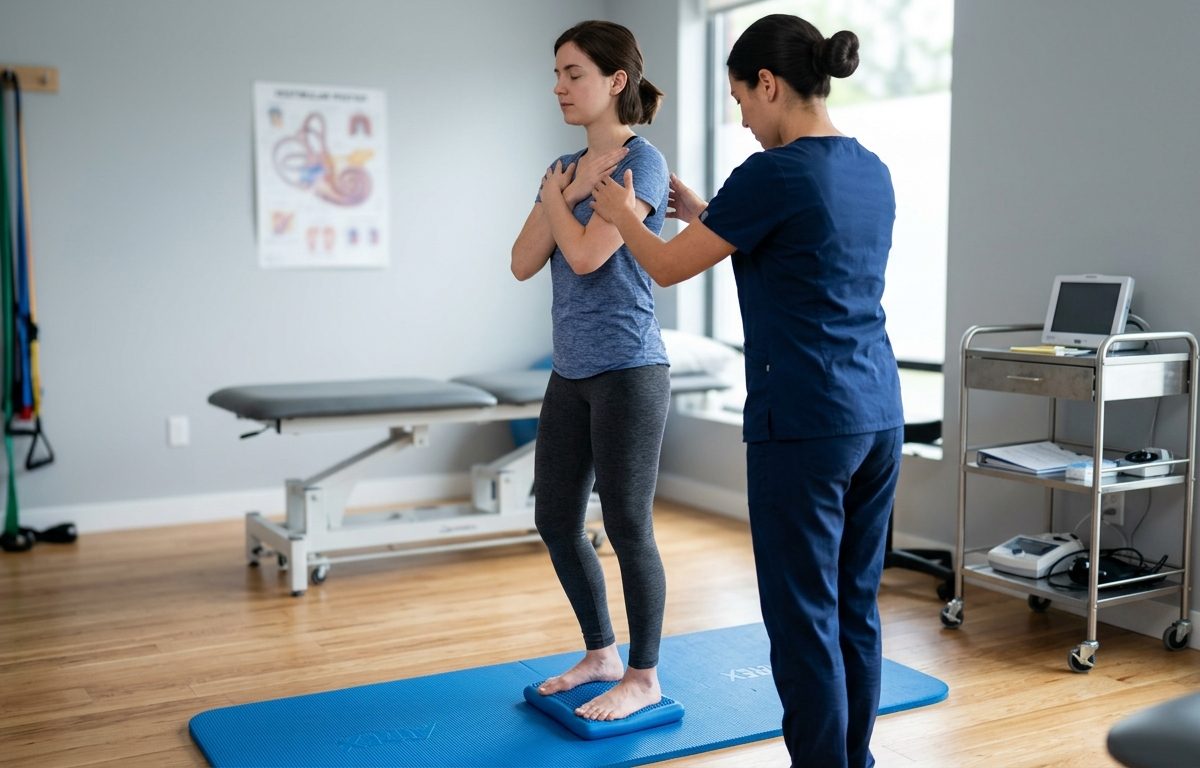
When vestibular findings are present, treatment may include gaze stabilization, head-movement drills, balance exercises, habituation, and graded exposure to motion triggers. Research suggests vestibular rehabilitation may help appropriate patients with persistent concussion symptoms, especially when dizziness and balance complaints remain active.
Visual-motor rehabilitation
If reading, screens, tracking, or shifting visual focus worsens symptoms, exercises may target eye movement control, visual attention, and tolerance for more complex visual environments.
Gait and postural retraining
Some patients need work on walking mechanics, head-body coordination, turning control, and confidence in more dynamic positions. This can be especially important for people who have started moving stiffly or cautiously because they do not trust their balance.
Neck-related support
If the neck appears to be amplifying symptoms, care may also address cervical mechanics, posture load, and the relationship between head movement and dizziness.
Graded return to activity
Many patients need a careful progression back to exercise, work, driving, and busy environments. Too much avoidance can slow recovery, but pushing too aggressively can also backfire. The right pace is usually specific to the patient.
What Patients Often Get Wrong
Assuming balance problems are “just dizziness”
Balance problems may involve vestibular, visual, cervical, and movement-control systems. Calling everything dizziness can hide the actual pattern.
Waiting too long to get evaluated
Some symptoms improve with time, but persistent unsteadiness often benefits from targeted assessment and rehab rather than indefinite waiting.
Trying random online exercises
Exercises that help one balance pattern may aggravate another. BPPV maneuvers, vestibular drills, and neck exercises are not interchangeable.
Stopping movement completely
Severe symptoms may require temporary activity modification, but long-term avoidance can reduce tolerance and confidence. Most patients do better with structured progression.
When to Seek Help
A deeper concussion balance evaluation may be worth considering when:
- you still feel unsteady days or weeks after a concussion
- walking in crowds or stores makes symptoms worse
- turning your head throws off your balance
- you feel unsafe on stairs or uneven surfaces
- you have dizziness plus visual or coordination symptoms
- you want to understand whether concussion symptoms and vestibular symptoms are overlapping
These symptoms do not always mean something dangerous is happening, but they do mean the balance system may need more attention.
What Recovery Can Look Like
Recovery from concussion-related balance problems is often gradual. Many patients improve in layers. First they may feel steadier standing still. Then they may tolerate walking better. Later they may handle stores, workouts, car rides, and head turns with less symptom escalation.
That kind of progression is normal. The goal is not simply to get through the day by moving more carefully. The goal is to restore steadier, more automatic balance across real-life situations. For some people, that means reducing dizziness. For others, it means improving visual stability, gait confidence, motion tolerance, or multitasking while moving.
It can also help to track what makes symptoms worse. Busy environments, poor sleep, screen exposure, quick head turns, exercise, heat, and stress can all influence recovery. These patterns can guide treatment much better than a generic label alone.
Another helpful point is that balance recovery is often task-specific. A person may feel fine sitting still but lose confidence when walking while turning the head, carrying groceries, or moving through patterned floors and fluorescent lighting. That difference matters because it shows why simple rest is not always enough. When the challenge is movement-based or visually driven, treatment often works best when it rebuilds tolerance under those real-world conditions instead of staying too general.
Patients also commonly benefit from understanding that balance problems can involve both symptom sensitivity and true performance underload. Someone may feel anxious because balance feels unreliable, but that does not mean the symptom is caused only by anxiety. A careful exam can separate fear of movement from measurable issues in gaze stability, postural control, head-motion tolerance, or gait mechanics. That clarity often helps people engage in rehab with more confidence.
How the Clinic Frames Its Role
San Diego Chiropractic Neurology approaches persistent concussion symptoms through a rehabilitation lens. The clinic’s role is to evaluate neurologic performance, vestibular function, visual-motor control, movement tolerance, and sensory integration so treatment can be more specific. That is different from simply telling patients to wait longer or guessing at the cause based on one symptom.
For the right patient, that can mean a clearer explanation of why balance feels off and a more structured plan for improving it.
Next Steps
If balance still feels off after a concussion, it may be time to look more closely at what system is being challenged. A broader neurologic and vestibular evaluation can help identify whether gaze stability, motion sensitivity, visual processing, gait control, or neck-related factors are keeping symptoms going.
Patients in San Diego who want a more complete rehabilitation-centered evaluation can learn more about vestibular therapy and related support such as neuro-visual rehabilitation when appropriate.
Call (619) 344-0111 or book a free consultation.
FAQ
How long do balance problems last after a concussion?
Some people improve within days, while others have symptoms for weeks or longer. If balance problems persist or interfere with daily function, a more complete evaluation may help clarify why.
Can a concussion affect walking or coordination?
Yes. Concussion can affect vestibular function, visual processing, reaction timing, and sensory integration, all of which can make walking and coordination feel less automatic.
What is the difference between dizziness and balance problems after concussion?
Dizziness often describes a sensation such as spinning, floating, or motion sensitivity. Balance problems describe trouble staying steady while standing or walking. Many patients have both.
When should someone seek a vestibular evaluation after concussion?
If symptoms linger, worsen with head movement or visually busy places, or make walking and daily tasks harder, vestibular-focused evaluation may be appropriate.
Medical Disclaimer
This article is for educational purposes only and is not medical advice, diagnosis, or a substitute for individualized care. Anyone with worsening neurologic symptoms, repeated vomiting, severe headache, new weakness, or urgent concerns after head injury should seek prompt medical evaluation.
References
- Centers for Disease Control and Prevention. Symptoms of Mild TBI and Concussion.
- Kleffelgaard I, Roe C, Soberg HL, Bergland A. Associations among self-reported balance problems, post-concussion symptoms, and performance-based tests. BMC Neurol. 2012.
- Murray DA, Meldrum D, Lennon O. Can vestibular rehabilitation exercises help patients with concussion? A systematic review. Br J Sports Med. 2017.
- Kontos AP, Deitrick JM, Collins MW, Mucha A. Review of vestibular and oculomotor screening and concussion rehabilitation. J Athl Train. 2017.
Not sure what is driving your symptoms?
Talk with our Functional Neurology Trained team on a free phone consultation. We will tell you honestly whether we can help.