BPPV Specialist San Diego: What a Thorough Visit Should Include
Free phone consultation with our San Diego functional neurology team. No obligation.
Finding the right BPPV specialist San Diego patients can trust often starts with understanding what benign paroxysmal positional vertigo, or BPPV, actually is. BPPV is a common cause of short, sudden spinning sensations that are triggered by head position changes, such as rolling over in bed, lying back, sitting up, or looking upward. Clinical guidelines describe it as one of the most common peripheral vestibular disorders and recommend a targeted bedside evaluation rather than guesswork or broad reassurance alone.
For many people, the spinning lasts seconds, but the disruption can last much longer. Even brief episodes can make driving, working, showering, exercising, and getting out of bed feel unpredictable. Some patients also develop lingering imbalance, motion sensitivity, or anxiety about triggering another episode. That is why a specialist visit should do more than label the problem. It should confirm whether symptoms really fit BPPV, identify which canal is involved when possible, screen for red flags, and outline the next step clearly.
At San Diego Chiropractic Neurology, the focus is on a structured dizziness and balance evaluation that helps determine whether symptoms match classic positional vertigo or whether another vestibular, neurologic, cervical, or post-concussion issue may also be contributing. For patients in San Diego who want a clear and conservative plan, that distinction matters.
What BPPV Usually Feels Like
BPPV often causes a strong sense that the room is spinning when the head changes position relative to gravity. Common triggers include rolling onto one side in bed, tipping the head back at the sink, bending down, getting up from bed, or looking overhead. Episodes are usually brief, but they can be intense. Nausea, imbalance, and a “washed out” feeling afterward are also common.
Even so, not every type of dizziness is BPPV. Lightheadedness when standing, rocking sensations, visual motion sensitivity, migraine-related dizziness, cervicogenic dizziness, and post-concussion vestibular problems can all feel similar at first. A thorough visit should separate these patterns instead of assuming every spinning complaint is caused by loose inner-ear particles.
What a BPPV Specialist Should Evaluate
A high-quality dizziness visit should start with symptom pattern recognition. The clinician should ask what movement triggers symptoms, how long the spinning lasts, whether hearing changes are present, whether headaches or migraines are involved, whether there was a recent concussion or illness, and whether the patient feels off-balance between episodes.
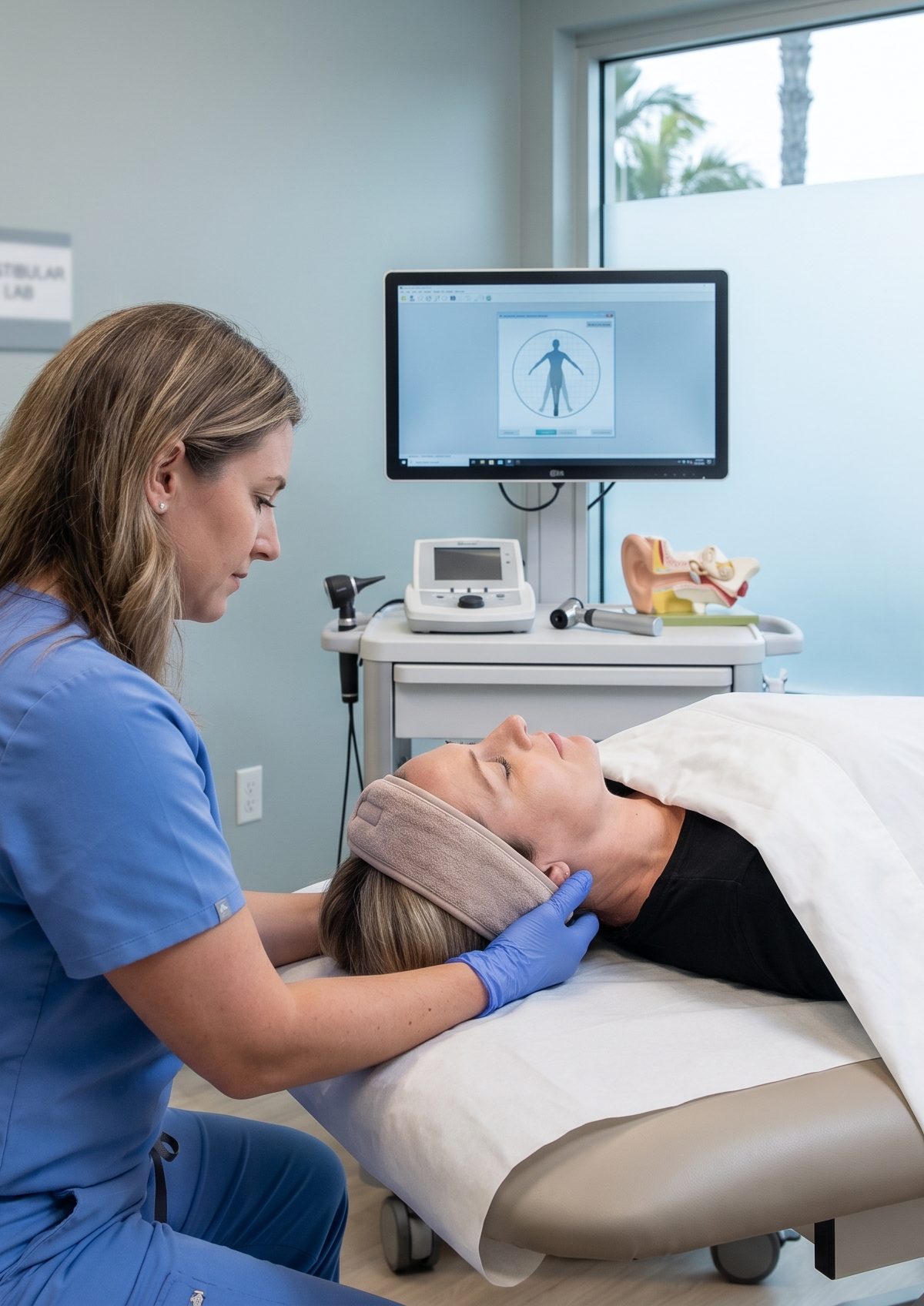
From there, the exam usually includes positional testing. The Dix-Hallpike test is the standard bedside test used to evaluate posterior-canal BPPV, while the supine roll test helps evaluate possible horizontal-canal BPPV. These tests are not just formalities. They help determine whether eye movement findings and symptom timing fit a classic positional vertigo pattern.
A complete visit may also include:
- Oculomotor screening to observe eye tracking and nystagmus
- Balance and gait assessment to identify fall-risk concerns
- Cervical screening when neck pain or stiffness may be contributing
- Review of migraine, concussion, or neurologic history
- Assessment of symptom severity, frequency, and functional impact
That broader screening matters because dizziness in adults, especially older adults, can affect confidence, stability, and day-to-day function. A visit should explain whether the pattern is straightforward BPPV or whether the patient may need additional vestibular rehabilitation, neurologic follow-up, or medical referral.
Why Identifying the Correct Canal Matters
BPPV is not one single presentation. Posterior-canal BPPV is most common, but horizontal-canal and less common variants can occur as well. Different patterns may need different repositioning strategies. If the positional tests are interpreted incorrectly, a patient may be told treatment “didn't work” when the real issue is that the involved canal was never identified correctly.
This is one reason a specialist evaluation can be useful. The goal is not simply to provoke dizziness. It is to match the history, positional findings, and eye movement pattern to the most likely mechanism. When that match is clear, care can be more targeted.
How BPPV Is Commonly Managed
For appropriate patients with posterior-canal BPPV, clinical practice guidelines recommend a canalith repositioning procedure as first-line care. These maneuvers are designed to guide displaced inner-ear particles into a less provocative position. Many people improve quickly, but response time can vary.
What matters from a compliance and patient-education perspective is setting expectations accurately. A specialist should not imply that every dizzy patient will improve after one maneuver or that every recurrence means something dangerous. Instead, patients should understand that positional vertigo can recur and may need reassessment. They should also know that if the presentation changes, the diagnosis may need to be revisited.
At the clinic level, this means framing care around careful assessment, evidence-based positional management when BPPV is present, and rehabilitation support when residual imbalance or motion sensitivity remains. It does not mean promising a cure for every cause of vertigo.
When Symptoms Are Not Classic BPPV
This is where many online articles fall short. They explain BPPV well but do not explain what happens when the presentation is not typical. A patient may describe spinning but also have lingering visual motion sensitivity, neck-triggered dizziness, post-concussion symptoms, migraine history, or balance problems between episodes. In those cases, the specialist visit should widen the lens.
A functional neurology and vestibular rehabilitation setting can help evaluate how the balance system, eye movements, head motion tolerance, gait, and sensory integration are functioning. That approach is not a replacement for emergency or specialty medical care when red flags are present. It is a way to assess performance and rehabilitation needs when the goal is to improve tolerance, confidence, and function after the main cause is identified.
For example, someone may have had BPPV initially but still feel unstable afterward. Another patient may think they have BPPV because rolling over triggers symptoms, but the stronger driver may be vestibular migraine or a post-concussion issue. The value of a specialist visit is in sorting those possibilities out.
Red Flags That Need More Than a Positional Vertigo Workup
Although BPPV is common, not every dizzy episode should be treated as routine. A thorough evaluation should screen for symptoms that point beyond classic positional vertigo. Patients should seek urgent medical care if dizziness is accompanied by new weakness, numbness, fainting, double vision, severe new headache, trouble speaking, chest pain, or other acute neurologic or cardiovascular symptoms. Atypical or persistent findings warrant broader medical consideration, not just repeated maneuvers.
That is part of what makes a good BPPV specialist valuable. The role is not merely to perform one maneuver. The role is to know when the pattern fits BPPV, when follow-up testing is needed, and when the patient should be redirected for a different level of care.
What San Diego Patients Can Expect From a Structured Dizziness Evaluation
Patients searching for a vertigo evaluation in San Diego usually want clarity as much as symptom relief. A structured visit should explain:
- whether symptoms match classic BPPV
- which movements are most provocative
- whether positional testing supports a specific canal pattern
- whether balance deficits or fall-risk concerns are present
- whether lingering symptoms suggest the need for vestibular therapy or additional rehabilitation
For some patients, the answer is straightforward. For others, the exam reveals overlap with migraine, neck-related dizziness, or concussion-related symptoms, making a broader plan more appropriate. When that happens, the clinic's role is to support neurologic and vestibular rehabilitation, symptom tolerance, and safer return to normal activity.
Why Recurrence Education Matters
Recurrence is not unusual in BPPV. That means patients benefit from education about what symptoms fit a repeat positional episode, when to come back for reassessment, and what warning signs suggest the picture has changed. It also helps to discuss sleep-position concerns, fall prevention, and activity pacing during the recovery window.
For adults who already feel unsteady, even one dizzy episode can change how they move through the day. They may avoid stairs, exercise, busy stores, or turning quickly. Over time, that can reduce confidence and activity level. A strong follow-up plan should account for both the inner-ear issue itself and the functional impact it leaves behind.
How a Specialist Connects Evaluation to Recovery
A careful dizziness visit should not end with a label alone. If positional vertigo is identified, the patient should leave understanding what was found, what movement pattern triggered the symptoms, what immediate next step is appropriate, and when reassessment is warranted. If symptoms are already improving, the visit can still be useful because it helps determine whether the patient is ready to resume normal movement or whether residual balance limits remain.
That transition matters for active adults, older adults, and patients who need to feel steady at work. Some people continue to avoid bending, turning quickly, or exercising after a major spinning episode because they no longer trust their balance. In those cases, recovery is not just about eliminating vertigo. It is also about restoring confidence in head movement, walking, visual focus, and daily activity tolerance.
A vestibular-focused rehabilitation plan may include graded head-motion exposure, balance exercises, gaze stabilization work when appropriate, and guidance on returning to ordinary tasks without excessive symptom fear. These steps should be individualized and based on exam findings, not handed out generically.
The Clinic's Role in Functional Neurology Terms
In a functional neurology setting, the clinic's role is to evaluate and support systems related to balance, gaze stability, positional tolerance, sensory integration, and neurologic performance. When classic BPPV is present, evidence-based positional management may be part of the plan. When symptoms extend beyond classic BPPV, rehabilitation may focus on balance training, visual-vestibular tolerance, graded head-motion exposure, and functional recovery goals.
This distinction is important. The clinic should describe its role in terms of assessment, regulation, performance, tolerance, and rehabilitation rather than making broad disease-cure claims. That kind of language is both more accurate and more useful to patients who are trying to understand what happens next.
Questions to Ask When Choosing a BPPV Specialist in San Diego
If a patient is comparing providers, it can help to ask practical questions:
- Do they perform Dix-Hallpike and supine roll testing?
- Do they explain whether the findings fit posterior- or horizontal-canal BPPV?
- Do they screen for migraine, concussion, cervical, or neurologic overlap?
- Do they provide guidance if symptoms recur?
- Can they help with residual imbalance through rehabilitation if the spinning improves but function does not?
These questions often reveal whether a clinic is focused on thorough evaluation or only on a single quick intervention.
When to Schedule an Evaluation
Anyone dealing with repeated spinning triggered by head position, especially when getting in and out of bed or looking upward, may benefit from an evaluation. It is especially reasonable to schedule a visit when symptoms keep coming back, the diagnosis is uncertain, balance feels off between episodes, or there is overlap with other problems such as concussion-related dizziness or migraine patterns.
Call (619) 344-0111 or book a free consultation.
Frequently Asked Questions
What does a BPPV specialist evaluate during a dizziness visit?
A specialist usually reviews symptom triggers, duration, medical history, and whether symptoms fit classic positional vertigo. The visit often includes Dix-Hallpike or supine roll testing, eye-movement observation, balance screening, and review of whether another vestibular or neurologic issue may be involved.
Is BPPV the same as every type of vertigo?
No. BPPV is one specific cause of vertigo related to head-position changes. Other causes include vestibular migraine, neuritis, concussion-related dizziness, cervicogenic dizziness, and central neurologic causes. That is why careful evaluation matters.
How long does BPPV usually last after treatment?
Some patients improve quickly after a repositioning maneuver, while others need reassessment or follow-up care. Response time depends on the presentation, involved canal, and whether other dizziness factors are also present.
Why does vertigo come back when I roll over in bed?
Recurrence can happen with BPPV, and rolling in bed is a common trigger because it changes head position relative to gravity. Repeat symptoms should be re-evaluated to confirm that the pattern still fits BPPV and not another source of dizziness.
When should dizziness be treated as an emergency instead of BPPV?
Urgent medical care is important when dizziness comes with fainting, chest pain, double vision, new weakness, trouble speaking, severe new headache, or other sudden neurologic symptoms. Those findings need broader medical assessment right away.
References
- Bhattacharyya N, Gubbels SP, Schwartz SR, et al. Clinical Practice Guideline: Benign Paroxysmal Positional Vertigo (Update). Otolaryngology-Head and Neck Surgery. 2017. https://pubmed.ncbi.nlm.nih.gov/28248609/
- Perez P, Franco V, Cuesta P, et al. Recurrence of benign paroxysmal positional vertigo. Otology & Neurotology. 2012. https://pubmed.ncbi.nlm.nih.gov/22472825/
- Agrawal Y, Ward BK, Minor LB. Vestibular dysfunction and functional status among older adults. Otology & Neurotology. 2013. https://pubmed.ncbi.nlm.nih.gov/23085787/
Medical disclaimer: This article is for educational purposes only and is not medical advice. Individual symptoms and health conditions vary. Seek prompt medical evaluation for severe, sudden, worsening, or emergency symptoms, and consult a qualified healthcare professional for diagnosis and treatment recommendations.
Not sure what is driving your symptoms?
Talk with our Functional Neurology Trained team on a free phone consultation. We will tell you honestly whether we can help.